

Nvidia's (NVDA) leadership crisis could not have come at a better time for Advanced Micro Devices (AMD). As investors question whether the artificial intelligence (AI) chip giant can maintain its dominance without Jensen Huang as CEO, AMD — its biggest rival — is gaining ground in the very market Nvidia helped create. AMD's data-center business is accelerating, its Instinct accelerators are attracting major customers, and CEO Lisa Su expects revenue growth to exceed 80% in 2027.
While Nvidia's troubles alone won't guarantee AMD's success, they could speed up a shift that has already started. AMD may gain if big customers look to diversify their AI chip suppliers.
More Top Stocks Daily: Go behind Wall Street’s hottest headlines with Barchart’s Active Investor newsletter.
 www.barchart.com
Nvidia's Leadership Crisis Gives AMD an Opening
Nvidia confirmed on Nov. 12 that Huang had stepped down, with CFO Colette Kress taking over as interim CEO while the board searches for a permanent successor. The announcement followed a governance controversy and raised questions about Nvidia's strategic direction. AMD shares initially gained 5.9% that day, while Nvidia closed 4.3% lower as investors considered whether customers might diversify their AI chip suppliers.
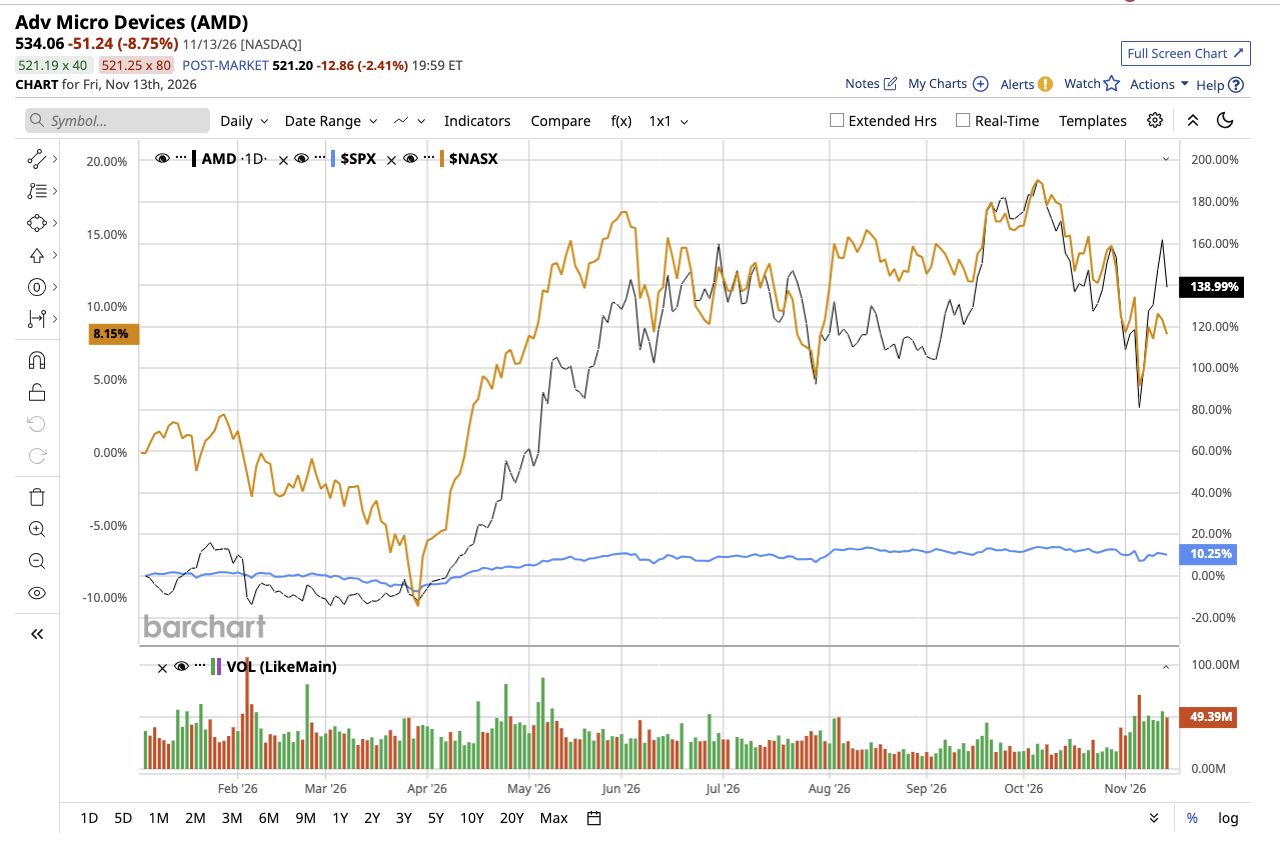
However, AMD’s rally quickly fizzled, revealing that Nvidia's leadership crisis was only a trigger, not the fuel. AMD stock may need a more powerful driver for lasting momentum.
Nvidia's products, software ecosystem, and existing customer contracts do not disappear with Huang. Still, hyperscalers and AI developers now have another reason not to rely too much on a single supplier. Choosing other processors can help them negotiate better, reduce supply risks, and gain more control over computing costs. AMD does not need Nvidia to fail to gain an advantage. It just needs customers to use more competing platforms supporting their new AI projects.
AMD's Data-Center Business Is Already Doing the Heavy Lifting
What really sets AMD apart isn't Nvidia's recent turmoil but the impressive momentum already reflected in its financials. In its third-quarter earnings report, AMD's revenue soared 45% year-over-year (YOY) to $13.4 billion, while adjusted diluted EPS surged 74% to $2.09. The data-center segment stood out, nearly doubling to $8.5 billion in revenue and accounting for about 64% of total revenue, up from 47% a year ago.
AMD is relying more on AI infrastructure growth than on its traditional PC and gaming markets. The company's data-center segment, which includes EPYC server CPUs and Instinct AI accelerators, is thriving thanks to rapid growth in cloud infrastructure and more complex AI workloads. According to Su, cloud and enterprise server sales have more than doubled compared to last year, and AMD is steadily capturing a larger slice of the server market.
The Q4 outlook points to even greater momentum ahead. AMD expects revenue of around $17 billion, give or take 3%, marking an impressive 66% YOY surge at the midpoint. Management is also projecting data-center revenue to jump by about 50% sequentially. Even more encouraging for investors, the data-center AI business is on track to outpace the server CPU business in revenue for the very first time. This shows AMD's AI accelerator opportunity is rapidly becoming a major driver of higher growth.
AMD forecast revenue growth above 80% for 2027, driven by a near-doubling of server CPU sales and even stronger expansion in data-center AI. The segment could contribute more than 80% of total company revenue. Demand for EPYC processors is also expanding, with OpenAI selecting Turin CPUs for its custom accelerator platforms and partners committing to more than 240 Venice platforms. However, supply is still a constraint. AMD is working to secure wafers, packaging, and memory, while inventory rose $3 billion sequentially to $11.5 billion in Q3.
Instinct GPUs and Helios Could Help AMD Win More AI Customers
AMD’s success relies on giving customers more than just another GPU option. The company is combining its Instinct accelerators with EPYC CPUs and rack-scale systems in the Helios platform. This is important because large AI projects need a full computing setup, where processors, memory, networking, and power efficiency all affect the cost of running AI models. AMD wants to be seen as a provider of complete systems, not simply individual chips.
The company has started attracting major customers like Anthropic (ANT), Meta Platforms (META), Microsoft (MSFT), OpenAI, and Oracle (ORCL), all of which have powered up their first Helios racks and are actively running models and workloads. AMD even ramped up shipments of its MI455X accelerators in Q3, delivering them in volume.
With manufacturing and technology partners like HPE (HPE), Dell (DELL), Lenovo (LNVGY), and Supermicro (SMCI) expanding their Helios portfolios, deployments are set to accelerate. These joint efforts open the door for AMD to transform its AI ambitions into significant commercial success. However, AMD cannot take market share from Nvidia with just hardware alone. Nvidia's CUDA ecosystem is deeply established, and developers have spent years building applications around it. To challenge this dominance, AMD is advancing with ROCm, its open software platform. The latest ROCm 10 release brings notable upgrades for large GPU clusters, boosts reliability for long-running workloads, and introduces automated performance tuning.
AMD's Opportunity Comes With Risks
AMD has a growing opportunity in AI, but Nvidia's CUDA ecosystem and competition from custom accelerators remain major obstacles. Its PC and gaming businesses are also struggling, with gaming revenue down 40% to $773 million in Q3.
Ultimately, Nvidia's leadership crisis may give AMD an opening, but its ability to turn customer interest into sustained Instinct and Helios deployments, revenue growth, and stronger cash flow will determine whether it can capture lasting market share.
Wall Street Is Becoming More Bullish on AMD Stock
AMD is getting all the love on Wall Street, owing to this improved outlook. On Nov. 12, William Blair upgraded AMD stock to “Outperform” from “Market Perform,” citing AMD's growing competitive edge and the uncertainty hovering around Nvidia's leadership. The firm now expects data-center AI revenue to overtake the server CPU business in Q4, and it foresees revenue soaring by more than 80% in 2027.
Similarly, Bank of America recently boosted its AMD stock price target to $700 from $650 while reaffirming its “Buy” rating. Analyst Vivek Arya pointed to AMD's diverse product lineup, promising server CPU prospects, and clearer supply chains as key strengths.
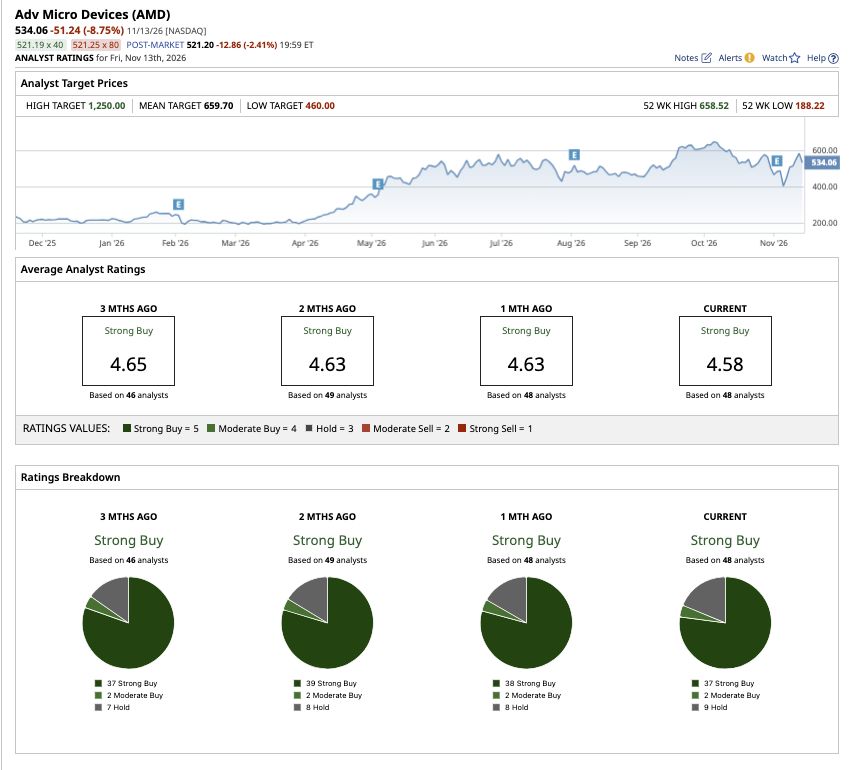
Overall, Wall Street has a consensus “Strong Buy” rating for AMD stock. Of the 48 analysts with coverage, 37 have a “Strong Buy,” two recommend a “Moderate Buy,” and nine analysts have a “Hold” rating. The average price target of $661.82 suggests potential upside of 35% from current levels, while the most bullish forecast on the Street is $1,250, pointing to a potential 155% surge from here.
 www.barchart.com
On the date of publication, Sushree Mohanty did not directly have a position in any of the securities mentioned in this article. All information and data in this article is solely for informational purposes. For more information please view the Barchart Disclosure Policy here.
More news from Barchart
Nvidia’s Leadership Crisis Could Be a Major Opportunity for AMD Stock McKesson Stock Is a Triple Threat at New All-Time Highs. How to Trade It Here. Ahead of Target Earnings, Here's What Barchart Data Says Comes Next for TGT Stock Dear Lowe’s Stock Fans, Mark Your Calendars for November 18