

Intuit (INTU), which develops and markets accounting software, is slated to unveil its first-quarter fiscal 2027 results on Nov. 19, after the market closes. INTU stock has dropped sharply since I wrote about the company in March 2026, causing its valuation to become much more reasonable. Moreover, Intuit is still growing meaningfully, while its attempt to attract new customers with lower prices could boost its financial results in the medium-to-long term.
Still, the Q1 report is not expected to be very important because the company generates a large amount of its revenue during tax season. So, the results, however solid they may be, are unlikely to get shares out of Wall Street's proverbial doghouse. Importantly, the firm's lowered prices could also have an inverse effect, potentially creating a negative catalyst that could weigh on earnings for an extended period. Meanwhile, Intuit has acknowledged that artificial intelligence (AI) is already negatively affecting its business. That trend could intensify in the longer term.
More Top Stocks Daily: Go behind Wall Street’s hottest headlines with Barchart’s Active Investor newsletter.
Goldman Sachs has a “Sell” rating on INTU stock. Let's take a closer look at why Intuit does not look especially attractive ahead of the Q1 print.
 www.barchart.com
Intuit's Growth and Reasonable Valuation
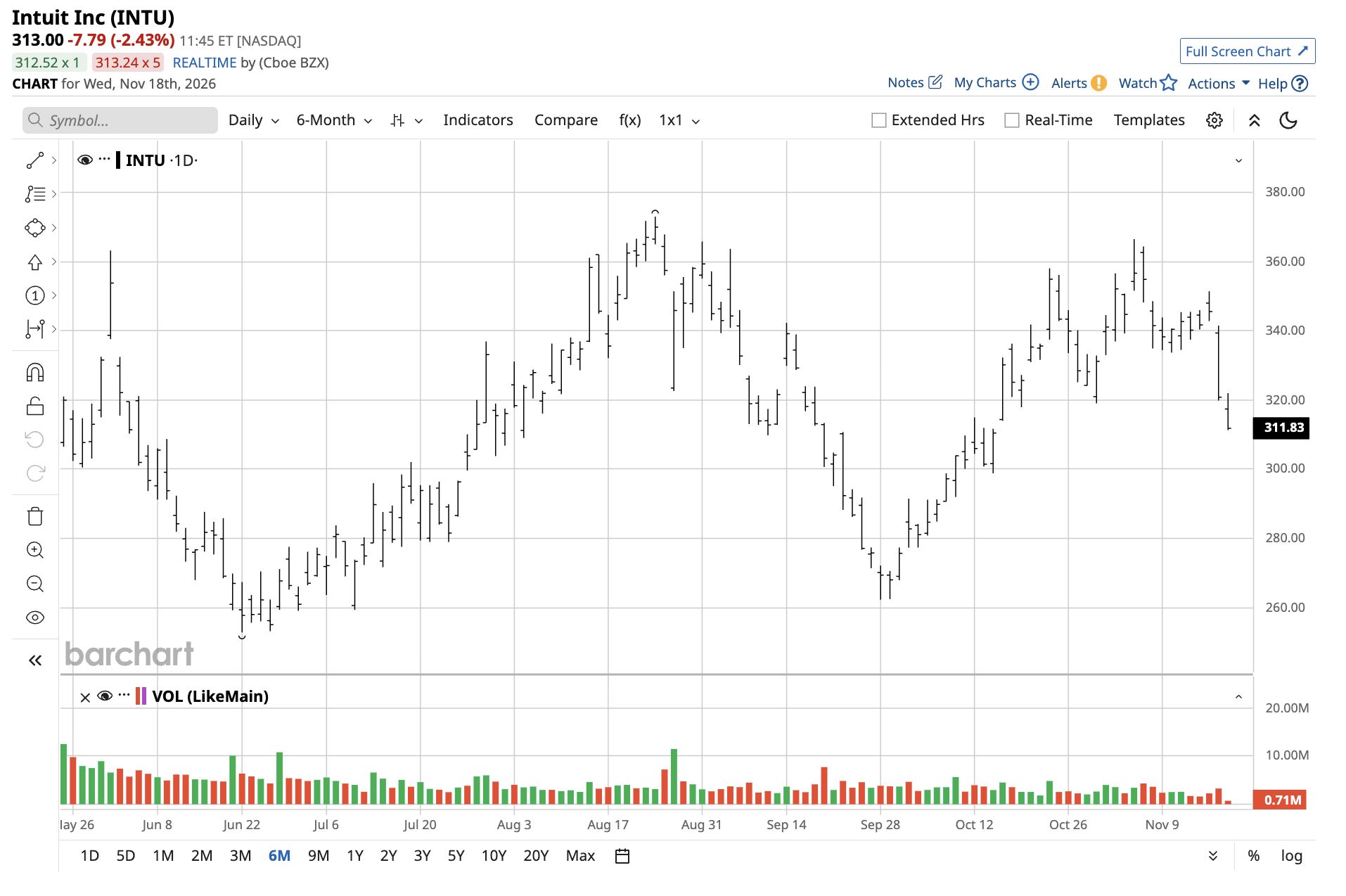
Shares of Intuit stock have slumped about 53% on a year-to-date (YTD) basis in 2026, as well as 52% over the past 52 weeks. As a result, the forward price-to-earnings (P/E) ratio is now 14.8 times, down from approximately 24 times at the beginning of the year.
In Q4, revenue rose 14% year-over-year (YOY) to $4.35 billion. Meanwhile, non-GAAP diluted EPS climbed 47% YOY to $4.03.
For the upcoming quarter, the company guided revenue of $4.29 billion to $4.31 billion and non-GAAP diluted EPS of $2.44 to $2.48. For full-year fiscal 2027, Intuit expects revenue of $23.28 billion to $23.51 billion, up by between 9% and 10% YOY, as well as non-GAAP diluted EPS of $22.88 to $23.12.
Intuit Lowers Prices to Counter AI
The number of Intuit's online paying customers rose only 3% YOY to 8.9 million at the end of fiscal 2026. In response, the company has effectively cut its prices sharply on a number of fronts.
Most prominently, Intuit started offering a service that will process federal taxes for free and charge $15 for calculating state taxes. Additionally, in September, the firm began providing a free version of Quickbooks, its business-accounting software, to solo entrepreneurs.
Earlier this year, Intuit also launched Quickbooks Lite, which has more features than the free version and is aimed at the same audience. Quickbooks Lite costs up to $20 per month. Intuit hopes to use fresh low prices to attract solo entrepreneurs who will later upgrade to its more expensive offerings for their businesses.
Goldman Sachs Is Bearish on Intuit Stock
Still, not everyone is convinced when it comes to Intuit stock. Concerned about threats to the company's offerings, Goldman Sachs slashed its price target on INTU stock earlier this year and now has a “Sell” rating with a $304 price target. In June, Goldman Sachs noted that AI services could process a standard individual tax return for about $0.12. "We see the potential for increased competition," warned analyst Gabriela Borges.
Overall, INTU stock has a consensus “Moderate Buy” rating on Wall Street based on 31 analysts with coverage.
On the date of publication, Larry Ramer did not directly have a position in any of the securities mentioned in this article. All information and data in this article is solely for informational purposes. For more information please view the Barchart Disclosure Policy here.
More news from Barchart
How to Play NKE Stock as Nike Risks Becoming a Forever Turnaround Story Michael Burry Is Doubling Down on Adobe Stock. Here's Why. Trump’s ‘National Champion’ Stocks Include Nvidia, Amazon, and Microsoft, Says WSJ. Will the Designation Really Matter? You Likely Haven’t Heard of This Hot Stock, But Its Roots Date Back to 1816