

The deadline for filing 13F holdings ended on Nov. 16, which means we can now access the equity ownership changes of hedge funds. One of the largest hedge funds on Wall Street is Soros Fund Management. With roughly $6 billion in assets under management, Soros Fund Management is the family office founded by George Soros in 1970.
The Wall Street Journal reported that it manages money for the foundation and the family. In 2023, George Soros ceded control of his empire to his son Alex. Alex is the only family member on the investment committee that oversees Soros Fund Management. Today, Chief Executive and Chief Investment Officer Dawn Fitzpatrick leads its investing vertical.
More Top Stocks Daily: Go behind Wall Street’s hottest headlines with Barchart’s Active Investor newsletter.
 www.barchart.com
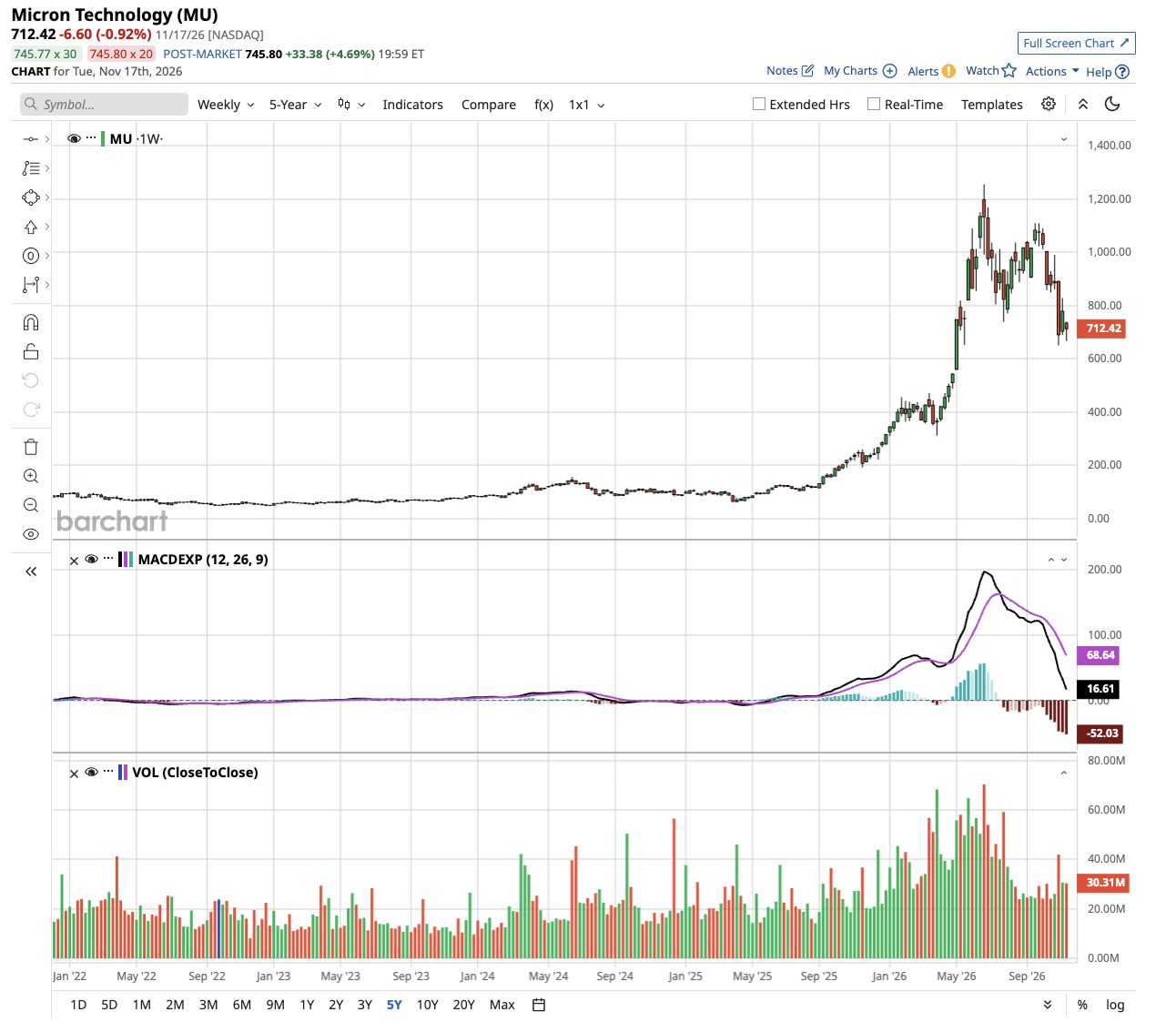
According to recent 13F filings, Soros Fund Management raised its stake in Micron (MU) stock by 58%. Let’s see why.
Soros Adds to Its Micron Stock Position
Soros Fund Management held 35,618 Micron shares at the end of the third quarter, according to its 13F filing. That is 13,196 more than in Q2, a jump of 58.85%.
Working backward, the fund started with about 22,400 shares. So the stake grew to roughly 1.6 times its old size. The position in Micron stock is worth $37.9 million, and accounts for 0.63% of the total fund portfolio.
Intel (INTC) is the fund's largest holding at $340.3 million, or 5.65% of the portfolio. Soros also added 2.73 million Intel shares in the quarter. Amazon (AMZN) is the second-largest holding, followed by Taiwan Semiconductor Manufacturing (TSM).
Notably, the hedge fund trimmed stakes in big tech giants such as Apple (AAPL), Nvidia (NVDA), and Microsoft (MSFT), while opening a new position in SK Hynix worth almost $60 million.
Micron Delivers a Record Quarter
In fiscal Q4 (ended in August) of 2026, Micron reported revenue of $54.2 billion, an increase of 379% year over year and 31% sequentially. It reported a gross margin of 87% while adjusted earnings per share grew to $33.42.
For the full year, revenue rose by 256% to $133.2 billion, and DRAM revenue topped $100 billion, CEO Sanjay Mehrotra said on Micron's earnings call. "We expect fiscal 2027 to be even better," Mehrotra said.
Data center SSD revenue reached nearly $10 billion in the quarter, more than 10 times the level a year earlier. Micron also said its HBM AI memory revenue grew faster than total company revenue.CFO Mark Murphy guided fiscal first-quarter revenue to $61.5 billion, plus or minus $1.5 billion. He expects earnings of $38.15 per share, plus or minus $1.
Micron's pitch is simple, as it expects demand to outpace supply. Management forecasts memory and storage conditions to be much tighter in 2027 and 2028 than in 2026. Mehrotra said the company cannot see when supply and demand will return to balance.
Micron also says more than 75% of its 2027 output is already committed. It has signed 26 strategic customer agreements, where customers agree to buy pre-defined volumes. Customer commitments total $32 billion, and most of that is cash deposits.
Micron says it has about $150 billion in contracted future business, which it calls remaining performance obligations. The chipmaker expects capital spending of about $25 billion in the first half of fiscal 2027, as it expands manufacturing capabilities.
Murphy also said Micron intends to increase capital returns to shareholders starting Dec. 9.
Micron held a technology webinar on Oct. 21, where Chief Technology and Products Officer Scott DeBoer shared a fun comparison. One HBM4 stack, Micron's top-tier AI memory, moves 2.8 terabytes of data per second. DeBoer said about 100 stacks could match the 282 terabytes per second of worldwide internet bandwidth.
Micron also sampled a 512 gigabyte DDR5 memory module, which DeBoer called the world's first of its kind. New DRAM and NAND generations are due to ramp in the second half of 2027.
DeBoer summed up the mood. He said Micron is in "the strongest position Micron has ever been in."
What the Soros Move Means for Investors
The filing is a snapshot of holdings as of Sept. 29, and Micron reported results the next day. So, the filing does not capture how Soros reacted to those numbers and does not show what the fund has done since.
However, there are certain risks associated with investing in MU stock. Bank of America analyst Vivek Arya asked on the call whether 2027 could mark a peak for memory pricing. Micron also flagged possible double-digit unit declines in PCs and smartphones this year.
Still, the bull case for Micron stock is hard to ignore given analysts forecast revenue to increase from $133 billion in fiscal 2026 to $320 billion in 2028. Meanwhile, free cash flow is forecast to improve from $59 billion to $175 billion.
 www.barchart.com
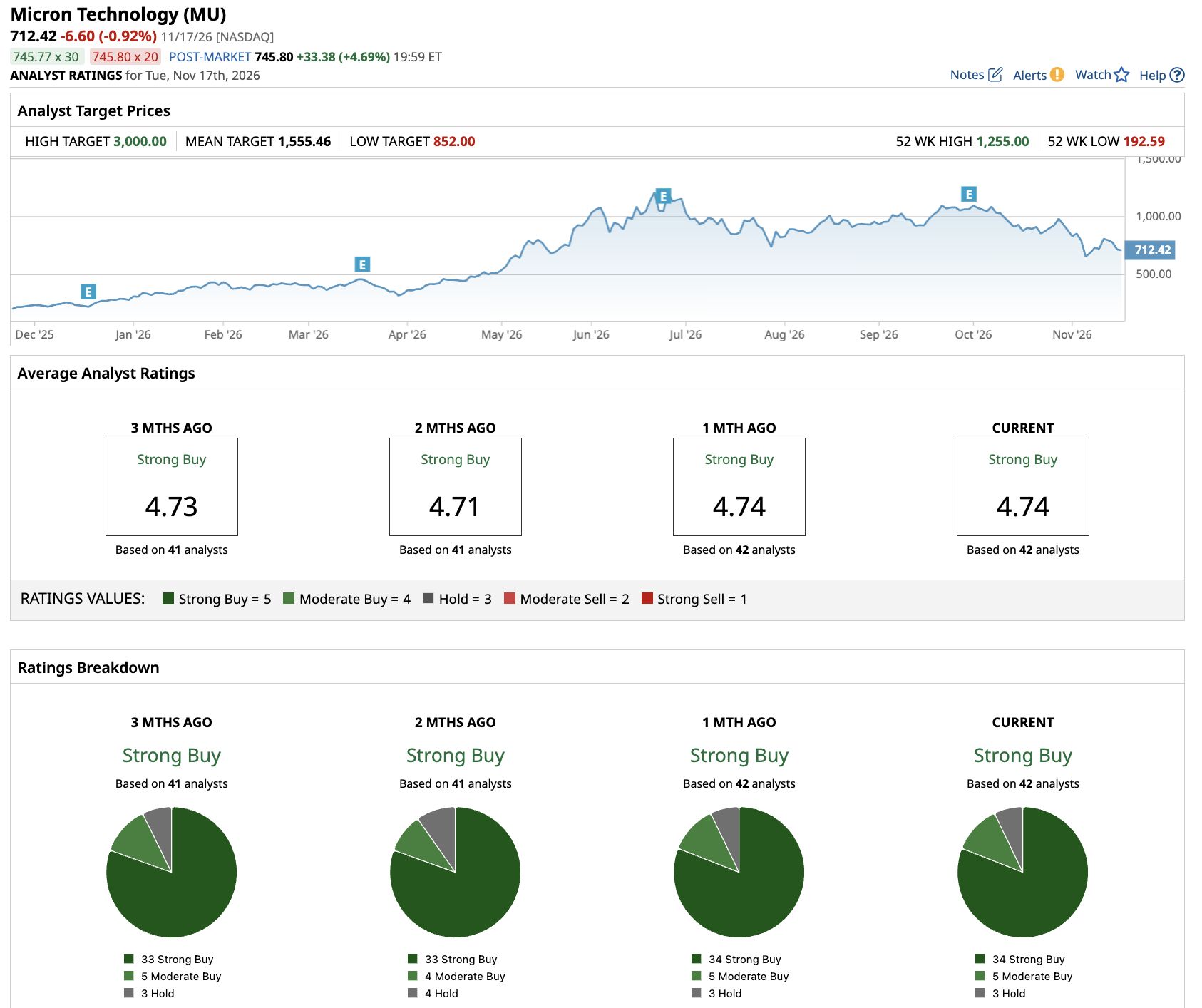
If MU stock is priced at 10x forward FCF, below the one-year average of 13x, it could double within the next 12 months. Out of the 42 analysts covering MU stock, 34 recommend “Strong Buy,” five recommend “Moderate Buy,” and three recommend “Hold.” The average Micron stock price target is $1,555, above the current price of $712.
On the date of publication, Aditya Raghunath did not directly have a position in any of the securities mentioned in this article. All information and data in this article is solely for informational purposes. For more information please view the Barchart Disclosure Policy here.
More news from Barchart
George Soros’s Fund Doubled Down on Micron Stock in Q3. The Bull Case Is Hard to Ignore. Barchart Experts ‘See’ an Opportunity with This Hot Stock at 2-Year Highs SpaceX Stock Is Down Nearly 40% from Its Post-IPO Highs but Nvidia Is Still Loading Up Nvidia Could Poach Arm's CEO to Replace Jensen Huang. Here's What That Might Mean for ARM Stock.