

The Federal Reserve raised interest rates in September, the first hike since 2023. That lifted its target range to 3.75% to 4%, and the Fed held there in October. Now, markets see another hike as a near-certainty at the Dec. 8 to Dec. 9 meeting.
Minutes from the October meeting, released on Nov. 18, show nearly all officials expect a hike in December, and some even floated a bigger half-point move. Banks have reacted in different ways.
More Yield, Less Trap: Sign up free to get Barchart’s daily Dividend Investor newsletter straight to your inbox.
United Bancorp (UBCP), a micro-cap bank holding company based in Martins Ferry, Ohio, just raised its quarterly dividend by 1.3%, from $0.1975 to $0.20 per share. The dividend goes to shareholders of record on Dec. 10 and will be paid on Dec. 18.
That is the bank's fourth dividend raise of the year. United Bancorp has lifted its regular payout every quarter of 2026, from $0.1925 in March to $0.20 now, and it slipped in a special $0.1750 dividend in the first quarter for good measure. Each regular step is small. So, does a 1.3% raise say anything useful about where UBCP stock will go next? Let's find out.
Reading United Bancorp's Latest Numbers
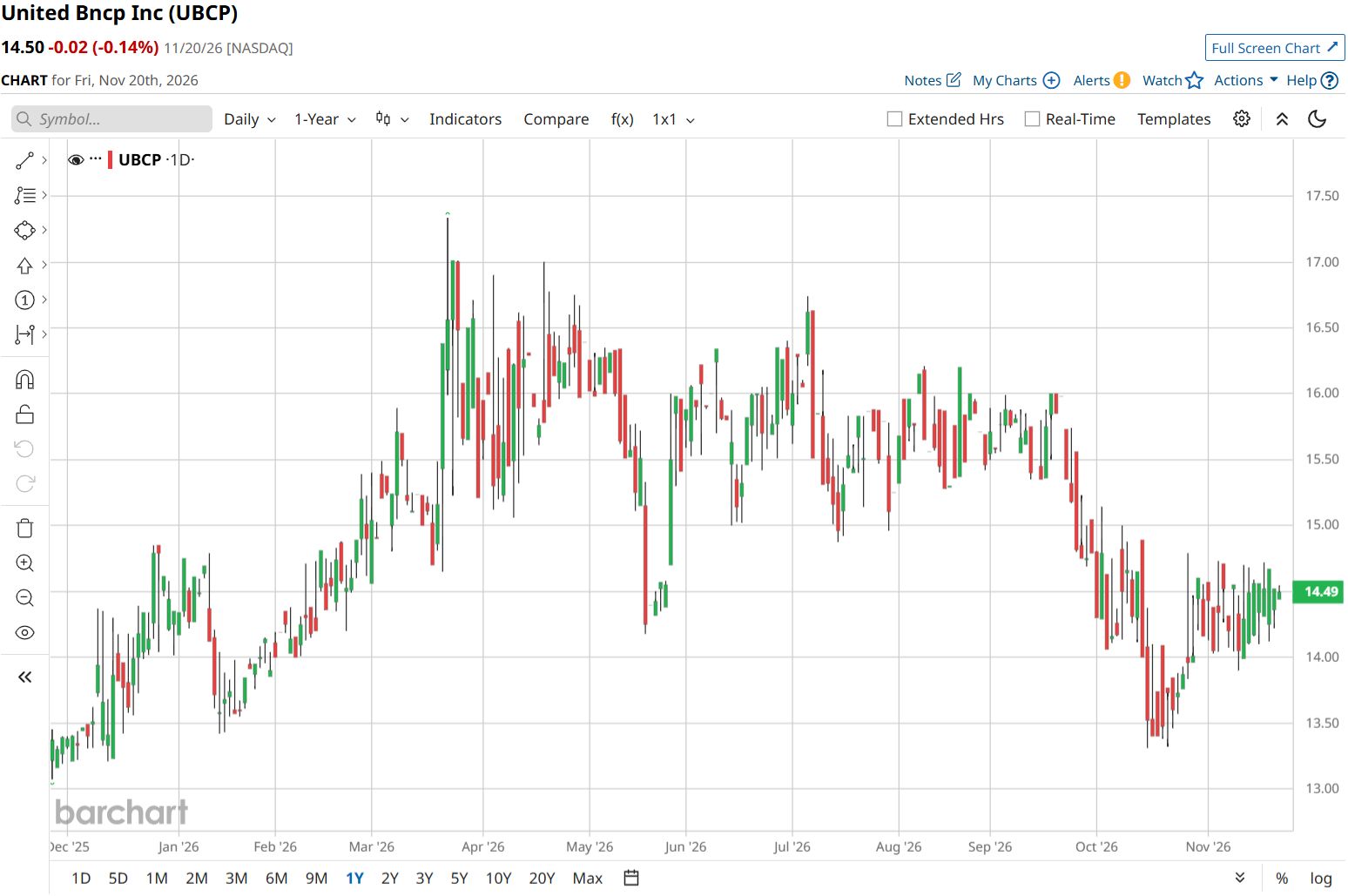
United Bancorp is a community bank holding company based in Ohio. It makes money the old-fashioned way: Collecting local deposits, lending them out, and keeping the spread. Investors have liked the story. UBCP stock is up 8% over the past 52 weeks but relatively flat in 2026, so nearly all the gains came late last year.
 www.barchart.com
Shareholders have been paid the whole time. The regular quarterly dividend hit $0.1975 in Q3, up from $0.1875 a year ago. Cash dividends for the first nine months came to $0.76 per share, up 4.1% from $0.73. At the quarter-end price of $14.79, the regular payout yielded 5.34%, right where it sat a year ago at 5.36%.
The new 1.3% raise looks small because profits took a hit, and the payout ratio shows it. United Bancorp paid out 62.23% of its earnings in regular dividends in the first nine months of this year, up from 56.06% last year. That leaves less room to grow the payment without stronger results.
Net income fell 27.4% to about $1.4 million in Q3, while diluted EPS slid 26.5% to $0.25 from $0.34. Almost all of the damage came from a $2.42 million provision for credit losses, up from just $186,000 a year earlier. That money went to cover one commercial loan that went bad, a $2.95 million charge-off.
Strip that out and the quarter looks fine. Net interest income, the gap between what the bank earns on loans and pays on deposits, rose 4% to about $7 million. Interest income crept up 0.4% while interest expense fell 5.8%. Noninterest income jumped 70.9% to about $2.3 million, helped by fee businesses and a securities gain. Noninterest expense fell 2.8%. Put it all together, and pre-provision net revenue, a non-GAAP measure, rose more than 66% to about $3.49 million.
The nine-month picture is softer but steady. Net income slipped 5.4% to about $5.41 million, EPS fell 5.1% to $0.94, and net interest income rose 4.8% to about $20.51 million.
Where Could Growth Come From?
United Bancorp is not buying its way bigger. It wants to grow on its own. Total assets, counted before the paper losses on its bond portfolio, crossed $900 million for the first time in Q3. Management said a $1 billion bank is coming "in the very near term," and three in-house projects are meant to get it there.
The first project is a regional hub in Wheeling, West Virginia. The hub opened on Dec. 9, 2025, and hit its full first-year loan target in about three months. CEO Scott Everson said the office drove much of this year's deposit growth. Deposits rose 12% to about $722.5 million, with most of the new money in cheap checking and savings accounts.
The second project is fee income. The company's Unified Mortgage Division is hiring loan originators, while the Treasury Management team sells cash-management, merchant, and payment services to business clients. That work does double duty; it earns fees and pulls in the low-cost deposits that cut the bank's funding costs.
Finally, the third is a new Unified Center in St. Clairsville, Ohio, the former corporate headquarters of Riesbeck's Food Markets which United Bancorp bought in 2024. It will house accounting, IT, and a sales-driven customer care center that handles questions from every channel. The grocer's lease on the extra space is the bank's only rental income. Rollout is set for the first few months of 2027.
What Do Analysts See Ahead?
Wall Street barely watches this bank. The only research shop with published coverage is Zacks Investment Research, which initiated coverage with a “Neutral” recommendation in July 2025. Zacks liked the 5.51% forward yield, the rising dividend, and the careful loan book. What held it back were rising funding costs, climbing expenses, and a business concentrated in southeastern Ohio and northern West Virginia.
Zacks hasn't warmed up much since then. In a July 2026 comparison of community banks, it picked Ohio Valley Banc Corp (OVBC) as the better near-term bet. Its read on United Bancorp was polite but patient, saying that the bank's technology and infrastructure spending "strengthen its long-term prospects," but "many of the benefits are expected to materialize gradually." On valuation, Zacks pointed out that UBCP stock traded at 11.9 times trailing earnings, above its own five-year median of 9.8 times though well below Zacks' sector average of 18.7 times. Zacks' verdict was that the market had "not fully recognized" the long-term earnings power of either bank.
Management sounds far more upbeat. In United Bancorp's Q3 release, CFO Randall Greenwood said that the past two years of investment were "paying off," pointing to pre-provision net revenue of $3.49 million, up 66% once you set aside the one-time loan charge-off. CEO Scott Everson said the company expects "a solid return" on that spending "within the next twelve to twenty-four months."
Conclusion
So, does a 1.3% raise tell you anything? Yes, just not a lot. It says management wants to keep paying shareholders, but a payout ratio above 62% and a 27% drop in quarterly profit leave little room for bigger bumps. The raise isn't a warning sign. It also isn't a reason to buy. Rising rates should help net interest income, and the Wheeling hub and fee businesses give the bank real growth levers. Still, higher credit costs and a stock trading at 165% of its tangible book value limit the upside. My read is that shares drift sideways until earnings recover, with the 5%-plus yield doing most of the work.
On the date of publication, Ebube Jones did not directly have a position in any of the securities mentioned in this article. All information and data in this article is solely for informational purposes. For more information please view the Barchart Disclosure Policy here.
More news from Barchart
This Bank Stock Just Raised Its Dividend by Just 1.3% Dear SpaceX Stock Fans, ANT’s IPO Just Gave You a Reason to Buy — But Don’t Go All In Yet Jensen Huang Is Back, and Nvidia's $227 Billion Buyback Could Retire Nearly 6% of NVDA Shares. Here's My Take Ahead of December 4. Ahead of Polestar Earnings, Here's What Barchart Data Says Comes Next for PSNY Stock