

Spot gold traded just under $4,500 an ounce on Thursday, close to a two-month high. Prices touched $4,525 earlier in the session after gaining more than 4% on Wednesday. JPMorgan's near-term target for gold in the fourth quarter of 2026 is $4,500 per ounce, a downward revision from its earlier projection of $6,000
The US Treasury doubled its long-bond buyback size on Wednesday, pushing yields lower. That move revived talk of gold reclaiming $5,000 before 2026 ends.
JPMorgan's Moving Target
Gold set an all-time high above $5,300 in February 2026 before retreating sharply this spring. The pullback pushed prices roughly 25% below that peak by May, ahead of this week's rebound.
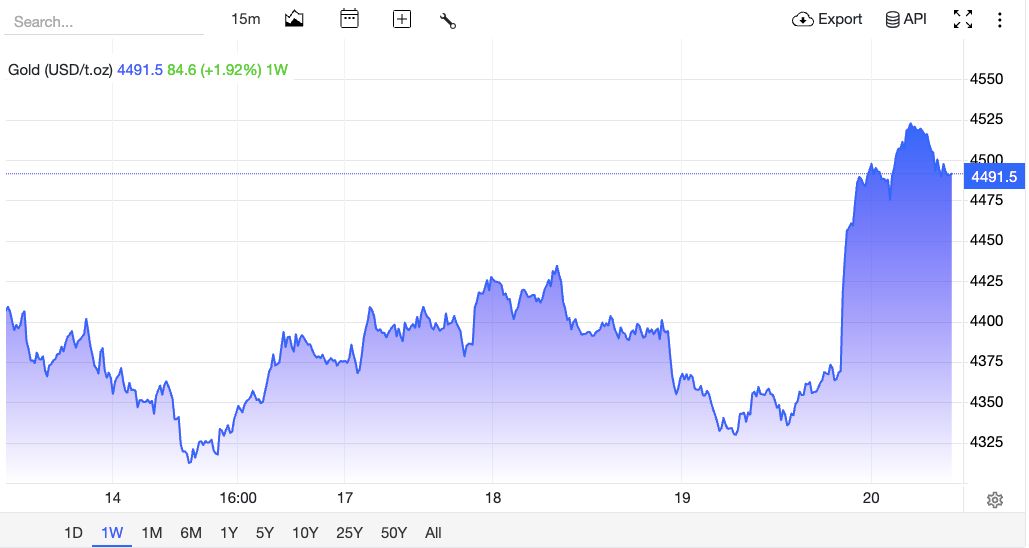 Gold nearly topped $4,525 in the past 24 hours. Image Source: Trading Economics
 Gold's climb toward $4,525 puts it near a level JPMorgan no longer expects to hold. The bank's own price target has swung sharply over the past year.
JPMorgan Global Research kept a $6,000 year-end target in mid-2026. The bank still trimmed its full-year average estimate to $5,243, down from $5,708. It then cut that Q4 forecast by roughly 25% in July.
JPMorgan cited softer demand from key buyers for the cut. Its new target sits at $4,500, roughly where spot gold trades now.
However, Thursday's rally puts gold's price action ahead of JPMorgan's own downgraded target. That gap shows how quickly Wall Street forecasts can lag a volatile market.
Meanwhile, other banks show a similar pattern of shifting conviction. Goldman Sachs cut its year-end call to $4,900 in June, down from $5,400. It also pushed back its expected first Fed rate cut from 2026 to 2027.
In contrast, BloFin Research took a different view, comparing gold's performance against equities instead of judging the drop alone. Gold sits 21% below its January peak, but the S&P 500 to gold ratio has rebounded roughly 40% this year.
Why Gold Is Rallying Again
A number of factors are pushing gold upwards again.
Treasury Secretary Scott Bessent doubled liquidity support buybacks for 10-to-30-year securities on Wednesday. The new minimum size is $4 billion per operation, up from $2 billion.
The announcement followed a bond selloff that pushed the 30-year Treasury yield to its highest level since 2007. Yields fell after the news, easing pressure on a strained bond market.
Total US federal debt topped $40 trillion this week, a new debt milestone that deepened fiscal concerns. Rising interest costs and social safety net spending continue to outstrip tax revenue, according to Treasury officials.
A weaker US dollar also added to gold's appeal this week. The dollar recently touched a three-month low against major currencies, making dollar-priced gold cheaper for foreign buyers.
Federal Reserve minutes released this week revealed a split committee. Several policymakers said they would support a rate hike if inflation stays above the Fed's 2% target.
Traders currently price a 32.7% chance of a September hike. They see a 67.3% chance the Fed holds steady, according to the CME FedWatch Tool. The tool tracks trader bets on upcoming Fed decisions.
US gold futures for December delivery rose 0.6% to $4,569.80. Other precious metals gained ground too. Spot silver rose 0.2% to $67.06 an ounce, while platinum slipped 0.4% to $1,816.78. Palladium added 0.3% to reach $1,339.05.
Rising debt service costs add another layer to the story. Net interest payments on federal debt hit $628 billion over the fiscal year's first seven months, per Treasury data. That figure already tops the government's $588 billion in Medicare spending over the same stretch.
What It Would Take to Reach $5,000
Central bank buying remains the clearest support under gold's price. The World Gold Council reported a 62% jump in central bank purchases last quarter. China extended its buying streak to 21 straight months. Poland, Kazakhstan, and the Czech Republic also ranked among the largest buyers.
That demand creates a floor, but reaching $5,000 needs more than steady buying.
A Fed pivot toward rate cuts would be the clearest catalyst for gold. Lower real yields make non-yielding gold more attractive than bonds.
A weaker dollar could add momentum too. So could fresh geopolitical stress or a worsening fiscal outlook tied to the $40 trillion debt figure.
Read the Original story JPMorgan’s Q4 Gold Target Was Just Crossed: Is $5,000 Next? by Darryn Pollock at beincrypto.com