


Vail Resorts, Inc. MTN is working through a difficult stretch shaped by weak snowfall, lower visitation and softer pass demand. The pressure is showing up in revenues, earnings and visibility into the next ski season.
The issue is not only one weak quarter. Weather, customer commitment and cost control are now closely linked to MTN’s near-term setup.
How Vail Resorts Makes Money
Vail Resorts is built around its Mountain segment, which generated 88.7% of fiscal 2025 net revenues. Lodging contributed 11.3%, while Real Estate accounted for only 0.01%.
The model depends on getting skiers and riders onto the mountain and then capturing spending across lift access, ski school, dining and retail or rental operations. The Epic Pass deepens that model by encouraging advance commitment and repeat visitation across a 42-resort network.
Vail Resorts, Inc. Price and EPS Surprise
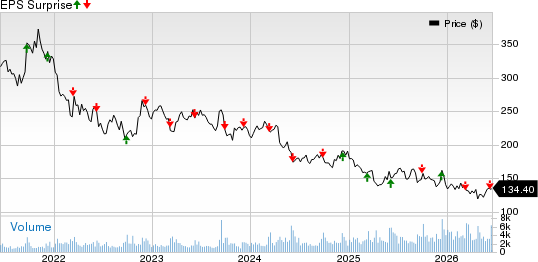
Vail Resorts, Inc. price-eps-surprise | Vail Resorts, Inc. Quote
Marriott International MAR is a useful lodging-demand benchmark. Hilton Worldwide Holdings HLT offers another hotel-focused comparison. Vail’s model is more weather-sensitive because the mountain visit drives lift revenues and ancillary spending.
MTN Faces a Weather-Driven Demand Shock
The latest season showed how quickly that model can come under pressure. Historically unfavorable winter conditions across the western United States hurt demand, especially in the Rockies and Tahoe.
In the fiscal third quarter, resort revenues declined 7% year over year, visitation fell 15% and Resort Reported EBITDA decreased 9.5%. The Rockies experienced the worst snowfall season on record, and industry visitation in the region fell approximately 24%.
Weather shocks are especially damaging when they hit peak ski-season traffic. MTN’s North American and European mountain operations typically peak from mid-December through mid-April, so weakness during that window leaves less room to recover later.
Vail Resorts Sees Pass Sales Slow
The spring selling period added another concern. Pass product units for the 2026/2027 North American ski season fell approximately 10% through May 26, 2026, while days sold declined 8% and sales dollars decreased 5%.
The softness was most visible in weather-affected markets such as Colorado, Utah and Lake Tahoe, and among destination guests who typically visit the Rockies. Advance pass sales help anchor future lift-access revenues before the season starts.
New passholder sales were weaker than renewals after reduced fiscal 2026 visitation created a smaller conversion pool. Frequency products also showed the biggest declines, suggesting lower-commitment customers may be more sensitive to weather and value perception.
MTN Still Has Operational Support Levers
MTN is not without stabilizers. Its advance-commitment model helped lift revenues decline less sharply than skier visits in the third quarter, supported by North American pass sales secured before the season began.
The company is also testing lift-ticket initiatives to broaden demand. Expanded Epic Friend Tickets at a 50% discount and super-advanced lift tickets at a 30% discount for purchases at least one month in advance target guests outside the core pass base.
Costs are another lever. Management expects $106 million of annualized efficiencies by the end of fiscal 2026, above the original two-year target, plus $30 million of savings expected in fiscal 2028.
Portfolio diversity may also soften volatility. Unlimited pass products outperformed frequency products, the new Young Adult pass product outpaced other age groups and Epic Australia Pass units rose approximately 26%.
What MTN Signals Say Now
The bottom line is that MTN still has scale, brand reach and operating levers, but the near-term investment case remains clouded by weather-sensitive demand, slower pass sales and a high fixed-cost structure. Severe conditions expose earnings risk when destination traffic weakens.
MTN currently carries a Zacks Rank #5 (Strong Sell).
You can see the complete list of today’s Zacks #1 Rank stocks here.
The Zacks Consensus Estimate picture has also weakened, with the current fiscal year earnings estimate moving down 8.8% over the past four weeks.
The Style Scores are not supportive either. MTN has a VGM Score of F, Growth Score of F, Value Score of D and Momentum Score of D. Since A and B scores indicate more favorable style characteristics, these grades point to a less attractive profile across growth, value and momentum screens.
For now, the signal set fits a stock facing limited near-term momentum. Investors watching MTN may need clearer evidence of pass-sales recovery, better snowfall conditions and sustained cost execution before the outlook looks more balanced.
Research Chief Names "Single Best Pick to Double"
From thousands of stocks, 5 Zacks experts each have chosen their favorite to skyrocket +100% or more in months to come. From those 5, Director of Research Sheraz Mian hand-picks one to have the most explosive upside of all.
This company targets millennial and Gen Z audiences, generating nearly $1 billion in revenue last quarter alone. A recent pullback makes now an ideal time to jump aboard. Of course, all our elite picks aren’t winners but this one could far surpass earlier Zacks’ Stocks Set to Double like Nano-X Imaging which shot up +129.6% in little more than 9 months.
Free: See Our Top Stock And 4 Runners UpWant the latest recommendations from Zacks Investment Research? Today, you can download 7 Best Stocks for the Next 30 Days. Click to get this free report
Marriott International, Inc. (MAR): Free Stock Analysis Report
Hilton Worldwide Holdings Inc. (HLT): Free Stock Analysis Report
Vail Resorts, Inc. (MTN): Free Stock Analysis Report
This article originally published on Zacks Investment Research (zacks.com).