

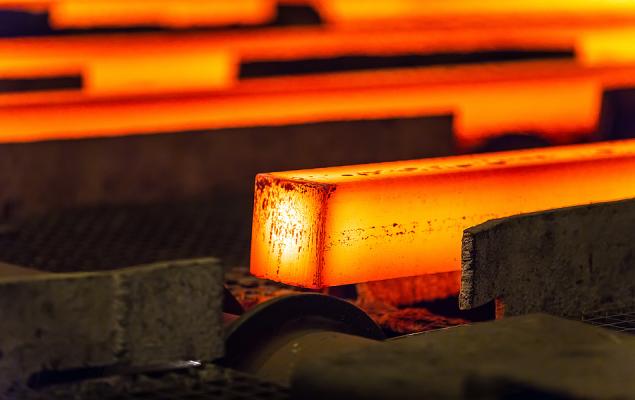
The commodities sector has been experiencing a massive wave of momentum of late, with steel witnessing a powerful surge driven by a confluence of factors, most notably explosive demand stemming from the artificial intelligence (AI) revolution. Last year we witnessed a spectacular rally in silver prices, which rose more than 130% from the 2025 level.
As the market's only pure-play steel fund, the VanEck Steel ETF SLX has been benefiting immensely from this upside, riding on a wave of massive global demand for AI infrastructure. The fund recorded a 47.2% average annual return during 2025, while fund inflows worth $81.41 million over the past year boosted its asset under management to more than $203 million (as per Trading View data).
The scenario this year is quite nuanced, with silver price, despite starting 2026 on a high note, experiencing a downward trajectory since January-end, which caused the S&P GSCI Silver index to slide 11.5% year to date.
Against this backdrop, with SLX having touched a new 52-week high at the beginning of this month, investors now face a critical question: Is the easy money already made, or is the fund left with more potential upside backed by the relentless AI buildout worldwide?
To find that out, we will break down steel's vital role in AI infrastructure, analyze the industry's key macro drivers, and deliver a definitive outlook on SLX's short- and long-term potential, in the next phase of this article.
The Role of Steel in AI & Other Factors at Play
The connection between AI and steel might not be immediately obvious, but it is fundamental. AI is not just virtual; it requires vast physical infrastructure.
AI data centers require drastically more physical structural support than legacy enterprise facilities. AI server racks are packed with power-dense GPUs, making them incredibly heavy and thermally intense. This requires heavy-gauge structural steel frameworks, reinforced flooring, and extensive specialized steel casing for electrical conduits and high-capacity HVAC cooling loops.
As per a BloombergNEF report published in March 2026, there are currently 831 data center projects under construction globally. This construction boom is undoubtedly boosting the consumption of steel.
This AI-led demand shock, along with an already tight supply chain for the metal, pushed up steel prices in 2025. Fears of trade restrictions and the imposition of targeted trade protectionism acts — such as the Section 232 investigations and threat of critical mineral tariffs by the U.S. administration — have heavily distorted the silver supply chain in the recent past.
A growing global infrastructure program, backed by increased investments in urbanization, development of transport infrastructures, office buildings, industrial sites, as well as renewable energy sector projects, is boosting the usage of structural steel. This is because structural steel remains the preferred construction material, thanks to its durability, versatility, sustainability and cost-effectiveness.
Is There More Room to Run for SLX?
The global macro environment for steel is currently caught in a fascinating paradox with a critical bifurcation shaping steel’s prospects. The global steelmaking capacity continues to expand aggressively despite an overall sluggish broader market demand, while actual production is actively tightening where it matters the most.
The global crude steel production dropped 0.3% year over year in May 2026, keeping up with last year’s broader trend of a 2% annual decline. This falling production, combined with the hyper-localized, insatiable infrastructure demand from AI data centers, creates a highly profitable environment for top-tier steelmakers.
According to recent OECD data, published in early June, planned additions of up to 138.8 million tons (Mt) of capacity are expected through 2028, which is projected to push global excess capacity to 745 Mt by 2028, approaching the historical highs of the steel crisis a decade ago.
With global demand growth projected to remain a sluggish 0.9% per year through 2030 due to Middle East conflicts, high energy prices, and supply-chain disruptions, worldwide mill utilization rates are expected to slide from 76% to 74% or less by 2028, intensifying financial pressure on inefficient global producers.
Given this complex backdrop, SLX is uniquely positioned to thrive across both time horizons.
In the near term, as hyperscalers aggressively build out data centers, asset managers will continue to rotate capital into SLX as a "hidden value" play, insulated from the broader global utilization crunch. This structural insulation explains why quantitative models like those from AI-platform Danelfin place a 65% probability on SLX outperforming the broader ETF universe in the near term.
Over the long term, the overcapacity data actually bolsters SLX's investment thesis. The financial pressure from low utilization is expected to primarily crush older, carbon-intensive blast furnaces overseas. In contrast, SLX's heavyweights — Nucor NUE and Steel Dynamics STLD — operate modern Electric Arc Furnaces (EAFs). This allows them to cut back production when global supply gluts hit, while still charging high prices for the premium steel needed by AI infrastructure.
However, investors should remain vigilant. Any easing of trade tariffs, a slowdown in AI capex spending, or a faster-than-expected ramp-up in global capacity could quickly reverse SLX's upward trajectory.
Boost Your Portfolio with Our Top ETF Insights
Zacks' exclusive Fund Newsletter delivers actionable information, top news and analysis, as well as top-performing ETFs, straight to your inbox every week.
Don’t miss out on this valuable resource. It’s free!
Get it now >>Want the latest recommendations from Zacks Investment Research? Today, you can download 7 Best Stocks for the Next 30 Days. Click to get this free report
Steel Dynamics, Inc. (STLD): Free Stock Analysis Report
Nucor Corporation (NUE): Free Stock Analysis Report
VanEck Steel ETF (SLX): ETF Research Reports
This article originally published on Zacks Investment Research (zacks.com).