


Serve Robotics Inc. SERV is increasingly positioning itself as more than an autonomous delivery company. Its long-term strategy centers on building a data and AI flywheel, where every robot deployed generates real-world data that improves its autonomy models, making the entire fleet smarter over time. As those models improve, robots can operate more efficiently across additional environments, creating a self-reinforcing cycle that could strengthen Serve Robotics' competitive position.
The first quarter of 2026 suggests this flywheel is beginning to accelerate. Serve Robotics' deployed fleet is now seven times larger than it was a year ago. Daily active robots increased to more than 800, while daily supply hours exceeded 10,000. The combined business has completed nearly 2 million deliveries and now operates across 44 cities in 14 states following the Diligent Robotics acquisition. These metrics are important not simply because they reflect operating growth, but because every additional robot, delivery and operating hour expands the volume of proprietary data flowing back into Serve Robotics' AI models.
A key differentiator is that Serve Robotics is no longer developing AI solely for sidewalk food delivery. The acquisition of Diligent Robotics extends the same autonomy platform into hospitals, while management also sees opportunities in healthcare logistics, package delivery and other commercial applications. Management's focus is shifting from fleet growth to increasing revenue per robot and operating hour through better AI, improved utilization and lower human intervention. Software contributed roughly one-third of first-quarter revenues, while nearly half of total revenues was recurring.
The long-term vision extends well beyond today's operations. Management continues to target a future fleet of 1 million robots deployed across cities, hospitals and other complex human environments. At that scale, the AI flywheel becomes significantly more powerful. A larger fleet generates more proprietary data, enabling better AI models, improved autonomy, broader commercial adoption and ultimately even more robot deployments. If successfully executed, this self-reinforcing cycle could create a platform advantage that becomes increasingly difficult for competitors to overcome.
The opportunity, however, remains accompanied by execution risk. Serve Robotics continues to report sizable operating losses while investing aggressively in research and development, and commercial deployment remains in its early stages. Ultimately, investors will need evidence that the expanding AI data advantage translates into higher revenue per robot, improving margins and sustainable profitability. Until then, the company's AI flywheel represents a compelling strategic vision, but one that still requires continued operational execution to become a lasting competitive edge.
Focus on Serve Robotics’ Competitive Impact
Serve Robotics competes in the rapidly evolving Physical AI market, where companies are racing to build autonomous systems that can operate safely in complex, human-centric environments. Larger players such as Uber Technologies, Inc. UBER and DoorDash, Inc. DASH provide significant commercialization opportunities through their delivery ecosystems.
Uber continues to solidify its footprint as a major participant in the autonomous mobility and delivery ecosystem. The company has expanded its portfolio to include more than 30 autonomous partners spanning both its Mobility and Delivery divisions. Notably, Uber's AV Mobility trips grew more than 10x year over year. Supported by the launch of Uber Autonomous Solutions, designed to provide the necessary technical and operational infrastructure to accelerate partner commercialization, the company remains on track to be live in up to 15 cities by the end of the year.
DoorDash is similarly advancing its autonomous delivery capabilities, highlighted by its proprietary Dot program. Management's vision relies on building an autonomous delivery platform that leverages a variety of delivery formats across both land and air to achieve optimal network efficiency. The company is currently focused on navigating the autonomy, hardware, remote operations and local regulatory requirements needed to harden the program and operate at scale. Over time, DoorDash’s large merchant base, robust local commerce platform and direct focus on constructing end-to-end autonomous delivery capabilities could create significant competitive pressure for smaller robotics players.
SERV’s Price Performance & Valuation
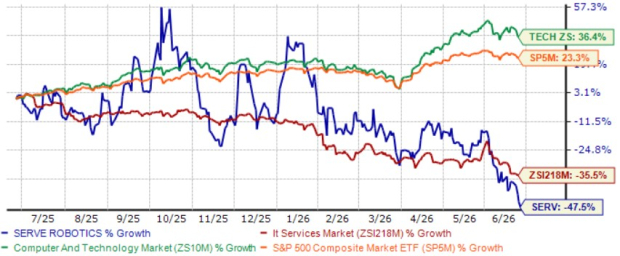
Shares of Serve Robotics have declined 47.5% in the past year, underperforming the Zacks Computers - IT Services industry, the broader Computer and Technology sector and the S&P 500 index.
SERV Stock's 12-Month Price Performance
Image Source: Zacks Investment Research
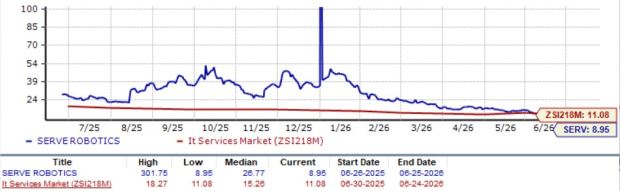
SERV stock is currently trading at a premium. It is currently trading at a forward 12-month price-to-sales (P/S) multiple of 8.95, well above the industry average of 11.08.
SERV’s P/S Ratio (Forward 12-Month) vs. Industry
Image Source: Zacks Investment Research
SERV’s EPS Trend
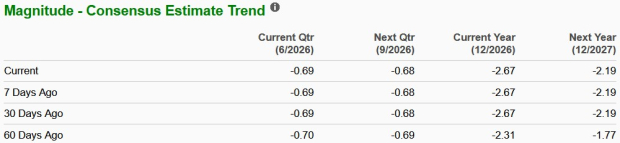
The Zacks Consensus Estimate for SERV’s 2026 loss per share has widened to $2.67 in the past 60 days. Also, the estimated figure indicates a wider loss from the year-ago estimated loss of $1.63 per share.
EPS Trend of SERV Stock
Image Source: Zacks Investment Research
Serve Robotics currently has a Zacks Rank #3 (Hold). You can see the complete list of today’s Zacks #1 Rank (Strong Buy) stocks here.
Beyond Nvidia: AI's Second Wave Is Here
The AI revolution has already minted millionaires. But the stocks everyone knows about aren't likely to keep delivering the biggest profits. AI’s second wave is moving from infrastructure to implementation and these companies are at the forefront of this transition, positioned to become what Amazon and Google were to the internet era.
See Stocks Now >>Want the latest recommendations from Zacks Investment Research? Today, you can download 7 Best Stocks for the Next 30 Days. Click to get this free report
Serve Robotics Inc. (SERV): Free Stock Analysis Report
Uber Technologies, Inc. (UBER): Free Stock Analysis Report
DoorDash, Inc. (DASH): Free Stock Analysis Report
This article originally published on Zacks Investment Research (zacks.com).