


Spyre Therapeutics SYRE has become a closely watched clinical-stage biotech stock as investors look ahead to a busy stretch of data readouts that could define the company’s next phase. The company is focused on inflammatory bowel disease, or IBD, where it is developing long-acting antibodies and antibody combinations aimed at improving disease control, convenience and durability of response.
The investment case for Spyre Therapeutics is built around a straightforward but high-risk question: can its broad IBD pipeline produce meaningful clinical proof-of-concept data? That question makes 2026 especially important for SYRE stock. A successful series of readouts could strengthen confidence in the company’s platform and support the case for a differentiated role in IBD. Disappointing results, however, could quickly pressure expectations that have already moved higher.
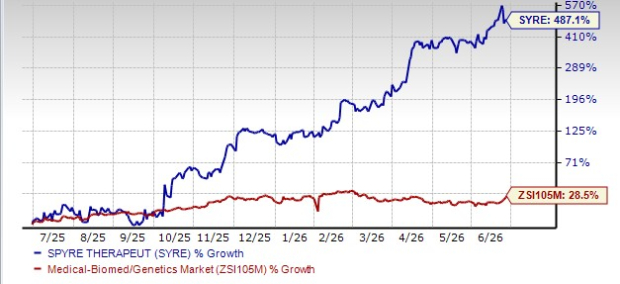
Spyre Therapeutics’ stock has risen 487.1% in the past year compared with an increase of 28.5% for the industry
Image Source: Zacks Investment Research
Spyre Builds a Multi-Asset IBD Platform
Spyre is not relying on a single experimental molecule. Its strategy centers on several validated inflammatory pathways, with assets being tested both as monotherapies and in combination regimens.
The company’s key monotherapy candidates include SPY001, an anti-α4β7 antibody; SPY002, an anti-TL1A antibody; and SPY003, an anti-IL-23 antibody. These targets are relevant in IBD because they are tied to immune-cell trafficking, inflammatory signaling and immune pathway activation. Spyre is seeking to use these mechanisms to produce better disease control in ulcerative colitis.
The company is also expanding the platform through combination candidates. SPY120 combines SPY001 and SPY002, SPY130 combines SPY001 and SPY003, and SPY230 combines SPY002 and SPY003. This approach reflects Spyre’s belief that blocking multiple inflammatory pathways at once could lead to deeper and more durable responses than single-agent therapy alone.
For investors, this creates a “multiple shots on goal” setup within one disease area. Instead of tying its valuation to one asset, Spyre is building a portfolio that gives it several opportunities to validate its science. That diversification is a meaningful strength, though it does not remove the core risks that come with clinical-stage drug development.
SYRE Has Six Key Readouts Ahead
The biggest near-term issue for SYRE stock is the clinical catalyst calendar. Spyre is on track for six proof-of-concept readouts in 2026 across its SKYLINE and SKYWAY phase II studies.
In IBD, the SKYLINE phase II platform study is evaluating SPY001, SPY002 and SPY003, along with pairwise combinations, in patients with moderately to severely active ulcerative colitis. Initial data from SPY001 and SPY002 have already helped frame investor expectations, while SPY003 data are expected to add another important readout. SKYLINE Part B, which includes both monotherapy and combination arms, is also important because combination data are central to Spyre’s longer-term differentiation thesis.
Beyond IBD, the SKYWAY phase II basket study is testing SPY072, an anti-TL1A antibody, in rheumatic diseases. The study includes rheumatoid arthritis, psoriatic arthritis and axial spondyloarthritis. Top-line proof-of-concept data from these studies are expected during 2026, giving investors additional opportunities to assess whether Spyre’s TL1A approach can extend beyond IBD.
A catalyst-rich year can work in two ways. Positive data may gradually reduce uncertainty, validate the company’s development strategy and improve investor confidence. Negative or mixed data could have the opposite effect, especially because clinical-stage biotech valuations often depend heavily on expectations for future trial success.
Spyre Targets Better Disease Control
Spyre’s broader treatment thesis is that IBD patients need therapies that deliver stronger, longer-lasting disease control with more convenient dosing. Current therapies can leave many patients without durable remission, and treatment burden remains an important issue in chronic diseases.
The company is pursuing long-acting antibodies designed to allow less frequent dosing. That profile could matter commercially if the drugs also show competitive efficacy and safety. Convenience alone is unlikely to be enough in a crowded market, but a combination of durable remission, favorable tolerability and less frequent administration could be compelling.
Spyre’s selected pathways also reflect a targeted approach to IBD biology. The α4β7 pathway is tied to gut-directed immune-cell trafficking. TL1A is associated with inflammatory signaling and has become an increasingly important target in immunology. IL-23 is already a validated pathway in immune-mediated disease. By developing candidates across these mechanisms, Spyre is trying to position itself around a set of biologically relevant and commercially meaningful targets.
The commercial prize is deeper and more durable remission. If Spyre can show that its monotherapies and combinations deliver stronger disease control than current options, the company could have a credible path toward meaningful value creation. But that outcome still depends on clinical results that are not yet fully proven.
SYRE Still Faces Big Execution Risks
Despite the pipeline potential, SYRE remains a high-risk biotech stock. Spyre has no approved products and no commercial product revenue. Its valuation is therefore tied mainly to clinical progress, investor confidence and expectations for future market opportunity.
Clinical development risk remains the biggest concern. Even promising early or mid-stage data can fail to translate into later-stage success. Trials may miss endpoints, reveal safety concerns or show results that are not sufficiently differentiated from existing therapies. In a field as competitive as IBD, simply being active against validated targets may not be enough.
Cash burn is another key issue. Spyre is investing heavily in clinical trials, manufacturing and personnel as it advances a broad pipeline. The company has strengthened its balance sheet, but continued development will require substantial spending. Like many clinical-stage biotechs, Spyre may need additional funding over time, which could create dilution risk for shareholders.
Competition is also intense. The IBD market includes established biologics, newer therapies and large pharmaceutical companies with deeper resources, broader development experience and existing commercial infrastructure. Major players in the space include AbbVie ABBV, Eli Lilly, Pfizer, Novartis, Merck, Sanofi, Gilead Sciences and Amgen. AbbVie and J&J JNJ are also developing combination therapies in IBD. That means Spyre must not only show positive data, but also prove that its candidates can stand out.
How SYRE Signals Fit the Story
The report supports a Neutral view on Spyre Therapeutics. That stance reflects the balance between a promising, diversified pipeline and the high execution risk still facing the company.
The bullish case is clear: Spyre has a broad IBD-focused platform, several validated targets, combination candidates and multiple 2026 readouts that could materially change investor confidence. If the data are strong, SYRE could gain further attention as a differentiated immunology platform.
The cautious case is just as important. Expectations have already risen and the company remains years away from potential commercialization. Clinical risk, competition and cash burn all remain meaningful obstacles.
For now, Spyre Therapeutics offers substantial pipeline potential, but the next phase of the SYRE stock story will depend heavily on whether 2026 trial results can justify the optimism already reflected in the shares.
SYRE’s Zacks Rank
Spyre Therapeutics is a Zacks Rank #3 (Hold) stock. You can see the complete list of today’s Zacks #1 Rank (Strong Buy) stocks here.
Research Chief Names "Single Best Pick to Double"
From thousands of stocks, 5 Zacks experts each have chosen their favorite to skyrocket +100% or more in months to come. From those 5, Director of Research Sheraz Mian hand-picks one to have the most explosive upside of all.
This company targets millennial and Gen Z audiences, generating nearly $1 billion in revenue last quarter alone. A recent pullback makes now an ideal time to jump aboard. Of course, all our elite picks aren’t winners but this one could far surpass earlier Zacks’ Stocks Set to Double like Nano-X Imaging which shot up +129.6% in little more than 9 months.
Free: See Our Top Stock And 4 Runners UpWant the latest recommendations from Zacks Investment Research? Today, you can download 7 Best Stocks for the Next 30 Days. Click to get this free report
Johnson & Johnson (JNJ): Free Stock Analysis Report
AbbVie Inc. (ABBV): Free Stock Analysis Report
Spyre Therapeutics, Inc. (SYRE): Free Stock Analysis Report
This article originally published on Zacks Investment Research (zacks.com).