


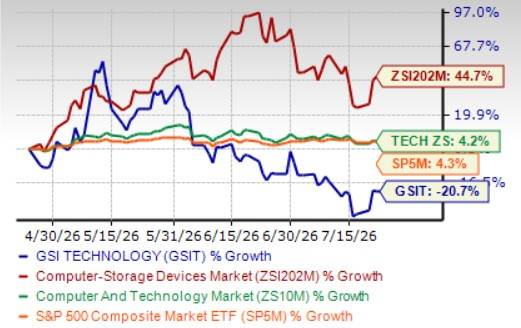
GSI Technology, Inc. GSIT shares have lost 20.7% in the past three months against the industry’s 44.7% growth. It has also lagged the broader Zacks Computer and Technology sector’s 4.2% rise and the S&P 500’s 4.3% increase in the said time frame. GSIT faces challenges from intense AI competition, execution risks, SRAM dependence, supply chain constraints, talent challenges, manufacturing costs and evolving regulatory pressures.
Image Source: Zacks Investment Research
What’s Weighing on GSIT’s Performance?
GSI Technology faces risks related to talent retention and technological execution. Developing advanced AI processors such as Gemini-II and Plato requires specialized engineering expertise, particularly in semiconductor design, software development and AI systems. Competition for skilled personnel remains intense, and any inability to attract or retain qualified employees could slow product development. Additionally, delays, higher costs or technical challenges in completing future Associative Processing Unit (APU) generations could impact commercialization timelines and increase financial pressure.
The company continues to face intense competition in both AI hardware and memory markets. Larger semiconductor companies with substantially greater financial, technical and manufacturing resources may develop competing solutions or offer products with stronger ecosystems and customer relationships. In the AI market, established players, such as NVIDIA and other well-funded entrants, could limit GSIT’s ability to gain market share. Similarly, evolving memory technologies and alternative architectures may pressure its traditional SRAM business.
GSI Technology remains dependent on its SRAM business to fund ongoing APU development, creating execution risk during its business transformation. Although SRAM revenues improved, demand for traditional external memory solutions faces long-term challenges as customers increasingly integrate memory into their own designs. The company has also experienced customer concentration, with major customers contributing a significant portion of revenue. Any reduction in purchases, customer transitions to internal solutions or changes in demand patterns could negatively affect financial performance.
Manufacturing, supply chain and regulatory challenges could also weigh on future growth. GSIT relies on third-party manufacturers, including TSMC, for wafer production and does not maintain long-term supply commitments that guarantee capacity or pricing. Rising manufacturing costs, geopolitical tensions, export restrictions and evolving AI regulations may increase operating complexity.
Stock Valuation
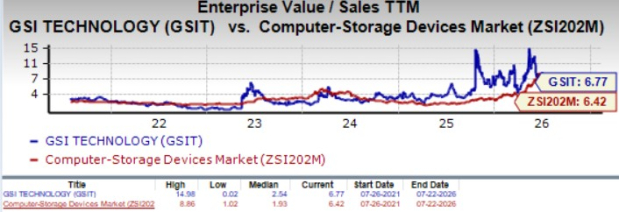
From a valuation perspective, GSI Technology appears relatively expensive. Currently, it is trading at a trailing 12-month EV/sales multiple of 6.77X compared with the past five-year median of 2.54X and the industry’s figure of 6.42X. However, it is lower than that of one of the company’s peers, Western Digital Corporation WDC, but higher than that of NetApp, Inc. NTAP. The metrics for both peers stood at 16.12X and 4.55X, respectively.
Image Source: Zacks Investment Research
Can GSIT Power Through the Challenges?
GSI Technology is positioned to benefit from the accelerating adoption of edge AI, where demand is rising for low-power, low-latency processing solutions. The company’s APU architecture addresses key limitations of traditional CPU and GPU systems by reducing data movement and improving power efficiency.
Strong demand for high-performance memory solutions, particularly in defense, aerospace and advanced computing applications, continues to support revenue generation. Additionally, growing validation of Gemini-II through defense programs, the Sentinel initiative and the Smart City project in Taiwan could expand commercial opportunities. Successful deployments may create new hardware and recurring software revenue streams as edge AI adoption broadens.
Wrapping Up
While its APU technology and expanding validation efforts offer long-term growth potential, execution challenges, competitive pressures and reliance on existing SRAM revenue remain key concerns for GSI Technology. Also, the stock seems overvalued at the moment. Therefore, a decline in share price may be a signal for investors looking to add the stock to their portfolios to wait for a better entry point.
Zacks' Research Chief Names "Stock Most Likely to Double"
Our team of experts has just released the 5 stocks with the greatest probability of gaining +100% or more in the coming months. Of those 5, Director of Research Sheraz Mian highlights the one stock set to climb highest.
This top pick is a little-known satellite-based communications firm. Space is projected to become a trillion dollar industry, and this company's customer base is growing fast. Analysts have forecasted a major revenue breakout in 2025. Of course, all our elite picks aren't winners but this one could far surpass earlier Zacks' Stocks Set to Double like Hims & Hers Health, which shot up +209%.
Free: See Our Top Stock And 4 Runners UpWant the latest recommendations from Zacks Investment Research? Today, you can download 7 Best Stocks for the Next 30 Days. Click to get this free report
NetApp, Inc. (NTAP): Free Stock Analysis Report
Western Digital Corporation (WDC): Free Stock Analysis Report
GSI Technology, Inc. (GSIT): Free Stock Analysis Report
This article originally published on Zacks Investment Research (zacks.com).