

Microsoft is set to close out its fiscal year on Wednesday, July 29th, reporting fiscal fourth-quarter results after the closing bell.
On paper, the setup looks routine for a company that has made beating expectations a habit. Management has guided to total revenues of $86.7 billion to $87.8 billion, implying growth of 13% to 15%, with accelerating commercial growth partially offset by the consumer business.
The Zacks Consensus Estimate for revenues sits at $87.44 billion, indicating growth of 14.4% from the year-ago quarter. On the bottom line, consensus calls for earnings of $4.21 per share, up roughly 15.3% year over year. Those are strong numbers by any standard. But this quarter, the numbers may not be what decides the stock’s reaction.
The Alphabet Read-Through: Cloud Is Booming, But the Bill Is Due
The most instructive preview of Wednesday came last week from Mountain View. Alphabet reported second-quarter revenue of $119.8 billion, beating expectations, driven by 82% growth in its cloud business.
That figure deserves a second look — Google Cloud revenue surged 82% year over year to $24.8 billion, far exceeding analyst expectations of 63% growth. Its backlog swelled by more than $50 billion sequentially to $514 billion, and cloud operating margin more than tripled to 35.6%.
For Microsoft shareholders, this is genuinely encouraging. Enterprise appetite for AI-enabled cloud capacity is not merely holding up; it is accelerating, and margins on that business are expanding rather than eroding. Microsoft entered this quarter with Azure and other cloud services growing 40% in constant currency and Microsoft Cloud revenue reaching $54.5 billion, up 29%. If Alphabet’s demand signal translates, Azure should have had a very good spring.
Yet there’s certainly reason to temper enthusiasm heading into Wednesday evening. Alphabet beat, and the stock fell anyway. Shares dropped around 7% after the company raised its 2026 capital expenditure forecast to $195 billion to $205 billion, up from prior guidance of $180 billion to $190 billion, having reported second-quarter capex of $44.9 billion — a 101% increase from the prior year — and warned that 2027 spending will “significantly increase.”
Free cash flow also turned deeply negative. The message from the market was unambiguous: after three years of granting Big Tech near-unlimited license to spend on AI, investors have started demanding evidence that the spending converts to cash. A revenue beat no longer buys forgiveness for a capex surprise.
Microsoft Faces the Same Question — With Its Own Complications
Microsoft walks into Wednesday carrying an identical burden, and arguably a heavier one. Capital expenditures are expected to exceed $40 billion in the fiscal fourth quarter, with the sequential increase including roughly $5 billion from higher component pricing as well as the impact from finance leases.
That component-pricing detail is worth pausing on — it is a direct pass-through from the memory and semiconductor shortages, and it means Microsoft is paying more for the same compute.
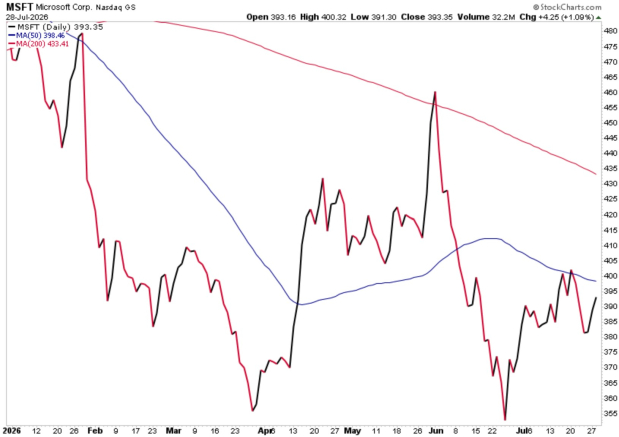
The cash-flow math is already showing strain: free cash flow fell 22% year over year to $15.8 billion in the fiscal third quarter on $31 billion of quarterly capex. The market’s verdict on this is visible in the tape. Shares have retreated roughly 19% year to date, with the decline largely stemming from mounting anxiety over the company’s aggressive AI infrastructure investments.
Image Source: StockCharts
What the Zacks Model Reveals
Our own framework counsels caution on the beat itself. Microsoft carries an Earnings ESP of -0.44% alongside a Zacks Rank #3 (Hold). The Most Accurate Estimate sitting below the Zacks Consensus Estimate suggests analysts have recently turned somewhat more bearish on the company’s near-term earnings prospects.
To be clear about what this does and does not mean: a negative ESP is not a prediction of a miss, and our research shows it is difficult to forecast beats with confidence for stocks in this configuration. It simply means the statistical edge that a positive ESP and favorable rank would provide is absent here.
Set against that, Microsoft has beaten consensus EPS estimates in each of the past fifteen quarters — a track record that argues the operational bar will likely be cleared even if the model is agnostic.
The Metrics That Will Actually Move the Stock
Given all of the above, the line items to watch are narrower than usual. Azure’s growth rate remains the headline — sustaining something in the high-30% to 40% range would validate that Alphabet’s GOOGL cloud acceleration is an industry phenomenon and not a Google-specific share gain.
Segment guidance calls for Productivity and Business Processes revenues of $37 billion to $37.3 billion, roughly 12% to 13% growth, and Microsoft 365 Commercial cloud growth guided at 15% to 16% in constant currency.
On AI monetization specifically, Copilot paid seats surpassed 20 million last quarter with seat additions up 250% year over year, and a $627 billion commercial backlog provides multiyear revenue visibility. But the number that likely determines Thursday’s open is fiscal 2027 capex guidance. If Microsoft MSFT follows Alphabet in guiding spending sharply higher without a commensurate free-cash-flow bridge, the stock will likely struggle regardless of how good the quarter was.
Bottom Line
The valuation argument has quietly become interesting. Microsoft trades at a forward P/E of roughly 20.3, modest by Microsoft’s own historical standards and reasonable for a company compounding earnings at this rate.
The bull case is straightforward: cloud demand is accelerating across the industry, Microsoft’s AI monetization is further along than most, the backlog is enormous, and the stock has already absorbed a 19% drawdown. The bear case is equally coherent: capital intensity keeps rising, component costs are inflating, free cash flow is contracting, and the market has plainly stopped rewarding spending narratives on faith.
A Zacks Rank #3 (Hold) feels like the honest posture. Wednesday will not settle the debate about whether the AI buildout pays off — but it will tell us whether Microsoft can grow into its spending faster than its peers can.
Zacks' Research Chief Names "Stock Most Likely to Double"
Our team of experts has just released the 5 stocks with the greatest probability of gaining +100% or more in the coming months. Of those 5, Director of Research Sheraz Mian highlights the one stock set to climb highest.
This top pick is a little-known satellite-based communications firm. Space is projected to become a trillion dollar industry, and this company's customer base is growing fast. Analysts have forecasted a major revenue breakout in 2025. Of course, all our elite picks aren't winners but this one could far surpass earlier Zacks' Stocks Set to Double like Hims & Hers Health, which shot up +209%.
Free: See Our Top Stock And 4 Runners UpWant the latest recommendations from Zacks Investment Research? Today, you can download 7 Best Stocks for the Next 30 Days. Click to get this free report
Microsoft Corporation (MSFT): Free Stock Analysis Report
Alphabet Inc. (GOOGL): Free Stock Analysis Report
This article originally published on Zacks Investment Research (zacks.com).