


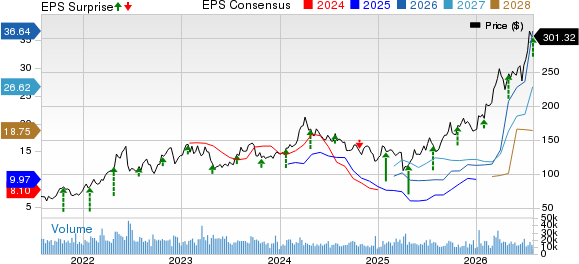
Valero Energy Corporation VLO reported second-quarter 2026 adjusted earnings of $12.54 per share, up 450% from $2.28 a year ago. The figure surpassed the Zacks Consensus Estimate of $9.87 by 27.1%.
Revenues climbed 48.8% year over year to $44.48 billion and beat the Zacks Consensus Estimate of $35.95 billion by 23.7%.
The results benefited from stronger refining margins and sharp profitability gains in renewable diesel and ethanol. Refining throughput averaged 2.95 million barrels per day, up from 2.92 million barrels per day in the prior-year quarter.
Valero Energy Corporation Price, Consensus and EPS Surprise
Valero Energy Corporation price-consensus-eps-surprise-chart | Valero Energy Corporation Quote
VLO's Refining Profitability Surges
Refining revenues from external customers increased to $42.3 billion from $28.32 billion a year earlier. The segment generated operating income of $4.47 billion compared with $1.27 billion in the second quarter of 2025. Adjusted operating income for the second quarter reached $4.44 billion, up from $1.27 billion in the year-ago period.
Refining margin nearly doubled to $6.34 billion from $3.28 billion a year ago. On a unit basis, the refining margin per barrel of throughput rose to $23.62 from $12.35. Adjusted refining operating income per barrel of throughput climbed to $16.56 from $4.78. Stronger gasoline and distillate product margins supported the improvement.
Of the total refining throughput volume, the Gulf Coast contributed approximately 62%, while the Mid-Continent, North Atlantic and West Coast regions accounted for 16.4%, 17.2% and 4.4%, respectively.
Valero's Regional Performance Strengthens
The Gulf Coast remained the largest contributor, with external conditions supporting a refining margin of $4.07 billion, up from $1.97 billion in the corresponding period of 2025.
The Mid-Continent refining margin rose to $903 million from $405 million a year ago. The North Atlantic refining margin climbed to $1.01 billion from $476 million. The West Coast refining margin declined to $360 million from $430 million, while throughput fell to 130,000 barrels per day (bpd) from 262,000 bpd in the prior year quarter.
VLO Sees Renewable Diesel Rebound
Renewable Diesel revenues from external customers more than doubled to $1.18 billion from $565 million in the second quarter of 2025. The segment posted operating income of $717 million, reversing the year-ago operating loss of $79 million.
Renewable Diesel margin surged to $879 million from $54 million in the year-ago quarter. Sales volumes averaged 3.83 million gallons per day, up from 2.73 million a year ago. Renewable diesel margin per gallon of sales improved to $2.52 from 22 cents, while operating income per gallon reached $2.06 versus a loss of 32 cents in the prior-year period.
Valero's Ethanol Margins Expand
Ethanol revenues from external customers remained unchanged at $1 billion. However, operating income increased sharply to $318 million from the year-ago figure of $54 million, indicating substantially better conversion of revenues into profit.
Ethanol margin rose to $489 million from $217 million in the corresponding period of 2025. Production volumes averaged 4.67 million gallons per day compared with 4.58 million a year ago. Ethanol margin per gallon of production increased to $1.15 from 52 cents, while operating income per gallon climbed to 75 cents from 13 cents in the year ago period.
VLO’s Total Costs
Total cost of sales increased to $39 billion from $28.6 billion in the year-ago quarter. Cost of materials and other rose to $35.1 billion from $24.7 billion, whereas depreciation and amortization expense decreased to $723 million from $786 million in the year-ago period.
VLO Generates Robust Cash Flow
Net cash from operating activities totaled $5.58 billion, up from $936 million in the prior-year quarter. Excluding working-capital movements and the portion attributable to the other Diamond Green Diesel joint venture member, adjusted operating cash flow was $4.49 billion.
Valero returned $2.6 billion to stockholders, representing 59% of adjusted operating cash flow. Capital investments totaled $350 million, including $290 million for sustaining activities. Capital investments attributable to Valero were $346 million, down from $399 million a year earlier.
Valero Maintains Financial Flexibility
Valero ended the June quarter with $7.87 billion in cash and cash equivalents. Total debt stood at $9.10 billion, while finance lease obligations were $2.25 billion. The debt-to-capitalization ratio, net of cash, was 11%.
The company declared a quarterly dividend of $1.20 per share on July 16. Valero also maintained its timeline for the $230 million FCC Unit optimization project at the St. Charles Refinery, which is expected to begin operations in the third quarter of 2026.
VLO’s Zacks Rank & Other Key Picks
VLO currently carries a Zacks Rank #2 (Buy).
Some other top-ranked stocks from the energy sector are Par Pacific Holdings PARR, HF Sinclair DINO and FuelCell Energy FCEL, each carrying a Zacks Rank #2 at present. You can see the complete list of today’s Zacks Rank #1 (Strong Buy) stocks here.
Par Pacific Holdings operates an integrated downstream energy business across the United States, with fuel retail operations in Hawaii, Washington and Idaho, refining operations in Hawaii, Wyoming, Washington and Montana, and a supporting logistics network. Its refineries have a combined crude oil throughput capacity of 219,000 barrels per day and produce gasoline, diesel, jet fuel, marine fuels, asphalt and other petroleum products.
HF Sinclair is an independent energy company producing and marketing gasoline, diesel, jet fuel, renewable diesel, lubricants, and specialty products. Incorporated in Delaware in 1947 and headquartered in Dallas, TX, it operates refineries in Kansas, Oklahoma, New Mexico, Wyoming, Washington and Utah. The company also provides transportation, terminaling and storage services to its refineries and third parties.
FuelCell Energy is a clean energy company that offers scalable, reliable, low-carbon power solutions. It produces power using flexible fuel sources such as biogas, natural gas and hydrogen. The company’s proprietary molten carbonate fuel cell systems generate electricity through an electrochemical process instead of burning fuel, reducing carbon emissions and minimizing the environmental impact of power generation. FCEL is anticipated to play a crucial role in the energy transition by enabling industries and communities to shift from traditional fossil fuels to low-carbon alternatives.
Beyond Nvidia: AI's Second Wave Is Here
The AI revolution has already minted millionaires. But the stocks everyone knows about aren't likely to keep delivering the biggest profits. AI’s second wave is moving from infrastructure to implementation and these companies are at the forefront of this transition, positioned to become what Amazon and Google were to the internet era.
See Stocks Now >>Want the latest recommendations from Zacks Investment Research? Today, you can download 7 Best Stocks for the Next 30 Days. Click to get this free report
Valero Energy Corporation (VLO): Free Stock Analysis Report
FuelCell Energy, Inc. (FCEL): Free Stock Analysis Report
Par Pacific Holdings, Inc. (PARR): Free Stock Analysis Report
HF Sinclair Corporation (DINO): Free Stock Analysis Report
This article originally published on Zacks Investment Research (zacks.com).