

HSBC Holdings HSBC is accelerating the simplification of its global operations and recently announced two major transactions involving its retail banking businesses in Egypt and Australia. The moves reflect the lender’s strategy of withdrawing capital from operations where it lacks sufficient scale while retaining businesses that benefit from its international network and competitive strengths.
HSBC has agreed to sell its entire Egyptian retail banking business to Emirates NBD Egypt. The transaction includes retail loans, deposits and customer accounts, along with employees supporting the business. Subject to regulatory approvals, the deal is expected to close in the second half of 2027 and generate an estimated pre-tax gain of approximately $300 million. The impact on HSBC’s common equity tier 1 capital ratio is expected to be immaterial.
Despite the retail exit, HSBC will maintain its corporate and institutional banking operations in Egypt. The bank sees growth opportunities in supporting multinational companies, facilitating trade and investment flows and helping domestic wholesale clients expand internationally. The disposal followed a strategic review and is intended to concentrate resources on areas where HSBC possesses a stronger competitive advantage.
Separately, HSBC Australia agreed to sell an approximately A$36-billion, or $25-billion, portfolio of home and personal loans to an entity owned by Blackstone-managed funds. Pepper Money will service the loans after completion, which is expected in the first half of 2027, subject to regulatory and competition approvals. The portfolio disposal is expected to result in an immaterial loss of less than $100 million.
HSBC will also wind down the remainder of its Australian retail operation over 18 months. Its corporate and institutional banking, private banking and asset-management businesses will subsequently be consolidated into the HSBC Sydney Branch, simplifying the group’s legal-entity footprint. The process is expected to entail around $300 million of restructuring costs and write-offs.
Our Take on HSBC’s Streamlining Initiatives
These two transactions extend HSBC’s broader portfolio reshaping. This year, the company completed the privatization of Hang Seng Bank and divested its U.K. life insurance business, as well as its retail banking operations in South Africa and Sri Lanka. HSBC also reclassified its Malta business as held for sale and agreed to sell its Indonesian retail banking business and Singapore life and health insurance business.
HSBC is undertaking these steps to reduce complexity, improve cost efficiency and redirect capital and spending toward higher-return franchises, particularly Hong Kong, the U.K., globally connected corporate banking and international wealth. The company had actioned roughly $1.4 billion of its targeted $1.5 billion in annualized simplification savings by the first quarter of 2026 and plans to redeploy about $1.8 billion from non-strategic activities into priority growth areas.
These efforts should strengthen operating leverage, sharpen management accountability and support HSBC’s target of delivering a return on tangible equity of at least 17% through 2028.
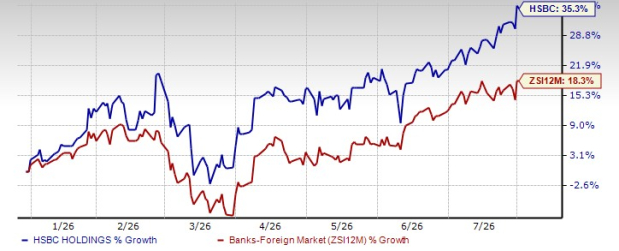
This year, HSBC shares have gained 35.3%, outperforming the industry's growth of 18.3%.
YTD Price Performance
Image Source: Zacks Investment Research
At present, HSBC carries a Zacks Rank #2 (Buy). You can see the complete list of today’s Zacks #1 Rank (Strong Buy) stocks here.
Similar Steps Taken by Other Banks
In July, Northern Trust Corporation NTRS agreed to sell its guardianship services business to Wintrust Financial Corporation's subsidiary, Wintrust Private Trust Company.
The divestiture aligns with NTRS' broader strategy of strengthening its core wealth management, asset servicing, and asset management businesses while streamlining its portfolio and focusing investments on areas with stronger long-term growth potential.
In June, Deutsche Bank AG DB entered into a definitive agreement to sell its retail banking, affluent private banking and wealth management business in India to Kotak Mahindra Bank.
The divestiture aligns with DB's broader Global Hausbank strategy, announced in November 2025, which emphasizes simplifying operations, enabling disciplined capital allocation and concentrating investments in businesses with stronger scale and competitive advantages.
Beyond Nvidia: AI's Second Wave Is Here
The AI revolution has already minted millionaires. But the stocks everyone knows about aren't likely to keep delivering the biggest profits. AI’s second wave is moving from infrastructure to implementation and these companies are at the forefront of this transition, positioned to become what Amazon and Google were to the internet era.
See Stocks Now >>Want the latest recommendations from Zacks Investment Research? Today, you can download 7 Best Stocks for the Next 30 Days. Click to get this free report
HSBC Holdings plc (HSBC): Free Stock Analysis Report
Deutsche Bank Aktiengesellschaft (DB): Free Stock Analysis Report
Northern Trust Corporation (NTRS): Free Stock Analysis Report
This article originally published on Zacks Investment Research (zacks.com).