


Duke Energy Corporation DUK used its second-quarter 2026 earnings call to reinforce a growth plan tied to contracted data-center demand, regulatory execution and a sizable generation build.
Management maintained its earnings framework while providing timing around potential capital upside, customer protections and the conditions required before new nuclear investment advances.
DUK Reaffirms Its Growth Framework
DUK’s second-quarter adjusted earnings of $1.43 per share topped the Zacks Consensus Estimate of $1.29. However, revenues of $7.59 billion missed the Zacks Consensus Estimate of $7.72 billion.
Duke Energy Corporation Price, Consensus and EPS Surprise
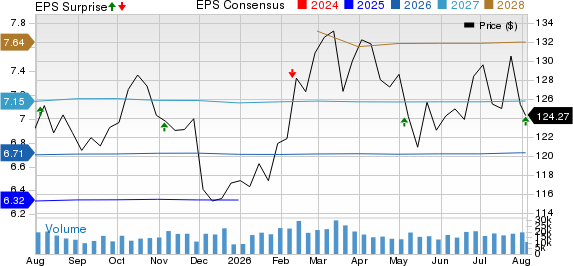
Duke Energy Corporation price-consensus-eps-surprise-chart | Duke Energy Corporation Quote
President and CEO Harry Sideris reaffirmed 2026 adjusted earnings guidance of $6.55-$6.80 per share and 5%-7% adjusted EPS growth through 2030.
Sideris said Duke Energy expects to earn in the top half of that range beginning in 2028, when contracted economic-development loads start contributing more meaningfully.
Duke Energy Expands Large-Load Commitments
Executive vice president and CFO Brian Savoy said Duke Energy has secured 7.8 gigawatts of electric service agreements with data-center customers.
Savoy expects the 15.4-gigawatt late-stage pipeline to convert to agreements by the first half of 2027.
Sideris said most late-stage opportunities are in Florida and Indiana. Savoy expects customers to begin taking power in the second half of 2027 and into 2028, then ramp up through the early 2030s.
DUK Connects Contracts to Capital Upside
Savoy outlined $5 billion-$10 billion of potential upside to the current five-year capital plan for added generation and transmission, particularly in Indiana and Florida.
A Barclays analyst asked whether that spending belonged in the next plan or farther into the 2030s. Savoy said it could enter the remaining four years of the existing plan.
Savoy stressed that the spending depends on signed agreements and modeled infrastructure needs, keeping capital deployment tied to contracted demand rather than the broader pipeline.
Duke Energy Puts Affordability at the Center
Sideris said Customer Protection Plus requires large users to cover the costs of serving their facilities.
Savoy said Duke Energy's contracts contain minimum-take provisions that support revenue projections and protect existing customers as new demand ramps up.
A Wells Fargo analyst asked whether Duke Energy could revisit a generation-company structure in Indiana. Sideris said the company may reconsider it as a financing tool and added customer safeguard.
Sideris also pointed to the proposed Duke Energy Carolinas settlement, including a 9.8% allowed return on equity, a 53% equity ratio and continued multiyear rate treatment.
DUK Defends Build and Fuel Readiness
A Barclays analyst pressed management on construction bottlenecks as Duke Energy scales its gas fleet. Sideris cited repeatable plant designs, coordinated engineering contractors and continuous milestone tracking.
Sideris said Duke Energy is using artificial intelligence tools to monitor schedules and has about 5 gigawatts under construction, with another 2.5 gigawatts in development.
A Goldman Sachs analyst asked about fuel constraints. Sideris said Duke Energy has secured the gas supply required through the early 2030s and is working on later needs.
Duke Energy Sets Guardrails on Funding and Nuclear
Savoy said Duke remains on track for 14.5% funds from operations to debt in 2026 and has priced $600 million through its at-the-market program for settlement at the end of 2027.
A Truist analyst asked about accelerated equity funding. Savoy said Duke Energy may continue using the ATM and dividend-reinvestment programs, but no large block issuance is planned in the five-year plan.
On new nuclear, Sideris said Duke Energy will not proceed without protections against first-of-a-kind, supply-chain and cost-overrun risks. He gave no commercial timeline.
DUK Maintains an Execution-First Posture
Sideris kept the emphasis on converting load agreements, completing generation projects on time and protecting existing customers as capital requirements expand.
Savoy paired that operational message with balance-sheet discipline, while Sideris said Duke Energy typically revisits the long-term growth range in the fourth quarter.
Duke Energy's Zacks Signals Are Mixed
Duke Energy carries a Zacks Rank #3 (Hold), with a Value Score of C, Growth Score of D, Momentum Score of B and VGM Score of D. The Momentum grade is the strongest of the four. You can see the complete list of today’s Zacks #1 Rank (Strong Buy) stocks here.
The Style Score framework favors A or B grades alongside Zacks Rank #1 or #2 (Buy) stocks. Duke Energy’s current combination is mixed, and its Zacks Rank can change as estimates are revised after the just-reported results.
Research Chief Names "Single Best Pick to Double"
From thousands of stocks, 5 Zacks experts each have chosen their favorite to skyrocket +100% or more in months to come. From those 5, Director of Research Sheraz Mian hand-picks one to have the most explosive upside of all.
This company targets millennial and Gen Z audiences, generating nearly $1 billion in revenue last quarter alone. A recent pullback makes now an ideal time to jump aboard. Of course, all our elite picks aren’t winners but this one could far surpass earlier Zacks’ Stocks Set to Double like Nano-X Imaging which shot up +129.6% in little more than 9 months.
Free: See Our Top Stock And 4 Runners UpWant the latest recommendations from Zacks Investment Research? Today, you can download 7 Best Stocks for the Next 30 Days. Click to get this free report
Duke Energy Corporation (DUK): Free Stock Analysis Report
This article originally published on Zacks Investment Research (zacks.com).