


Amgen’s AMGN stock hit a fresh 52-week high of $440.51 on Aug. 21, 2026, before closing the session at $439.33. The stock has gained 16.8% over the past month, mainly driven by strong second-quarter results and increased guidance. Amgen beat estimates for both earnings and revenues in the second quarter. Amgen also raised its financial outlook for 2026, for the second time this year, reinforcing management’s confidence in the portfolio.
The stock’s sharp recent rally and its proximity to a 52-week high have left investors wondering whether to buy the stock at current levels or take profits after its strong run. Let’s examine Amgen’s key strengths and weaknesses to assess whether investors should buy, sell or hold the stock at this stage.
Key Drugs & New Products Driving AMGN’s Top Line
Amgen markets a range of drugs across oncology, cardiovascular, bone health, immunology and other areas.
Amgen’s revenues rose around 8% to $18.7 billion in the first half of 2026, driven by growing patient demand for its innovative medicines. Amgen’s growth is distributed across numerous franchises rather than being dependent on a single product.
Amgen’s key medicines like Repatha, Evenity, Uplizna and Blincyto and new drugs like Tavneos, Tezspire and Imdelltra are driving the top line. New biosimilar launches are contributing to top-line growth as well. These drugs are offsetting declining revenues from oncology biosimilars and mature products such as Enbrel. Seventeen of Amgen’s products are now annualizing at more than $1 billion in sales.
Amgen’s key growth drivers, which include Repatha, Evenity, Tezspire and oncology and rare disease drugs, as well as biosimilar products, rose 24% year over year in the first quarter and 26% in the second quarter. These key growth drivers, which represent almost 70% of Amgen’s total product sales, are expected to drive top-line growth in future quarters, making up for the impending loss of exclusivity (LOE) cliff.
MariTide Anchors Amgen’s Promising Pipeline
Amgen has several key pipeline assets, with a primary focus on the obesity candidate, MariTide.
Amgen is developing MariTide, a GIPR/GLP-1 receptor for monthly and maybe less frequent dosing, which may help reduce treatment burden and improve persistence on treatment over time. This key feature differentiates it from Eli Lilly LLY and Novo Nordisk’s NVO popular GLP-1-based obesity drugs, Zepbound and Wegovy, respectively, which are weekly injections.
Amgen is evaluating MariTide in type II diabetes, obesity and obesity-related conditions as part of its comprehensive MARITIME phase III program. Amgen has nine global phase III studies underway with MariTide in obesity and other obesity-related conditions like obstructive sleep apnea, cardiovascular disease, and heart failure. Three phase III studies of MariTide in type II diabetes will be initiated in 2026.
In clinical studies, MariTide has shown predictable and sustained weight loss and a meaningful impact on cardiometabolic parameters. However, some investors were not impressed with MariTide’s data from phase II obesity studies. Also, some investors believe that Amgen has entered the obesity market later than rivals like Lilly and Novo Nordisk and the market is becoming increasingly competitive.
Beyond MariTide, Amgen’s key pipeline candidates in late-stage development are olpasiran, xaluritamig and dazodalibep, which have the potential to address areas of significant unmet medical need.
Amgen is also evaluating Kyprolis, Otezla, Nplate, Repatha, Lumakras, Imdelltra, Tezspire and Blincyto for additional indications. Approval for the expanded use of these drugs can potentially drive further top-line growth. Amgen has also invested several billion dollars in M&A deals over the last decade, including platform and technology-related deals as well as acquisitions of marketed products.
Biosimilars Provide Amgen With a Strong Growth Opportunity
Amgen has successfully launched biosimilars of J&J’s Stelara (Wezlana), Alexion’s Soliris (Bekemv) and Regeneron’s Eylea (Pavblu) in the past couple of years. Phase III studies are ongoing to evaluate biosimilar versions of Bristol-Myers’ Opdivo (ABP 206), Merck’s Keytruda (ABP 234) and Roche’s Ocrevus (ABP 692).
In the second quarter of 2026, its biosimilar products generated $855 million in sales, up 29% year over year. Since the first launch in 2018, Amgen’s biosimilars have delivered more than $15 billion in sales, significantly contributing to top-line growth and generating meaningful cash flows. Meanwhile, Amgen’s next wave of biosimilar candidates for Eylea HD, Opdivo, Keytruda and Ocrevus are in late-stage clinical development, positioning the company to capitalize on significant market opportunities.
Amgen’s new biosimilar launches will play a key role in cushioning the impact of Amgen’s upcoming LOEs over the next few years.
AMGN’s Key Drugs Prolia & Xgeva’s LOE & Other Headwinds
Amgen also faces significant biosimilar pressure on its denosumab franchise. Patents covering Prolia and Xgeva expired in the United States in February 2025 and in select European countries in November 2025. Multiple denosumab biosimilars have subsequently been launched.
While Prolia’s sales declined 32%, Xgeva declined 34% in the second quarter. Amgen expects accelerated sales erosion for both products through the rest of the year.
Amgen faces a significant patent-expiration overhang as key products such as Prolia, Xgeva, Enbrel and Otezla have either already lost exclusivity or are expected to do so within the next few years. Together, these medicines accounted for roughly 30% of Amgen’s 2025 product sales, leaving the company exposed to potential revenue pressure from generic and biosimilar competition as patents expire.
Pricing headwinds and competitive pressure are hurting sales of many products. Amgen’s net selling price has declined for the past few years, with the trend expected to continue due to increased competition. Sales prices of some key drugs like Repatha, Aimovig and Otezla are declining due to higher rebates to support and expand access for commercial and Medicare Part D patients. Amgen expects continuous price declines across its portfolio of drugs in 2026.
The Medicare Part D redesign and provisions of the Inflation Reduction Act (IRA), as well as the 340B Program, are affecting and are likely to continue to adversely impact sales of some drugs. Enbrel and Otezla have been selected by the Centers for Medicare & Medicaid Services for Medicare Part D price setting beginning in 2026 and 2027, respectively, which can result in further declines in net selling prices of these drugs.
Amgen has faced some recent pipeline and regulatory setbacks, including FDA scrutiny of Tavneos, which remains on the U.S. market while the company contests a proposed withdrawal. The company also discontinued the development of AMG 193 in oncology and AMG 513 in obesity in 2026.
AMGN’s Price, Valuation & Estimates
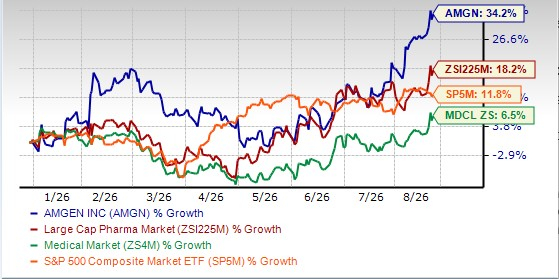
Amgen’s shares have risen 34.2% so far this year compared with an increase of 18.2% for the industry.The stock has also outperformed the sector and the S&P 500 index.
AMGN Stock Outperforms Industry, Sector and S&P 500 Index
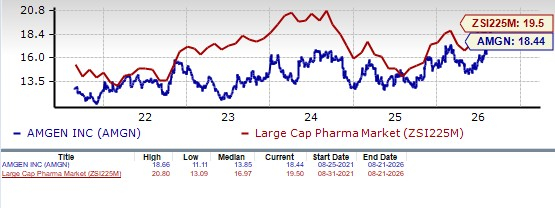
From a valuation standpoint, Amgen is reasonably priced. Going by the price/earnings ratio, the company’s shares currently trade at 18.44 forward earnings, which is lower than 19.50 for the industry. However, the stock is trading above its five-year mean of 13.85.
AMGN Stock Valuation
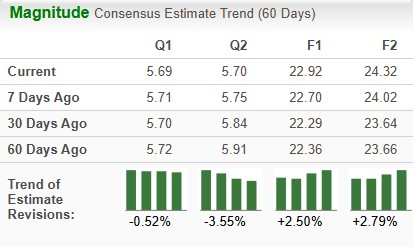
The Zacks Consensus Estimate for earnings has risen from $22.29 to $22.92 per share for 2026 over the past 30 days. For 2027, the consensus mark for earnings has increased from $23.64 to $24.32 per share over the same time frame.
AMGN’s Estimate Movement
Stay Invested in AMGN Stock
After analyzing the factors discussed above, we believe the company is well placed to maintain long-term revenue growth. Amgen expects that its rapidly growing key growth drivers, including Repatha, Imdelltra, Uplizna, and Tezspire, will offset the financial impact of patent expirations and increased competition in 2026. Beyond that, success with late-stage pipeline assets, such as olpasiran, xaluritamig, dazodalibep and the biosimilars pipeline, can support long-term growth. However, accelerating Prolia and Xgeva erosion, pricing pressure and regulatory uncertainties warrant caution.
Given AMGN’s strong gains and valuation above its historical average, investors should avoid chasing the stock at current levels. Existing investors should stay invested in this Zacks Rank #3 (Hold) stock for now while looking for a better entry point on any pullback. You can see the complete list of today’s Zacks #1 Rank (Strong Buy) stocks here.
Beyond Nvidia: AI's Second Wave Is Here
The AI revolution has already minted millionaires. But the stocks everyone knows about aren't likely to keep delivering the biggest profits. AI’s second wave is moving from infrastructure to implementation and these companies are at the forefront of this transition, positioned to become what Amazon and Google were to the internet era.
See Stocks Now >>Want the latest recommendations from Zacks Investment Research? Today, you can download 7 Best Stocks for the Next 30 Days. Click to get this free report
Amgen Inc. (AMGN): Free Stock Analysis Report
Novo Nordisk A/S (NVO): Free Stock Analysis Report
Eli Lilly and Company (LLY): Free Stock Analysis Report
This article originally published on Zacks Investment Research (zacks.com).