

Nvidia NVDA will step back into the earnings spotlight after the market closes on Wednesday, August 26, when the AI chip leader reports its much-anticipated Q2 results.
Expectations are understandably elevated, but the setup looks increasingly interesting as Nvidia’s valuation has compressed despite extraordinary earnings growth.
Beyond another potential top-and-bottom-line beat, Wall Street will be focused on the Vera Rubin product ramp, gross margins, and Nvidia’s growing role in financing the massive buildout of AI infrastructure.
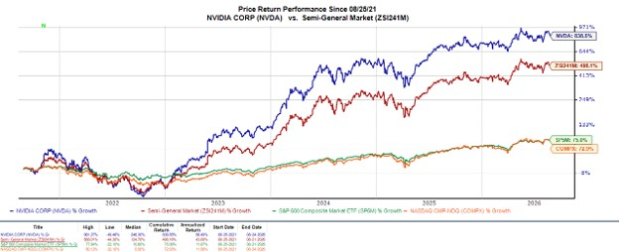
Investors are certainly wondering if NVDA can gain momentum with shares up a somewhat subpar 12% year to date despite sitting on enormous gains of +800% in the last five years.
Image Source: Zacks Investment Research
Nvidia's Q2 Expectations
The Zacks Consensus Estimate calls for Nvidia to post Q2 revenue of $91.85 billion, representing a whopping 96% increase from $46.74 billion in the year-ago period. Adjusted earnings are projected at $2.09 per share, up 99% year over year.
Those projections are essentially in line with Nvidia's own guidance for $91 billion in revenue, plus or minus 2%, which notably assumes no Data Center compute revenue from China. Data Center sales remain the primary growth engine, with the Zacks Consensus calling for roughly $85.14 billion, or 107% YoY growth.
Is the Vera Rubin Ramp Taking Off?
Perhaps more important than the headline Q2 numbers will be Nvidia's commentary surrounding its next-generation Vera Rubin platform, the company’s latest rack-scale AI supercomputer architecture designed to power the next era of agentic AI — systems that can reason, plan, and execute multi-step workflows at massive scale.
Nvidia announced in May that Vera Rubin was ramping into full production, with production shipments slated to begin this fall. More recently, the company said Rubin-based racks are already running at partners including CoreWeave CRWV), Alphabet’s GOOGL) Google Cloud, Microsoft’s MSFT) Azure, Oracle ORCL) Cloud Infrastructure, and Nebius NBIS).
Therefore, investors shouldn't necessarily expect Rubin to be a major Q2 revenue contributor. Instead, Wall Street will be looking for evidence that production remains on schedule, customer deployments are accelerating, and Rubin can provide another powerful growth leg as Nvidia's Blackwell series of AI chips matures. Any indication that Rubin is pulling forward orders could strengthen expectations for the second half of Nvidia's current fiscal 2027 and FY28.
Gross Margins Remain a Key Checkpoint
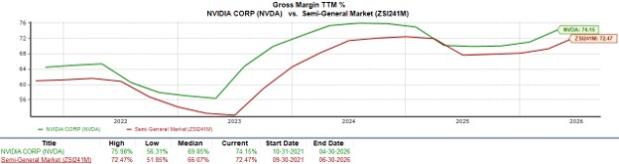
Nvidia's profitability will also be closely scrutinized. Management guided for a 75% non-GAAP gross margin, plus or minus 50 basis points, essentially matching the 75% achieved during Q1.
That stability is important as investors assess higher memory and component costs associated with increasingly sophisticated AI systems. Some analysts expect modest pressure during the Rubin transition, but maintaining gross margins in the mid-70% range would reinforce Nvidia's enormous pricing power and help alleviate concerns that escalating hardware costs are eating into profitability.
Image Source: Zacks Investment Research
How Much of Nvidia's Balance Sheet Is Supporting the AI Boom?
Another emerging concern is Nvidia's increasingly aggressive effort to help finance the infrastructure that ultimately purchases its chips.
Most notably, Nvidia has provided up to roughly $105 billion of financial backing tied to an OpenAI data-center project in Ohio and is investing another $1.5 billion in SB Energy to support those efforts. Importantly, the $105 billion figure is a contingent backstop involving certain lease, power, and residual-value obligations rather than an immediate $105 billion cash expenditure.
Nvidia has also teamed with major Wall Street firms on a framework intended to mobilize more than $500 billion of third-party capital for AI infrastructure, which could shift more of the financing burden away from Nvidia itself.
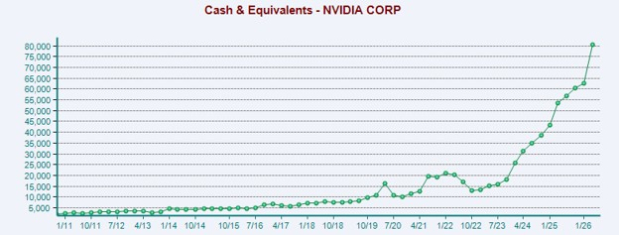
Still, investors have reason to monitor the exposure, even with Nvidia ending Q1 with nearly $80.6 billion in cash and equivalents, while generating an exceptional $50.3 billion of operating cash flow during the quarter.
The balance sheet remains extremely strong, but Wall Street will want greater clarity on how much capital Nvidia ultimately intends to put behind customers and AI infrastructure projects, especially if these commitments keep expanding.
Image Source: Zacks Investment Research
Nvidia's Valuation May Be More Attractive Than It Looks
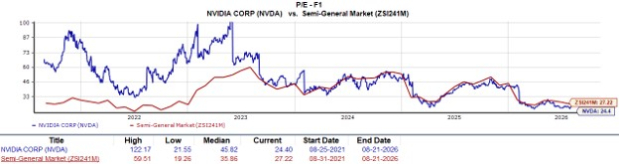
Despite Nvidia's massive market capitalization, its valuation no longer looks particularly excessive relative to its growth rate.
NVDA is trading at 24X forward earnings, near the low end of its five-year P/E valuation range. Furthermore, Nvidia’s PEG ratio is around 0.34 with the optimum level being less than 1.0, meaning investors are paying less than one unit of P/E multiple for each unit of expected earnings growth—a metric that can make Nvidia look surprisingly inexpensive on a growth-adjusted basis.
This valuation disconnect has caught Wall Street's attention. Bank of America BAC) has argued that Nvidia is significantly undervalued compared with other AI-compute names, while Cantor Fitzgerald has similarly suggested the market is failing to fully price in Nvidia's longer-term earnings power.
Of course, PEG ratios become less useful when growth rates are exceptionally high, but Nvidia's combination of nearly triple-digit Q2 earnings growth and a mid-20s forward P/E certainly makes its valuation harder to characterize as expensive.
Image Source: Zacks Investment Research
Bottom Line: Is NVDA Stock a Buy Before Earnings?
Nvidia still has plenty to prove when it reports Wednesday. Investors will want another strong quarter, an encouraging Vera Rubin ramp, resilient gross margins, and reassurance that the company's expanding AI-financing ambitions won't create unnecessary balance-sheet risk.
That said, a 24X forward P/E looks increasingly compelling if Nvidia can sustain even a fraction of its current earnings growth rate. The long-term AI investment thesis remains strong, although elevated expectations could produce significant post-earnings volatility even if results exceed consensus estimates.
For now, NVDA lands a Zacks Rank #3 (Hold), suggesting investors may want to maintain existing positions while looking for Wednesday's report to provide the next catalyst for a more bullish stance.
Beyond Nvidia: AI's Second Wave Is Here
The AI revolution has already minted millionaires. But the stocks everyone knows about aren't likely to keep delivering the biggest profits. AI’s second wave is moving from infrastructure to implementation and these companies are at the forefront of this transition, positioned to become what Amazon and Google were to the internet era.
See Stocks Now >>Want the latest recommendations from Zacks Investment Research? Today, you can download 7 Best Stocks for the Next 30 Days. Click to get this free report
NVIDIA Corporation (NVDA): Free Stock Analysis Report
Bank of America Corporation (BAC): Free Stock Analysis Report
Microsoft Corporation (MSFT): Free Stock Analysis Report
Oracle Corporation (ORCL): Free Stock Analysis Report
Alphabet Inc. (GOOGL): Free Stock Analysis Report
Nebius Group N.V. (NBIS): Free Stock Analysis Report
CoreWeave Inc. (CRWV): Free Stock Analysis Report
This article originally published on Zacks Investment Research (zacks.com).