

Eli Lilly LLY remains heavily reliant on its GLP-1 franchise, but oncology is becoming a more meaningful secondary growth engine. The company generated $4.84 billion in oncology revenues in the first half of 2026, up 11% year over year, with U.S. sales rising to $2.70 billion and ex-U.S. sales reaching $2.14 billion. Verzenio, approved for breast cancer, remained the largest contributor at $2.78 billion, up 5%, while other oncology products collectively generated $2.06 billion, up 20%. The faster growth beyond Verzenio indicates that Lilly’s oncology franchise is gradually becoming broader and less dependent on its flagship product.
The key opportunity is the growing contribution from newer medicines. BTK inhibitor Jaypirca generated $357 million in first-half sales, up 66%, driven by increasing use in chronic lymphocytic leukemia (CLL) and mantle cell lymphoma. The drug also received European Commission approval in the second quarter as a monotherapy for adults with CLL across all lines of therapy, expanding its addressable market. Inluriyo, Lilly’s newer breast cancer therapy, contributed $110 million in the first half following its U.S. launch in late 2025, providing another source of incremental growth. Inluriyo/imlunestrant is also currently under phase III development for adjuvant breast cancer.
Lilly’s oncology pipeline also offers several avenues for future growth. Retevmo (selpercatinib), a RET inhibitor approved for RET-driven cancers, is also being evaluated in a phase III study as an adjuvant treatment for patients with early-stage RET fusion-positive non-small cell lung cancer (NSCLC). Treatment with the drug in the NSCLC study showed an 83% reduction in the risk of disease recurrence or death, which could potentially expand Retevmo’s use into earlier-stage disease if approved.
Lilly is also strengthening its blood-cancer pipeline through acquisitions. The acquisition of Ajax Therapeutics added AJ1-11095, a first-in-class type II JAK2 inhibitor in early-stage development for patients with myelofibrosis previously treated with a type I JAK2 inhibitor, with potential development in polycythemia vera as well. Lilly’s acquisition of Kelonia added an investigational early-stage in vivo CAR-T therapy targeting BCMA for relapsed or refractory multiple myeloma. Both acquisitions were completed in the second quarter of 2026.These deals expand Lilly’s presence in hematologic cancers and add clinical-stage assets that could support longer-term oncology growth.
Taken together, Lilly’s first-half performance supports a positive but measured outlook for oncology. Although still smaller than its GLP-1 franchise, the growing contribution from Jaypirca, Inluriyo and pipeline assets could make oncology an increasingly important growth driver.
LLY Faces Strong Competition in Oncology
AstraZeneca AZN remains one of Lilly’s strongest oncology competitors, with $14.1 billion of oncology revenues in the first half of 2026, up 15% at constant exchange rates. Tagrisso, approved for EGFR-mutated NSCLC, generated $3.8 billion during this period, while other key oncology drugs, including Lynparza, Imfinzi, Calquence and Enhertu (in partnership with Daiichi Sankyo), also contributed to AZN’s top line.
Merck MRK generated $19.53 billion in oncology revenues in the first half of 2026, with its blockbuster PD-L1 inhibitor Keytruda and Keytruda Qlex contributing $16.4 billion, up 8% year over year. Growth was supported by increasing use across its approved indications. Welireg, approved for certain advanced cancers, added $470 million, up 57%, providing another fast-growing oncology asset. Merck’s oncology alliance revenues from the sale of products such as Lynparza, Reblozyl and Lenvima also contributed to the company’s top line.
Pfizer PFE generated $7.99 billion in oncology revenues in the first half of 2026, up about 6% year over year. Ibrance, approved for breast cancer, remained the largest contributor at $2.07 billion, while Padcev, approved for urothelial cancer and muscle-invasive bladder cancer, and Lorbrena, approved for NSCLC, also posted growth. Other key contributors include Xtandi, Inlyta, Adcetris and Braftovi/Mektovi.
LLY’s Price Performance, Valuation and Estimates
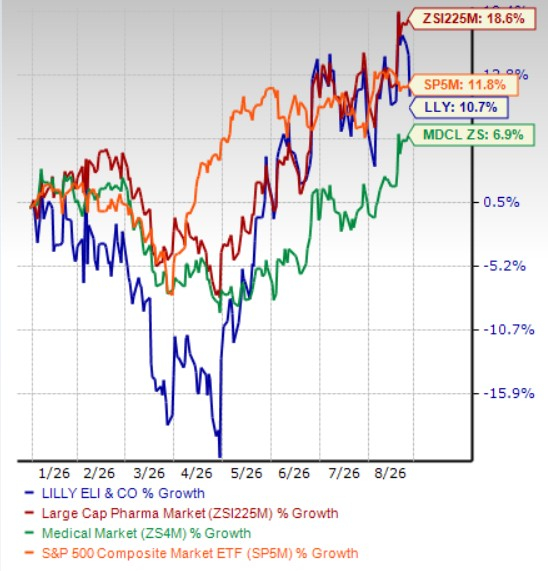
Lilly stock has risen 10.7% so far this year compared with the industry’s growth of 18.6%. During the same time frame, the company has outperformed the sector, but underperformed the S&P 500, as seen in the chart below.
LLY Stock Price Movement
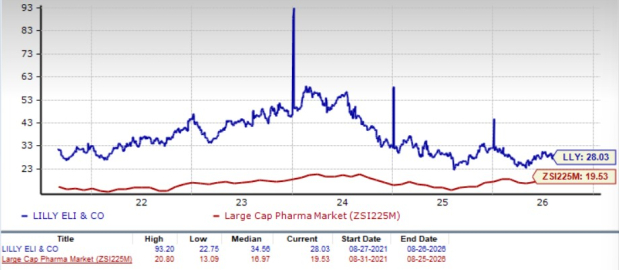
From a valuation standpoint, Lilly stock is expensive. Going by the price/earnings ratio, the company’s shares currently trade at 28.03 forward earnings, higher than 19.53 for the industry. However, the stock is trading below its five-year mean of 34.56.
LLY Stock Valuation
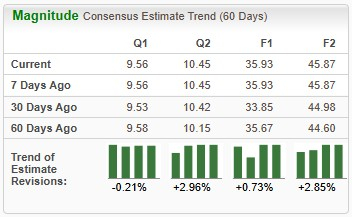
The Zacks Consensus Estimate for 2026 earnings per share has risen from $33.85 to $35.93 over the past 30 days, while that for 2027 has risen from $44.98 to $45.87.
LLY Estimate Movement
LLY has a Zacks Rank #3 (Hold) at present. You can see the complete list of today’s Zacks #1 Rank (Strong Buy) stocks here.
7 Best Stocks for the Next 30 Days
Just released: Experts distill 7 elite stocks from the current list of 220 Zacks Rank #1 Strong Buys. They deem these tickers "Most Likely for Early Price Pops."
Since 1988, the full list has beaten the market more than 2X over with an average gain of +23.9% per year. So be sure to give these hand picked 7 your immediate attention.
See them now >>Want the latest recommendations from Zacks Investment Research? Today, you can download 7 Best Stocks for the Next 30 Days. Click to get this free report
Eli Lilly and Company (LLY): Free Stock Analysis Report
AstraZeneca PLC (AZN): Free Stock Analysis Report
Pfizer Inc. (PFE): Free Stock Analysis Report
Merck & Co., Inc. (MRK): Free Stock Analysis Report
This article originally published on Zacks Investment Research (zacks.com).