


PrimeEnergy Resources Corporation PNRG has rallied 23.8% over the past year, significantly outperforming the industry composite’s 18.1% return. Among its upstream peers, CNX Resources CNX has advanced 11.6%, while Venture Global, Inc. VG has declined 1.4% over the same period. PNRG has also comfortably outpaced the S&P 500’s 15.1% return.
Image Source: Zacks Investment Research
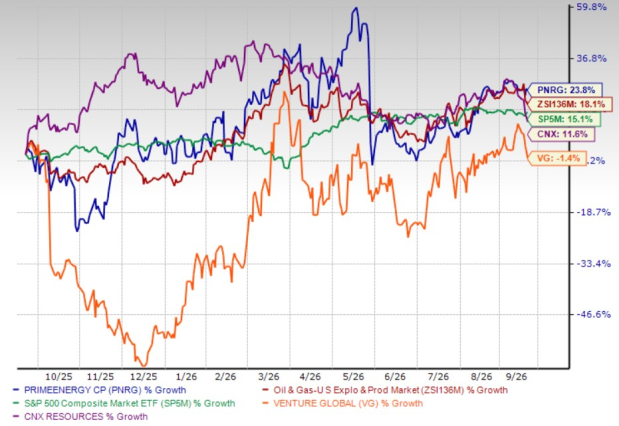
Given the sharp rise in the upstream energy player’s shares, investors may be wondering what to do next. Before concluding, it is worth taking a closer look at PrimeEnergy’s production outlook, commodity-price exposure, financial position and valuation.
New Wells Could Drive PrimeEnergy’s Production Recovery
PNRG’s ongoing development program provides a potential catalyst for production growth toward the end of 2026. In the second quarter, oil production declined 31.5% year over year to 411,000 barrels, although stronger realized pricing helped cushion the impacts on revenues.
During the quarter, drilling began on 24 horizontal wells in Martin and Upton Counties, with first production expected in the fourth quarter of 2026. The 12 Upton County wells carry an average 41.8% ownership interest and an estimated investment of $34.1 million. PrimeEnergy is also participating in 12 Martin County wells, with its investment of roughly $120,000 primarily intended to provide additional geological and production data.
For 2026, the company expects to invest $52 million in 28 horizontal wells. This would bring cumulative horizontal-development spending during 2024-2026 to $261 million, largely focused on the Midland Basin.
PrimeEnergy also estimates that its 16,998 gross acres in the Permian Basin could accommodate as many as 100 additional horizontal wells. The combination of new production expected in the fourth quarter and a sizable drilling inventory provides scope for further volume growth if commodity prices and drilling economics remain favorable.
Strong Oil Prices Support PNRG’s Revenue Outlook
PrimeEnergy’s second-quarter results highlighted its significant exposure to oil prices. The company’s realized oil price increased to $98.85 per barrel from $56.96 a year earlier. As a result, oil revenues climbed to $40.6 million from $34.2 million despite the sharp decline in oil volumes.
Natural gas remained a notable headwind. Permian takeaway constraints pushed PrimeEnergy’s realized natural gas price to negative $3.53 per Mcf, resulting in $9.2 million in negative gas revenues during the quarter.
Even with this pressure, second-quarter net income increased to $6.5 million from $3.2 million, underscoring the positive impacts of stronger oil realizations on overall profitability.
The broader industry backdrop could remain supportive. The U.S. Energy Information Administration expects Brent crude prices to average $90 per barrel during the second half of 2026. Meanwhile, additional Permian gas-pipeline capacity could gradually ease regional transportation bottlenecks. The Hugh Brinson pipeline began interstate shipments in June 2026 and is expected to ramp up through early 2027.
Although stronger takeaway capacity does not guarantee a quick recovery in PrimeEnergy’s natural gas realizations, reduced infrastructure constraints could help moderate one of the company’s largest recent revenue headwinds.
Strong Liquidity Gives PrimeEnergy Financial Flexibility
PrimeEnergy is funding this development cycle from a comparatively strong financial position. Cash increased from $7.4 million at the end of 2025 to $28.7 million as of June 30, 2026, while the company had no outstanding bank debt. After the August borrowing-base reset, it retained $105 million in unused credit availability. First-half operating cash flow also rose to $31.5 million from $29.9 million despite lower first-half net income, strengthening internally generated funding capacity.
That liquidity gives PrimeEnergy room to pursue its $52-million 2026 horizontal program while continuing capital returns. With no bank debt currently consuming balance-sheet capacity, capital can be directed toward drilling opportunities and selective repurchases rather than deleveraging. If the planned wells translate into incremental production and cash flow, the combination of asset growth and a lower share count could enhance the per-share financial benefit of that development program.
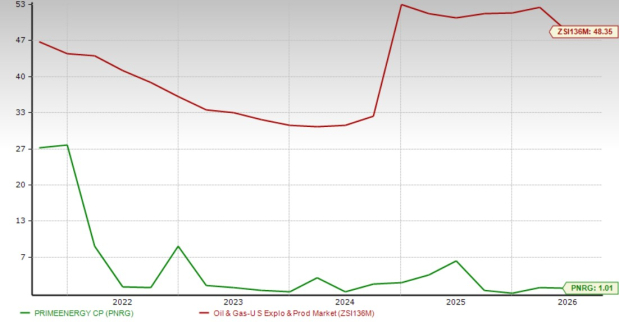
Investors should note that PNRG’s debt-to-capitalization ratio of 1.01% is substantially lower than the industry average of 48.35%.
Image Source: Zacks Investment Research
Is PrimeEnergy Resources Corporation Stock Cheap?
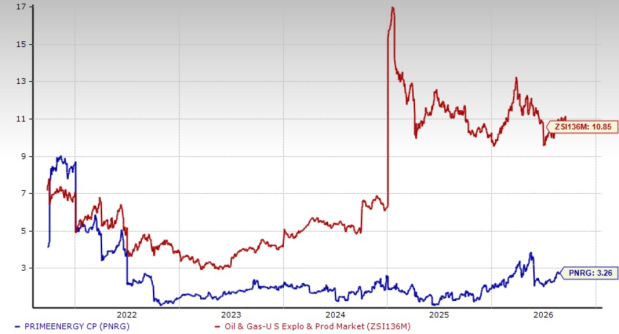
From a valuation perspective, PNRG trades at a trailing 12-month EV/EBITDA multiple of 3.26X, substantially below the broader industry average of 10.85X.
The discount likely reflects factors such as commodity-price volatility, production uncertainty and the company’s exposure to weak Permian natural gas realizations. Still, the relatively low multiple could become more attractive if PrimeEnergy delivers the expected production increase from its new wells and maintains strong oil-driven cash flows.
Image Source: Zacks Investment Research
Should Investors Invest in PNRG Stock Now?
PrimeEnergy has several factors working in its favor. New horizontal wells scheduled to begin production in the fourth quarter provide a potential volume catalyst, while strong oil realizations have supported profitability despite lower production. A debt-free balance sheet and ample liquidity strengthen the company’s financial position. PNRG’s discounted EV/EBITDA valuation also provides some support to the investment case.
However, the stock has already gained 23.8% in three months, meaning some optimism surrounding the upcoming production ramp may already be reflected in the share price. PrimeEnergy also remains highly exposed to commodity-price fluctuations, while weak Permian natural gas pricing continues to present a meaningful risk.
Given these factors, investors already owning PNRG may consider holding their positions while monitoring the fourth-quarter production ramp-up. New investors may prefer to wait for clearer evidence that the new wells are translating to sustainable production and cash-flow growth before taking a position.
Beyond Nvidia: AI's Second Wave Is Here
The AI revolution has already minted millionaires. But the stocks everyone knows about aren't likely to keep delivering the biggest profits. AI’s second wave is moving from infrastructure to implementation and these companies are at the forefront of this transition, positioned to become what Amazon and Google were to the internet era.
See Stocks Now >>Want the latest recommendations from Zacks Investment Research? Today, you can download 7 Best Stocks for the Next 30 Days. Click to get this free report
PrimeEnergy Corporation (PNRG): Free Stock Analysis Report
CNX Resources Corporation. (CNX): Free Stock Analysis Report
Venture Global, Inc. (VG): Free Stock Analysis Report
This article originally published on Zacks Investment Research (zacks.com).