


With rapid growth in food delivery and e-commerce and the need for lower delivery costs, demand for autonomous delivery is gradually advancing. Amid such a market scenario, firms like Serve Robotics Inc. SERV and Symbotic Inc. SYM are benefiting immensely, even if the market is still in its early stages.
Serve Robotics operates autonomous sidewalk delivery robots for food, healthcare and future package-delivery applications, while strategically expanding its fleet, geographic footprint, software monetization capabilities and multi-domain autonomy platform. Meanwhile, Symbotic specializes in AI-powered warehouse automation, combining robotic systems with proprietary software to orchestrate inventory movement, routing and fulfillment.
Let’s compare the fundamentals of the two robotics stocks to determine which one is a better investment now.
The Case for Serve Robotics Stock
Serve Robotics is emerging as an early pure-play player in autonomous last-mile delivery. It has established meaningful commercial scale, with more than 2,000 sidewalk robots deployed across 44 U.S. cities, alongside more than 100 Moxi hospital robots following its Diligent Robotics acquisition. The company reported more than 1.8 million combined sidewalk and hospital deliveries and a 99.8% completion rate, highlighting the operational data generated from real-world deployments. During the second quarter of 2026, fleet services revenues reached $2.31 million, up from $330,000 a year earlier, while software services climbed to $933,000 from $312,000.
Meanwhile, DoorDash-related revenues grew nearly 50% sequentially as of the second quarter of 2026 and management expects to announce another major delivery marketplace partner. Serve Robotics is also expanding into laundry, grocery and healthcare applications. This broader mix could help offset Uber-related weakness while increasing utilization opportunities for its growing autonomous fleet. SERV is also developing an end-to-end Physical AI platform spanning perception, localization, planning, connectivity and fleet management. Its Beacon product could expand the addressable merchant base by eliminating Wi-Fi, POS and integration requirements. Management estimates roughly two-thirds of delivery orders in its operating areas currently face back-end integration barriers, giving Beacon significant potential to unlock additional demand.
Additionally, SERV’s balance sheet provides substantial financial flexibility as it invests in autonomy, software and fleet utilization. Management is simultaneously implementing tighter cost controls following the reduction in its revenue outlook. Full-year 2026 non-GAAP operating expense guidance was lowered to $140-$150 million from $160-$170 million, while capital-expenditure guidance was reduced to $15-$17 million from approximately $25 million. This combination of liquidity and lower planned spending gives Serve Robotics additional runway to develop its next-generation autonomy platform while pursuing higher-utilization partnerships.
However, despite its strong revenue growth, the company is facing significant near-term execution and profitability challenges. The reduction in 2026 revenue guidance to $9-$10 million from $26 million reflects the removal of the expected second-half Uber Eats volume ramp after delivery activity declined in the second quarter of 2026. Moreover, cash consumption and dilution remain concerns. Operating cash burn reached $84.7 million in the first half of 2026, while shares outstanding increased about 16% from year-end 2025 to 86.5 million by June 30, 2026. Thus, substantial liquidity may be needed to fund continued investment before the business reaches sustainable profitability.
The Case for Symbotic Stock
Symbotic's $22.5 billion contracted backlog, as of the third quarter of fiscal 2026, provides substantial visibility into future growth, particularly as it expands its customer base and deployment footprint. The backlog remains supported by blue-chip customers across grocery, general merchandise, food and beverage, healthcare and other verticals. Importantly, the backlog does not include Walmart's planned 400-store back-of-store opportunity, providing potential incremental upside if the rollout progresses. The company's business model also extends beyond upfront system sales, with 15-year contracts generating recurring software, maintenance, parts and services revenues after systems become operational.
SYM has multiple avenues to expand beyond its established distribution-center automation business. The company estimates more than $500 billion of annual warehouse-as-a-service opportunity, $432 billion of potential one-time system sales and recurring software in operator-owned warehouses, and more than $300 billion of U.S. micro-fulfillment opportunities. Its technology platform is also expanding into back-of-store automation, case-to-each fulfillment through BreakPack, perishables, healthcare and third-party logistics. The next-generation storage structure could further improve economics through higher storage density, faster bot travel and quicker installation, potentially supporting margin expansion as adoption increases.
Meanwhile, Exol/GreenBox provides an as-a-service model, while ARMS and Fox Robotics broaden Symbotic's software and robotics offerings. The company's 650+ issued patents, 1,000+ issued or pending patents and $1 billion-plus cumulative R&D investment further support its technology differentiation and long-term expansion potential. The tailwinds benefited SYM, demonstrating strong operating momentum, with the third quarter of fiscal 2026 revenues rising 21.7% year over year to $720.8 million, while adjusted EBITDA more than doubled to $95.2 million from $45.4 million. Management expects fourth quarter of fiscal 2026 revenues of $760-$780 million and adjusted EBITDA of $100-$105 million, supporting continued profitable growth.
However, customer concentration remains a major concern, particularly its dependence on Walmart, which represents a significant portion of the business and could expose Symbotic to delays, order changes or slower adoption. It is also facing cash-flow volatility and execution risks associated with large, complex automation deployments. The $22.5 billion backlog is not immune to execution, timing and cancellation risks, and revenue recognition can be lumpy based on deployment schedules. Symbotic operates in a rapidly evolving automation market with increasing competition and technology changes, creating risks around product development, customer adoption and pricing.
Stock Performance & Valuation
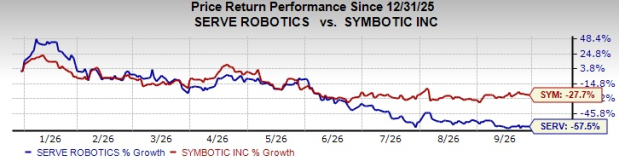
As witnessed from the chart below, year to date, shares of Symbotic have outperformed those of Serve Robotics, even though both of them reflect a declining trend.
Image Source: Zacks Investment Research
Considering valuation, over the last three years, Serve Robotics has been trading above Symbotic on a forward 12-month price-to-sales (P/S) ratio basis.
Image Source: Zacks Investment Research
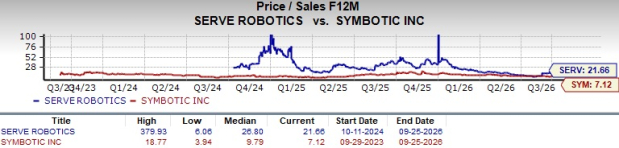
Overall, from these technical indicators, it can be deduced that SERV stock offers a declining trend but with a premium valuation, while SYM stock offers a diminishing growth trend with a discounted valuation.
Comparing EPS Estimate Trends: SERV vs. SYM
The Zacks Consensus Estimate for SERV’s bottom line for 2026 and 2027 indicates losses per share of $2.71 and $2.22, respectively, which have widened over the past 60 days. The estimated figures for 2026 imply a year-over-year decline of 66.3%, while the same for 2027 indicates year-over-year improvement of 18.2%.
SERV's EPS Trend
Image Source: Zacks Investment Research

The Zacks Consensus Estimate for SYM’s fiscal 2026 and fiscal 2027 earnings has trended upward over the past 60 days to 58 cents and 75 cents per share, respectively. The estimated figures for fiscal 2026 imply a year-over-year decline of 68.1%, while the same for fiscal 2027 indicates year-over-year growth of 28.5%.
SYM's EPS Trend
Image Source: Zacks Investment Research

Return on Equity (ROE) of SERV & SYM Stocks
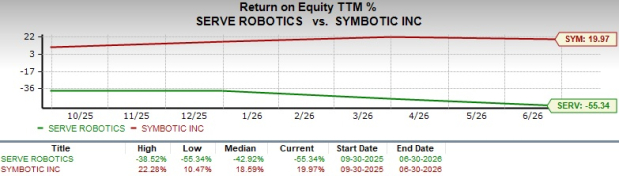
Symbotic’s trailing 12-month ROE of 20% significantly exceeds Serve Robotics negative average, underscoring its efficiency in generating shareholder returns.
Image Source: Zacks Investment Research
Should You Invest in SERV Stock or SYM Stock?
Serve Robotics and Symbotic are benefiting from increasing adoption of autonomous robotics, but their financial profiles differ considerably.
Serve Robotics is expanding its autonomous delivery platform, with more than 2,000 sidewalk robots across 44 U.S. cities and more than 100 Moxi hospital robots. However, SERV cut 2026 revenue guidance to $9-$10 million from $26 million, while first-half operating cash burn reached $84.7 million. Consensus estimates project losses of $2.71 and $2.22 per share for 2026 and 2027, respectively.
Meanwhile, Symbotic offers greater scale and visibility, supported by a $22.5 billion contracted backlog and recurring revenue opportunities from 15-year service contracts. Fiscal third-quarter revenues rose 21.7% year over year to $720.8 million, while adjusted EBITDA more than doubled to $95.2 million. SYM also has positive earnings estimates of 58 cents and 75 cents for fiscal 2026 and 2027, respectively.
Both robotics stocks currently carry a Zacks Rank #3 (Hold), making growth, profitability and execution key differentiators. Thus, based on backlog visibility, profitability, earnings revisions and ROE, SYM stock appears to be better positioned, as SERV stock offers higher-risk exposure to the emerging autonomous-delivery market. You can see the complete list of today’s Zacks #1 Rank (Strong Buy) stocks here.
Beyond Nvidia: AI's Second Wave Is Here
The AI revolution has already minted millionaires. But the stocks everyone knows about aren't likely to keep delivering the biggest profits. AI’s second wave is moving from infrastructure to implementation and these companies are at the forefront of this transition, positioned to become what Amazon and Google were to the internet era.
See Stocks Now >>Want the latest recommendations from Zacks Investment Research? Today, you can download 7 Best Stocks for the Next 30 Days. Click to get this free report
Serve Robotics Inc. (SERV): Free Stock Analysis Report
Symbotic Inc. (SYM): Free Stock Analysis Report
This article originally published on Zacks Investment Research (zacks.com).