


Novo Nordisk NVO and Viking Therapeutics VKTX both operate in the obesity-treatment market.
Novo Nordisk is recognized as a leader in the GLP-1 treatment space, marketing its semaglutide drugs under the brands Ozempic (injection and oral pill) and Rybelsus (pill) for type II diabetes (T2D) and Wegovy (injection and pill) for chronic weight management.
In contrast, Viking is a clinical-stage biotech developing its investigational dual GIP and GLP-1 receptor agonist, VK2735, as both oral and injectable formulations across separate late-stage studies.
Although this comparison seems uneven given the stark contrast in size and commercial maturity between the two companies, they offer investors two distinct ways to capitalize on the growing obesity-treatment market. Per research conducted by Goldman Sachs, global sales of obesity drugs are projected to reach $114 billion by 2030, with oral medications expected to account for 40% of the market.
Let's examine the fundamentals of the two stocks to make a prudent choice.
The Case for NVO
Novo Nordisk’s leading position in diabetes care provides a strong foundation for future growth.
The Wegovy products are a key contributor to the company's topline. In the first half of 2026, reported sales of the injectable formulation rose 12% at constant exchange rates (CER), benefiting from volume growth. The Wegovy pill has provided an incremental boost to the franchise, with prescriptions reaching around 2.9 million in the second quarter and exceeding 5 million since its U.S. launch in January. The oral Wegovy opportunity is also expanding internationally, with approvals secured in the UAE and Europe following its U.S. launch, while additional launches are planned in selected markets. Alongside Wegovy pill, Novo Nordisk launched the Ozempic pill in the United States in May, further expanding its oral semaglutide offering for people with T2D.
Semaglutide-based medications have also demonstrated benefits beyond blood sugar control and weight loss, including reducing cardiovascular (CV) risk and improving kidney disease outcomes. These additional indications could significantly expand the addressable market for Novo Nordisk's therapies over time.
Beyond its existing products, NVO continues to invest heavily in next-generation obesity and metabolic disease therapies. A regulatory filing is currently under FDA review for CagriSema, a once-weekly treatment that combines semaglutide with cagrilintide, a long-acting amylin receptor agonist. A final decision is expected before this year’s end. The company is also expanding its obesity pipeline through external opportunities. Last month, it entered into an exclusive licensing agreement with China-based Hengrui Pharma for a phase I-ready GLP-1/GIP dual receptor agonist designed for once-weekly oral dosing. This agreement has a potential total value of up to $2.6 billion.
Novo Nordisk is also seeking to diversify beyond its diabetes franchise by expanding its Rare Disease portfolio. Regulatory filings for denecimig (Mim8) to treat hemophilia A are currently under review in the United States and the EU. Another important candidate in the company’s pipeline is the once-daily oral etavopivat, which is being developed for sickle-cell disease (SCD) and thalassemia. Following positive phase III results in SCD, NVO expects to submit its regulatory filing with the FDA for the indication in the fourth quarter of 2026.
However, Novo Nordisk’s biggest challenge is Eli Lilly LLY, a formidable competitor across several key markets. Lilly markets its tirzepatide injections under the brand name Mounjaro for T2D and Zepbound for obesity. Both products have gained traction, intensifying competitive pressure on Ozempic and Wegovy injections. The competition has also expanded into oral obesity treatments. Lilly launched Foundayo in the United States in April 2026. Unlike oral Wegovy, Foundayo can be taken without food or water restrictions, giving Lilly a dosing-convenience advantage.
The Case for VKTX
Viking is one of the handful of biotech stocks that have shown immense potential in this space. VK2735 has shown blockbuster potential, having demonstrated superior weight reduction capabilities in clinical studies as both a subcutaneous (SC) injection and an oral pill.
The company is conducting two phase III studies — VANQUISH-1 and VANQUISH-2 — evaluating VK2735 SC for 78 weeks. VANQUISH-1 is evaluating the drug in adults without type II diabetes (T2D) who have obesity or are overweight with at least one weight-related co-morbid condition. VANQUISH-2 is assessing its efficacy in obese or overweight adults with T2D. Data from these studies are not expected before 2027.
Recently, the company initiated a late-stage program on oral VK2735, dubbed SUNRISE, which comprises two studies evaluating the drug in adults who are overweight or obese, both with and without T2D. These studies broadly follow the framework of the VANQUISH studies but are smaller in scale and shorter in duration.
Beyond developing oral and injectable formulations of VK2735, Viking is also exploring strategies to support long-term weight maintenance. Last month, Viking reported encouraging results from the first part of its VK2735 maintenance study, showing that participants preserved most of their weight loss from the induction phase even when dosing frequency was materially reduced. Data showed that participants who moved to every-other-week dosing maintained an average of 90% of their earlier weight loss, while those who switched to monthly dosing maintained an average of 85%.
Building on these results, Viking recently initiated the second part of its maintenance study to evaluate oral VK2735 as a potential option for maintaining weight loss. The study will assess whether weight loss achieved with weekly VK2735 SC can be maintained using oral tablets or less frequent injections. An update on this study is expected next year.
Viking is also broadening its obesity pipeline beyond VK2735. In June, the company initiated a phase I study of VK3019, an investigational dual amylin and calcitonin receptor agonist. Management believes therapies targeting these receptors could be used alone or in combination with GLP-1 or dual GLP-1/GIP agonists to improve weight-loss induction and support longer-term weight management.
Yet, Viking's biggest challenge lies in its lack of an approved product in its portfolio and the intense competition from pharma giants that already dominate the obesity landscape.
How Do Estimates Compare for NVO & VKTX?
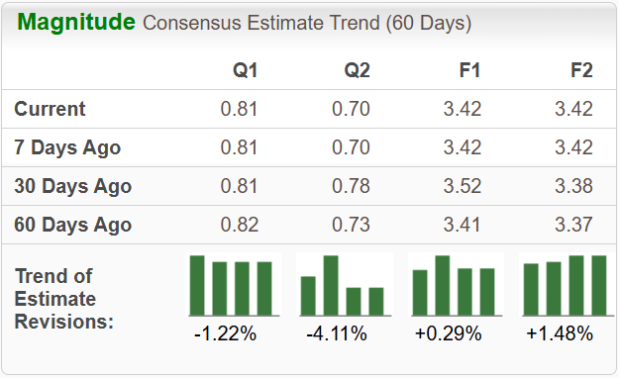
The Zacks Consensus Estimate for Novo Nordisk’s 2026 sales and earnings per share (EPS) implies a year-over-year decrease of roughly 3% and 14%, respectively. While EPS estimates for 2026 have declined over the past 30 days, those for 2027 have improved during the same period.
Image Source: Zacks Investment Research
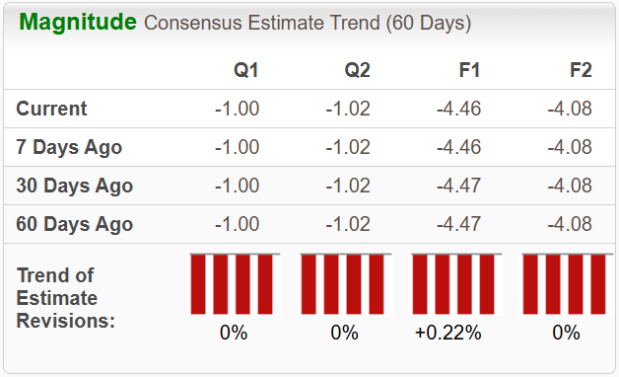
With no marketed product generating revenue, Viking Therapeutics is expected to remain loss-making as it advances its clinical programs. We expect Viking’s 2026 loss per share to widen by about 40%. While loss estimates for 2026 have slightly improved in the past 30 days, those for 2027 have remained constant.
Image Source: Zacks Investment Research
Price Performance and Valuation of NVO & VKTX
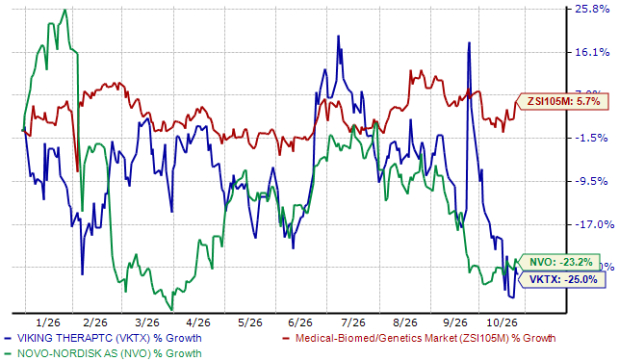
Year to date, shares of NVO have lost about 23%, while those of VKTX have plummeted 25%. In comparison, the industry has gained about 6%, as seen in the chart below.
Image Source: Zacks Investment Research
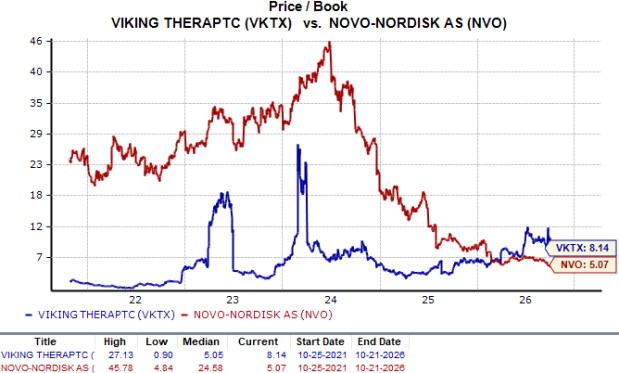
From a valuation standpoint, Viking Therapeutics seems to be more expensive than Novo Nordisk. Going by the price-to-book-value (P/B) ratio, NVO’s shares currently trade at 5.07 times trailing book value, lower than 8.14 times for VKTX.
Image Source: Zacks Investment Research
NVO or VKTX: Which Is a Better Pick?
Both stocks offer exposure to the growing obesity-treatment market, but Viking Therapeutics appears to offer greater potential upside for investors willing to take on higher risk.
While Novo Nordisk has an established product portfolio, it faces intensifying competition from Lilly and pressure on its earnings outlook. Viking, meanwhile, offers a riskier but potentially more rewarding opportunity. With VK2735 advancing into phase III development in both injectable and oral formulations, VKTX has made meaningful clinical progress that supports its growth potential. Given the projected $114 billion obesity-drug market by 2030, even a modest market share could create significant opportunities for the company if its candidates succeed, although clinical and commercial risks remain.
The reported maintenance study results also give VK2735 a potential point of differentiation in the obesity market, as maintaining weight loss with less frequent dosing could offer an advantage for long-term weight management.
The Zacks Rank also favors VKTX, which carries a Zacks Rank #2 (Buy) compared to NVO's #3 (Hold). You can see the complete list of today’s Zacks #1 Rank (Strong Buy) stocks here.
7 Best Stocks for the Next 30 Days
Just released: Experts distill 7 elite stocks from the current list of 220 Zacks Rank #1 Strong Buys. They deem these tickers "Most Likely for Early Price Pops."
Since 1988, the full list has beaten the market more than 2X over with an average gain of +23.9% per year. So be sure to give these hand picked 7 your immediate attention.
See them now >>Want the latest recommendations from Zacks Investment Research? Today, you can download 7 Best Stocks for the Next 30 Days. Click to get this free report
Novo Nordisk A/S (NVO): Free Stock Analysis Report
Viking Therapeutics, Inc. (VKTX): Free Stock Analysis Report
Eli Lilly and Company (LLY): Free Stock Analysis Report
This article originally published on Zacks Investment Research (zacks.com).