

Novo NVO is scheduled to report its third-quarter 2026 results on Nov. 4, 2026, before the opening bell. The Zacks Consensus Estimate for quarterly revenues in the to-be-reported quarter is pegged at $11.39 billion, while the same for earnings is pinned at 81 cents per share.
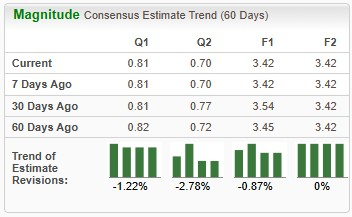
In the past 60 days, the Zacks Consensus Estimate for Novo’s 2026 earnings per share (EPS) has deteriorated from $3.45 to $3.42. During the same time frame, the company’s 2027 EPS forecast has remained constant at $3.42.
NVO Estimate Movement
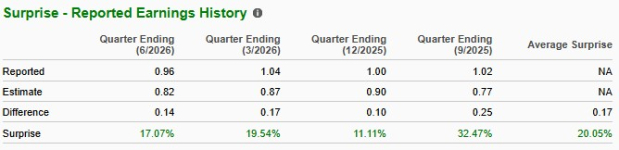
NVO’s Earnings Surprise History
Novo has an impeccable performance history over the trailing four quarters, with earnings beating estimates each time. On average, Novo registered an earnings surprise of 20.05% in the trailing four quarters. In the last reported quarter, the company reported an earnings surprise of 17.07%.
What Does Our Model Say?
Per our proven model, companies with the combination of a positive Earnings ESP and a Zacks Rank #1 (Strong Buy), 2 (Buy) or 3 (Hold) have a good chance of delivering an earnings beat, which is not the case for NVO, as you will see below. You can uncover the best stocks to buy or sell before they’re reported with our Earnings ESP Filter.
Novo has an Earnings ESP of 0.00% and a Zacks Rank #3 at present. You can see the complete list of today’s Zacks #1 Rank stocks here.
Factors Shaping NVO’s Upcoming Results
Novo operates under two segments — Diabetes and Obesity Care and Rare disease.
Novo’s third-quarter revenues are expected to have been driven by sales of its diabetes and obesity treatments, particularly semaglutide-based (GLP-1) drugs — Ozempic (for type II diabetes [T2D]) and Wegovy (for obesity).
Since launch, Novo has steadily expanded the commercial opportunity for both Ozempic and Wegovy through multiple label expansions. Investors will be most interested in the sales numbers for these two drugs when Novo reports third-quarter 2026 results.
Novo has also broadened its oral semaglutide franchise. Following FDA approval in late December 2025, the oral Wegovy pill became available in the United States in early January 2026, offering a more convenient alternative to injectable treatment. The pill has demonstrated strong early uptake, with Novo reporting more than five million U.S. prescriptions in approximately 30 weeks after launch. In July 2026, Wegovy pill received European regulatory approval for obesity, following launches in the UAE in June and the United Kingdom in early July. These international launches likely contributed to additional sales growth in the to-be-reported quarter. In late September, the Wegovy pill was launched in Germany, with additional launches planned across select markets in the coming quarters.
Beyond obesity, Novo is expanding its diabetes portfolio with oral semaglutide. The FDA approved the Ozempic tablet brand in February 2026, and Novo made the pills available in the United States in May for adults with T2D, including those at high cardiovascular risk. The launch offers an additional growth opportunity, with investors keen to assess early uptake when Novo reports third-quarter results. Novo continues to generate meaningful revenues from Rybelsus, its oral semaglutide therapy for T2D, although the company reports Ozempic pill and Rybelsus sales together.
Despite raising its 2026 outlook following the second quarter, Novo still expects adjusted sales and operating profit to range from flat to a 6% decline at CER. This outlook underscores the challenges facing Novo’s GLP-1 franchise, suggesting third-quarter sales growth for Wegovy and Ozempic are likely to have remained under pressure, particularly in the United States amid intensifying competition from arch-rival Eli Lilly LLY. Pricing pressure, weaker prescription trends for its injectable GLP-1 drugs, reduced Medicaid coverage for obesity treatments, and intensifying competition remain significant operational and executional challenges.
Beyond its GLP-1 franchise, Novo's insulin and Rare Disease portfolios are likely to have provided additional support to overall revenues during the period.
NVO’s Stock Price & Valuation
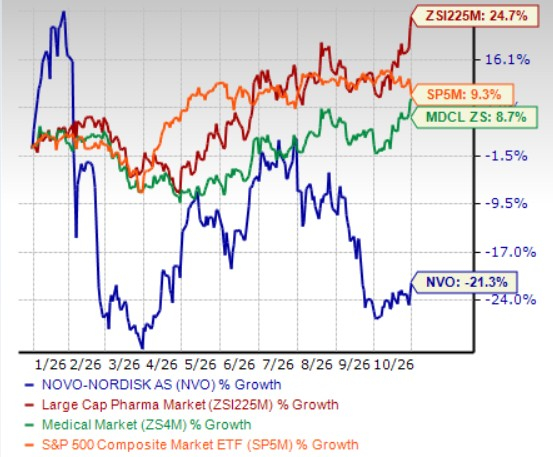
Year to date, Novo shares have lost 21.3% against the industry’s 24.7% growth. The company has also underperformed the sector and the S&P 500 during the same time frame, as seen in the chart below.
NVO Stock Underperforms the Industry, Sector & the S&P 500
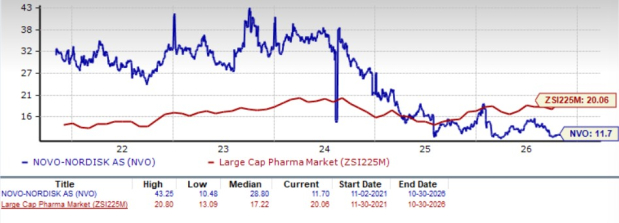
Novo is trading at a discount to the industry, as seen in the chart below. Going by the price/earnings ratio, the company’s shares currently trade at 11.70 forward earnings, which is lower than 20.06 for the industry. The stock is trading much below its five-year mean of 28.80.
NVO Stock Valuation
NVO’s Investment Thesis
Novo has achieved tremendous commercial success with Wegovy and Ozempic injections since their launch. However, the company’s growth trajectory has suffered in the past year.
The biggest challenge facing Novo is the rapid ascent of Eli Lilly in the obesity market. Competition in the obesity treatment space has intensified significantly over the past year, driven by the vast, still-underpenetrated market opportunity. Lilly has emerged as Novo's strongest rival in the diabetes and obesity markets with its tirzepatide-based therapies — Mounjaro for T2D and Zepbound for obesity — which compete directly with Novo's Ozempic and Wegovy, respectively. Despite launching later, Mounjaro and Zepbound have rapidly gained market share in both indications, emerging as Lilly's primary growth drivers while increasing competitive pressure on Novo. LLY’s GLP-1 pill, Foundayo (orforglipron), for obesity now competes directly with Novo’s Wegovy pill.
Last week, Eli Lilly reported impressive third-quarter results, with its GLP-1 franchise continuing to drive strong growth. Mounjaro and Zepbound remained the primary growth engines, benefiting from robust demand across U.S. and international markets. Foundayo also contributed to growth, reflecting encouraging early uptake. Revenues from the newly launched oral GLP-1 drug nearly doubled sequentially in the third quarter, highlighting its growing commercial contribution. Strong volume growth across the franchise more than offset lower realized prices, underscoring the sustained demand for Lilly's diabetes and obesity treatments.
The obesity space has drawn much of the spotlight over the past year because of the sizeable and still underpenetrated market opportunity. Smaller biotech firms, such as Viking Therapeutics VKTX and Structure Therapeutics GPCR, are also advancing GLP-1–based therapies to challenge the incumbents. Viking Therapeutics’ dual GIPR/GLP-1 RA, VK2735, is being developed in both oral and subcutaneous formulations for the treatment of obesity. Viking recently announced initiating the phase III SUNRISE program, comprising two late-stage studies, evaluating oral VK2735 in adults with obesity and in obese or overweight adults with T2D.
Structure Therapeutics’ phase II ACCESS program on its orally administered small molecule GLP-1 RA, aleniglipron, demonstrated significant weight loss across all doses. Based on such encouraging results, Structure Therapeutics has initiated dosing patients in its late-stage ACCOMPLISHprogram to evaluate aleniglipron for chronic weight management.
Beyond its existing products, NVO continues to invest heavily in next-generation obesity and metabolic disease therapies. A regulatory filing is currently under FDA review for CagriSema, a once-weekly treatment that combines semaglutide with cagrilintide, a long-acting amylin receptor agonist. A final decision is expected before this year’s end. The company is also expanding its obesity pipeline through external opportunities. In September, it entered into an exclusive licensing agreement with China-based Hengrui Pharma for a phase I-ready GLP-1/GIP dual receptor agonist designed for once-weekly oral dosing. This agreement has a potential total value of up to $2.6 billion.
Novo is also seeking to diversify beyond its diabetes franchise by expanding its Rare Disease portfolio. Regulatory filings for denecimig (Mim8) to treat hemophilia A are currently under review in the United States and the EU. Another important candidate in the company’s pipeline is the once-daily oral etavopivat, which is being developed for sickle-cell disease (SCD) and thalassemia. Following positive phase III results in SCD, NVO expects to submit its regulatory filing with the FDA for the indication in the fourth quarter of 2026.
Here's How to Play NVO Stock Before Q3
Ahead of third-quarter results, Novo's near-term outlook remains challenging, with limited earnings visibility, slowing growth in its core GLP-1 franchise and continued market share losses amid intensifying competition from Eli Lilly. Despite raising its 2026 outlook after the second quarter, the company still expects adjusted sales and operating profit to decline by up to 6% at CER. Continued earnings estimate cuts and pricing pressure, particularly in the United States, suggest that a sustained recovery remains elusive. Lilly's impressive third-quarter performance further highlights the competitive challenges facing Novo.
The longer-term outlook also remains uncertain, as Novo needs to demonstrate that its next-generation pipeline can sustain growth beyond the semaglutide franchise. While the oral Wegovy launch and candidates like CagriSema offer growth opportunities, their ability to offset competitive pressure remains uncertain. Given the ongoing business challenges and limited visibility into an earnings recovery, we believe investors should remain on the sidelines ahead of the earnings release.
Radical New Technology Could Hand Investors Huge Gains
Quantum Computing is the next technological revolution, and it could be even more advanced than AI.
While some believed the technology was years away, it is already present and moving fast. Large hyperscalers, such as Microsoft, Google, Amazon, Oracle, and even Meta and Tesla, are scrambling to integrate quantum computing into their infrastructure.
Senior Stock Strategist Kevin Cook reveals 7 carefully selected stocks poised to dominate the quantum computing landscape in his report, Beyond AI: The Quantum Leap in Computing Power .
Kevin was among the early experts who recognized NVIDIA's enormous potential back in 2016. Now, he has keyed in on what could be "the next big thing" in quantum computing supremacy. Today, you have a rare chance to position your portfolio at the forefront of this opportunity.
See Top Quantum Stocks Now >>Want the latest recommendations from Zacks Investment Research? Today, you can download 7 Best Stocks for the Next 30 Days. Click to get this free report
Novo Nordisk A/S (NVO): Free Stock Analysis Report
Eli Lilly and Company (LLY): Free Stock Analysis Report
Viking Therapeutics, Inc. (VKTX): Free Stock Analysis Report
Structure Therapeutics Inc. Sponsored ADR (GPCR): Free Stock Analysis Report
This article originally published on Zacks Investment Research (zacks.com).