


The payments landscape is changing as digital transactions become more common, cross-border spending expands and businesses look for faster, safer ways to move money. Commercial payments, digital wallets and emerging technologies are creating fresh growth opportunities, even as shifting consumer habits and growing competition reshape the industry. Yet, behind every seemingly simple card transaction, the economics can be very different. Some payment companies make money by connecting merchants and banks, while others build their business around owning the customer relationship.
Visa Inc. V and American Express Company AXP represent these two distinct approaches. Visa relies on the reach of its global payments network, rising transaction volumes and expanding payment services without directly taking on consumer lending risk. American Express follows a more customer-focused model, combining premium card memberships, lending and rewards to encourage spending and loyalty. Both are pursuing growth, but their strategies, revenue opportunities and exposure to consumer credit set them apart.
Let’s dive deep and closely compare the fundamentals of the two stocks to determine which stock is more attractive now.
The Case for V
Visa's core strength lies in its extensive global payment network, strong bank and merchant relationships, and ability to process transactions at scale. Its network-based model allows it to benefit from rising digital payments without directly taking on the credit risk associated with card lending. This gives V exposure to consumer spending, cross-border transactions and digital commerce across multiple markets. In the fourth quarter of fiscal 2026, payments volume rose 9% year over year, while processed transactions increased 10%. Cross-border volume, excluding intra-Europe transactions, grew 14% in constant dollars, reflecting continued demand for international payments.
V is also tapping into opportunities beyond traditional card transactions. Its Commercial and Money Movement Solutions business is gaining traction as companies increasingly seek faster and more efficient ways to transfer funds. Revenues from this business grew 16% year over year in constant dollars during the fiscal fourth quarter, while Visa Direct transactions climbed 23%. Expansion into business-to-business payments and real-time money movement could broaden Visa's revenue base.
Another advantage is Visa's growing portfolio of value-added services (VAS), which helps financial institutions and merchants manage fraud, strengthen security and improve payment experiences. Revenues from VAS reached $14 billion in fiscal 2026, growing 30% in constant dollars. Continued investments in cybersecurity, authentication and consulting could strengthen customer relationships and generate additional revenues beyond payment processing. The company expects VAS revenues to grow in the low-to-mid-20s in fiscal 2027.
Visa is also preparing for the next phase of digital commerce through investments in AI-powered payments and stablecoin infrastructure. Its Visa Intelligent Commerce initiative aims to make AI-driven purchases more secure, while stablecoin settlement volume surpassed a $25 billion annualized run rate, growing tenfold year over year. Visa Direct's stablecoin prefunding capabilities have also moved into commercial production. These initiatives could open new opportunities in cross-border payments and digital transactions as adoption expands.
However, rising operating expenses and higher client incentives could weigh on V's profitability. In the fourth quarter of fiscal 2026, adjusted operating expenses increased 12.2% year over year to $4.1 billion, primarily reflecting higher marketing and personnel costs. Client incentives jumped 21% to $5.1 billion amid new partnership agreements. With roughly 25% of payments volume expected to come up for renewal in fiscal 2027, higher incentives could continue to pressure net revenue growth.
The Case for American Express
American Express stands out for its premium customer base, strong brand recognition and integrated payments model. Unlike network-focused competitors, the company combines card issuance, lending and payment processing with a membership ecosystem built around rewards and exclusive benefits. This approach supports customer engagement and multiple revenue streams. In the third quarter of 2026, billed business increased 8% year over year to $454 billion, while revenues rose 9% to $20.1 billion.
Its premium card strategy remains a key growth driver. Net card fee revenues increased 17% on a foreign exchange-adjusted basis during the third quarter, supported by demand for premium products and the refreshed U.S. Platinum Card. About 76% of new card acquisitions came from fee-paying products. AXP is also attracting millennials and Gen Z customers, creating opportunities to build long-term relationships and increase spending as their purchasing power grows.
The company continues to strengthen its merchant network and travel-related offerings to encourage greater card usage. Its global acceptance network has surpassed 190 million merchant locations, improving convenience for cardholders. Partnerships with Marriott and Airbnb further expand its travel ecosystem, supporting customer engagement and reinforcing the appeal of its premium membership offerings.
AXP is also investing in AI to improve customer experiences, strengthen fraud detection and streamline operations, while exploring agentic commerce opportunities that could extend its role beyond traditional card payments. Beyond technology, the company is expanding its commercial payments and financial services capabilities through new corporate card offerings, expense management solutions and business savings products. These initiatives could deepen business relationships and broaden revenue opportunities. However, its greater exposure to lending makes credit quality and funding costs important considerations, particularly during periods of economic weakness.
Rising expenses present additional challenges for AXP. In the third quarter of 2026, consolidated expenses increased 9% year over year to $14.5 billion, reflecting higher customer engagement costs and investments in premium card benefits. Higher rewards costs and growing competition for premium customers could further pressure margins.
How Do Estimates Compare for V & AXP?
The consensus estimates for V’s fiscal 2027 earnings indicate a 13.2% increase from a year ago, while the same for revenues suggests 11.1% growth. It has witnessed 10 positive earnings estimate revisions over the past 30 days against three downward revisions. The company beat earnings in each of the past four quarters with an average surprise of 3.1%.
Visa Inc. Price, Consensus and EPS Surprise
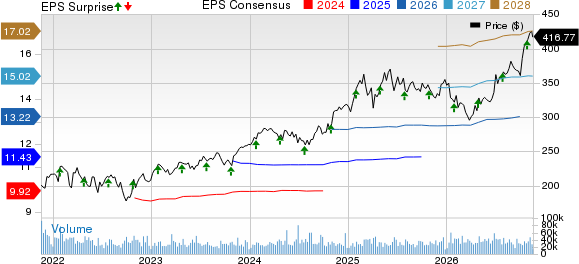
Visa Inc. price-consensus-eps-surprise-chart | Visa Inc. Quote
The Zacks Consensus Estimate for AXP’s 2026 EPS indicates 16.6% year-over-year growth, and the same for revenues signals a 10% rise. It has witnessed seven positive earnings estimate revisions over the past 30 days against one downward revision. For 2027, EPS is expected to climb another 12.5%. The company beat earnings in three of the past four quarters and missed once, with an average surprise of 3.3%.
American Express Company Price, Consensus and EPS Surprise
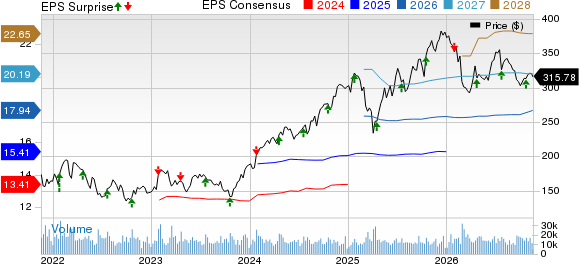
American Express Company price-consensus-eps-surprise-chart | American Express Company Quote
Valuation: V vs. AXP
Visa trades at a premium forward price-to-earnings multiple relative to American Express, reflecting its capital-light structure and lower risk profile. V currently trades at a forward P/E of 27.26X, higher than AXP’s 15.85X. The valuation gap underscores the market’s preference for Visa’s stability and diversified growth drivers.
Image Source: Zacks Investment Research
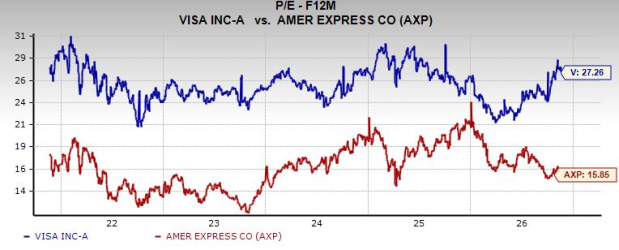
Price Performance Comparison
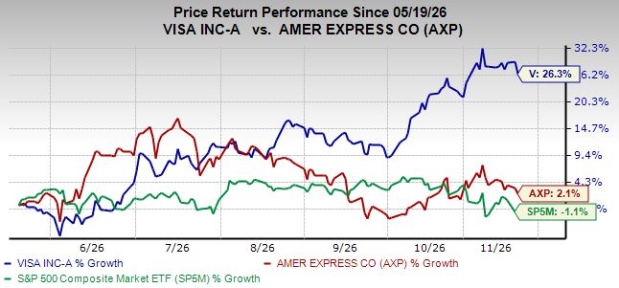
Over the past six months, Visa’s shares have risen 26.3%, outperforming American Express’ growth of 2.1%. The S&P 500 has declined 1.1% during this time.
6M Price Performance – V, AXP & S&P 500
Image Source: Zacks Investment Research
Conclusion
Both Visa and American Express offer solid growth prospects. AXP's premium card strategy and expanding business offerings support growth, rising costs and credit-related risks remain concerns. Meanwhile, Visa's stronger transaction momentum, accelerating adoption of value-added services and expanding money movement capabilities provide greater earnings visibility. Despite near-term expense pressures, its diversified growth opportunities and favorable earnings outlook strengthen its long-term prospects.
As such, V appears to have a better hand at the moment, even though both companies currently carry a Zacks Rank #3 (Hold). You can see the complete list of today’s Zacks #1 Rank (Strong Buy) stocks here.
Discover the Stocks Our Experts Want to Own This Quarter
Each quarter, four Zacks editors compile their favorite stocks into one report. As a sign of the times, three of this quarter's picks can potentially cash in on the massive AI boom. One grew its commercial revenue more than 140% last quarter.
The fourth stock is an online retailer posting its most significant growth since the pandemic. Its shares jumped more than 25% after its last earnings report, then pulled back, giving investors a chance to capitalize on what could be a longer-term bullish trend.
Get Your Free Ultimate Four Report >>Want the latest recommendations from Zacks Investment Research? Today, you can download 7 Best Stocks for the Next 30 Days. Click to get this free report
Visa Inc. (V): Free Stock Analysis Report
American Express Company (AXP): Free Stock Analysis Report
This article originally published on Zacks Investment Research (zacks.com).