


I asked where lumber prices were heading into the 2026 construction season in a February 27, 2026, Barchart article. While seasonality during the construction season starting in spring is a factor, the path of interest rates is a far more critical issue for lumber demand. I wrote:
I am bullish on lumber prices and expect them to break above the first resistance at $618.50, driven by seasonality and the prospects of falling U.S. interest rates.
Don’t Miss a Day: From crude oil to coffee, sign up free for Barchart’s best-in-class commodity analysis.
Physical lumber futures prices have remained below $618.50 per 1,000 board feet since February 27 due to a geopolitical event.
Interest rates have increased after February 28
Crude oil remains the energy commodity that powers the world. After the U.S. and Israel attacked Iran on February 28, and Iran retaliated against Middle Eastern countries and sealed off traffic through the Strait of Hormuz, oil prices soared, and inflationary pressures increased. Long-term U.S. interest rates rose.
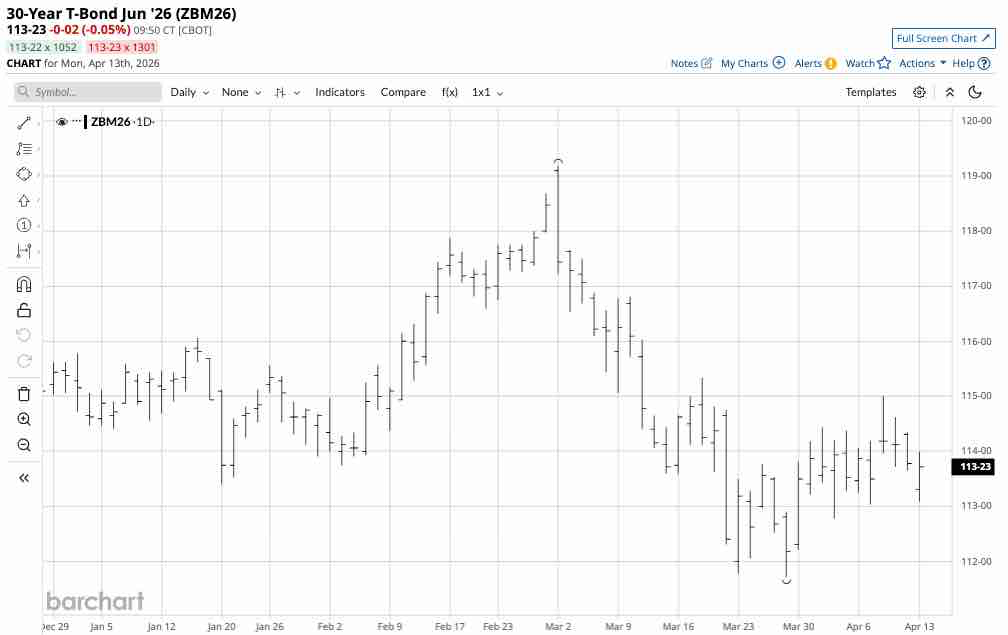
The daily chart of U.S. 30-year Treasury bond futures shows that bond prices fell and interest rates rose after the late February hostilities.
A bearish reversal in the long-term U.S. bond market in March
While the long bond futures fell from late February, they formed a bearish pattern on the monthly chart in March.
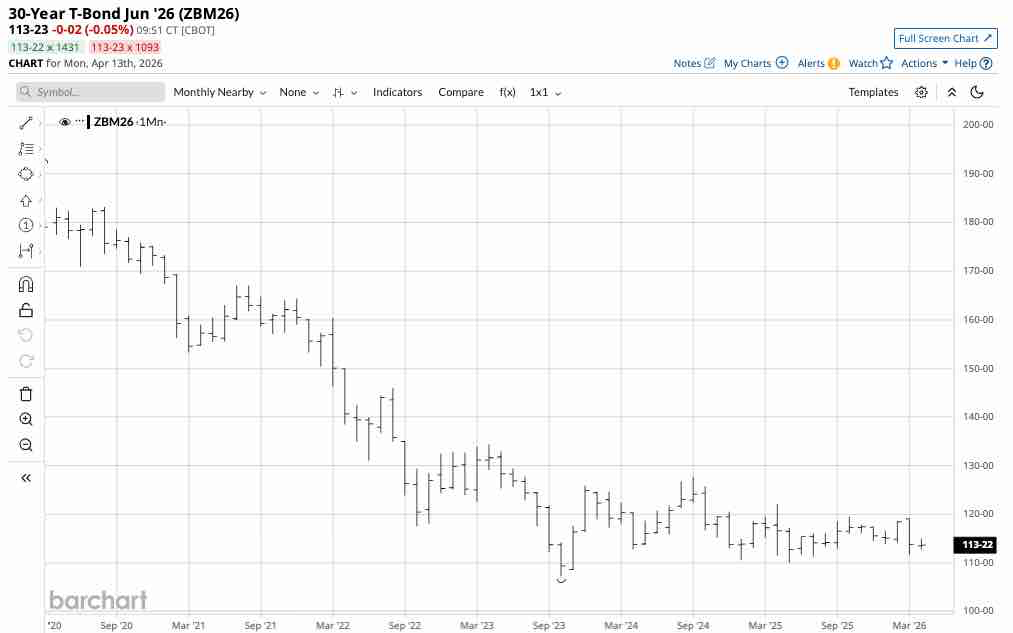
The monthly continuous U.S. long bond futures chart shows that they traded between 114-07 and 118-22 in February, and the month closed at 118-15. In March, the range was wider, between 111-23 and 119-06, closing the month at 113-28. The long bond futures reached a higher high in March than in February and closed March below February’s low, forming a bearish key reversal pattern on the monthly chart. These patterns often portend lower lows over the coming months.
Lumber prices have made higher lows since December 2025
Lumber futures are highly sensitive to mortgage rates, as lower rates support new-home demand and construction. Lumber is a critical ingredient in building a home.
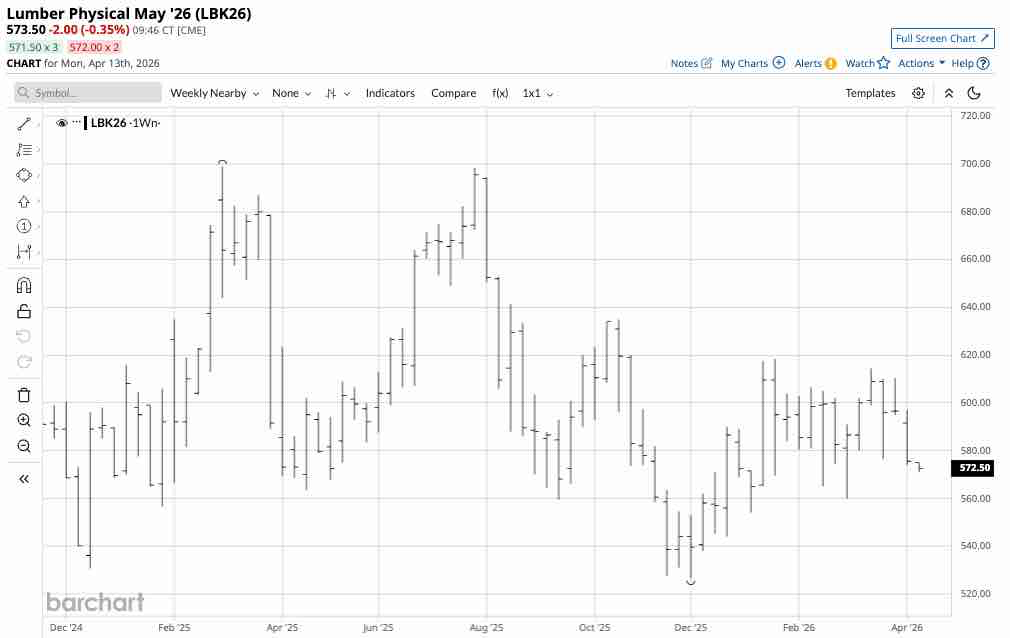
The weekly continuous lumber futures chart shows that after reaching a $526.50 per 1,000 board feet low in December 2025, which is the offseason for construction, lumber futures have made higher lows as the market moved toward spring, which tends to be the strongest season for lumber demand and prices. Lumber prices reached an all-time high in May 2021 and a lower but still substantial peak in March 2022.
In mid-April, the May physical lumber futures at below $575 per 1,000 board feet level are trading around the middle of the range from December 2025.
Critical technical resistance is at $618.50 per 1,000 board feet
The monthly continuous contract lumber chart shows that wood prices are trading sideways between $450 and $700 per 1,000 board feet.
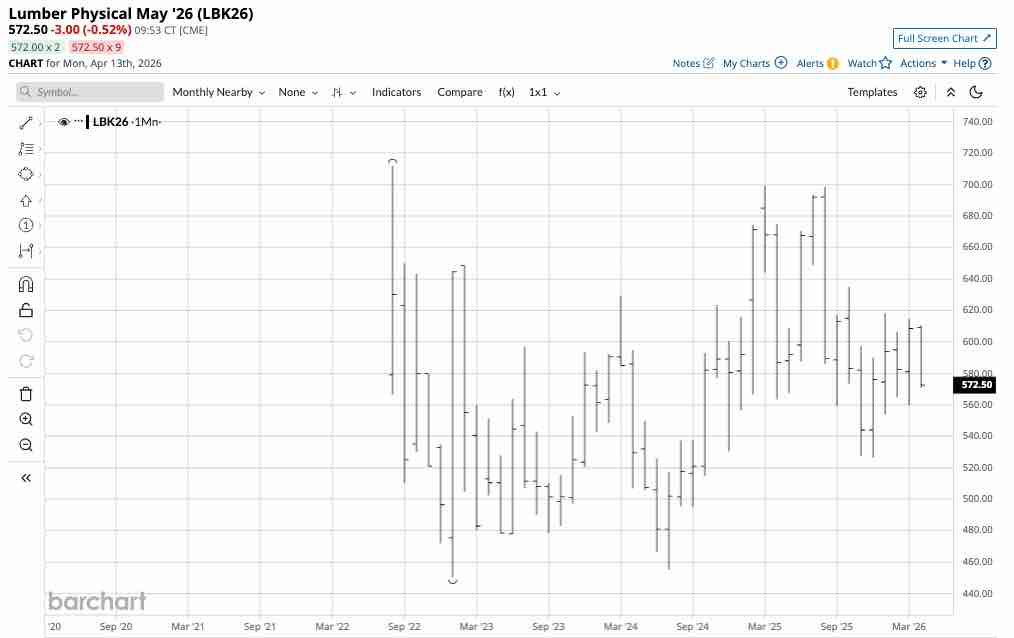
After reaching $1,711.20 in 2021 and $1,477.40 per 1,000 board feet on the random length lumber futures contract, prices have been stable between $450 and $700. However, the monthly sideways chart displays a bullish bias. Higher prices likely depend on falling interest rates that spur new home demand and construction. Meanwhile, U.S. tariffs on Canadian lumber could distort prices, but interest rates will determine the path of least resistance for wood prices.
Lumber proxies have moved mostly lower since February 26, 2026
Lumber futures remain a highly illiquid market, with open interest below 10,000 contracts. Lumber proxies are far more liquid and tend to follow lumber prices over time. On February 26, 2026, the May physical lumber futures contract traded at $580.50 per 1,000 board feet. On April 9, May lumber futures were slightly lower at $572.50.
The WOOD ETF traded at $78.02 on February 26, 2026. At $71.29 per share on April 13, WOOD declined by 8.6%.
The CUT ETF traded at $31.51 on February 26, 2026. At $28.95 per share on April 13, CUT fell 8.1%.
Weyerhaeuser Company (WY) shares traded at $24.18 on February 26, 2026. At $24.43 per share on April 13, WY rose by only 1.03%.
Weakness in the WOOD and CUT ETFs reflects selling in the broader stock market amid the situation in the Middle East. WY has most closely tracked lumber prices, as the change since late February was minimal.
Lumber’s path of least resistance depends on where interest rates are heading over the coming weeks and months. If crude oil prices increase inflation, lumber is likely to decline, along with lumber-related and other stocks, as higher rates tend to weigh on the stock market. However, if hostilities end, interest rates could fall along with crude oil prices, fostering higher demand for lumber and higher lumber prices. In April 2026, the current environment is highly uncertain as lumber is now in the peak construction and demand season with no explosive price action on the horizon.
On the date of publication, Andrew Hecht did not have (either directly or indirectly) positions in any of the securities mentioned in this article. All information and data in this article is solely for informational purposes. For more information please view the Barchart Disclosure Policy here.
More news from Barchart
Can Lumber Prices Explode? Where are Lumber Prices Heading into the 2026 Construction Season? What are the Prospects for Lumber Prices as Spring 2026 Approaches? Is Lumber Waiting Until Spring to Recover?