

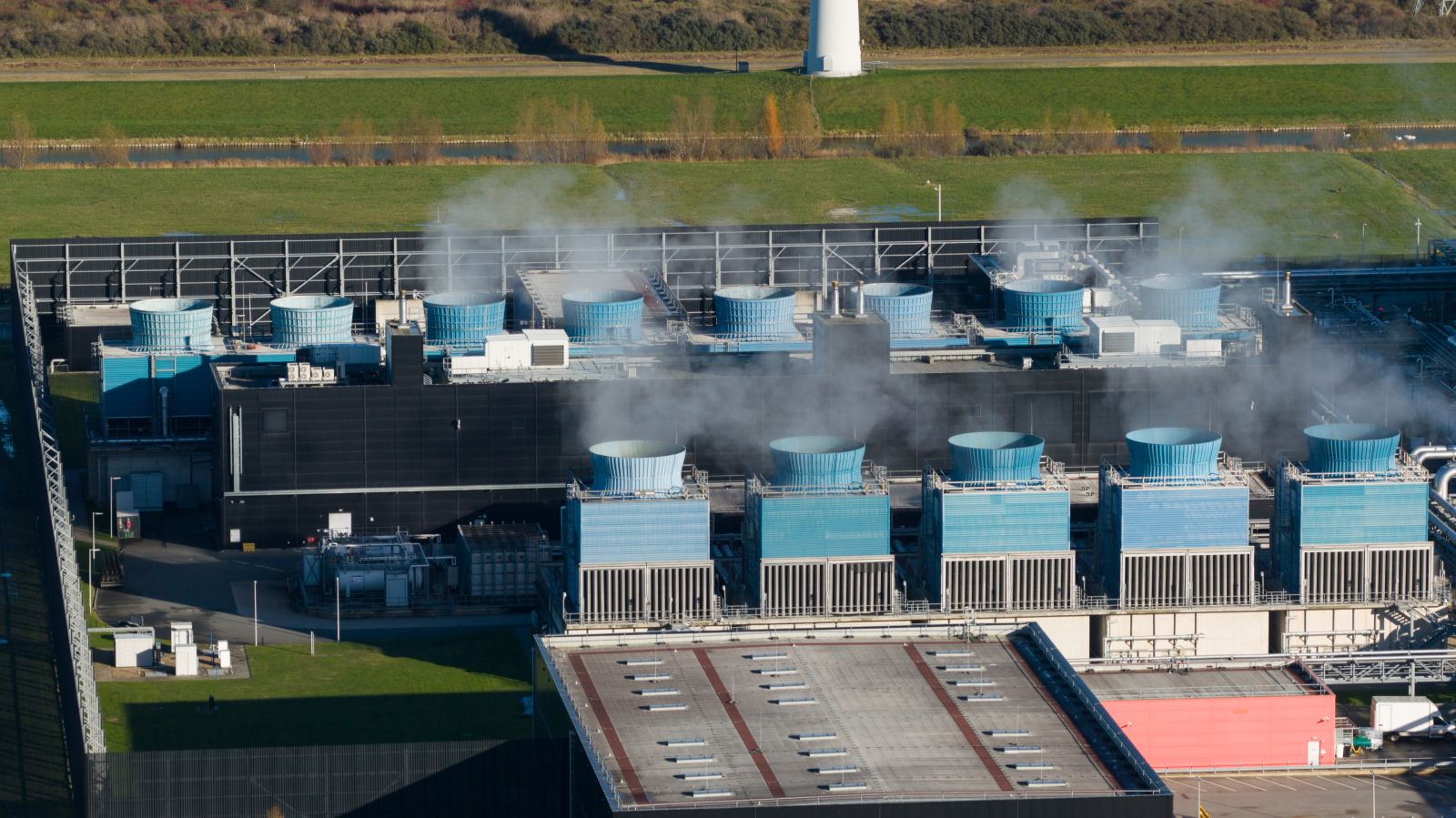
Americans across multiple states are being urged to conserve water as drought conditions intensify, reservoirs shrink, and utilities issue increasingly urgent warnings. At the same time, a different kind of consumer is quietly demanding unprecedented amounts of water: artificial intelligence.
The collision between worsening drought and the AI boom is raising alarms among environmental experts, utility operators, and local governments as hyperscale data centers consume hundreds of millions of gallons of water to cool the servers powering chatbots, image generators, and AI search tools.
Don’t Miss a Day: From crude oil to coffee, sign up free for Barchart’s best-in-class commodity analysis.
According to market research firm Mordor Intelligence, nearly 1 trillion liters of water were consumed by AI data centers in 2025. That amounts to roughly 264 billion gallons for the year, or the annual water usage of 1.8 million Americans. AI data centers are currently consuming 550 million gallons of water per day. That’s roughly the same rate of water consumption as the entirety of the world’s bottled water industry.
Now, with drought conditions spreading across large portions of the country, questions are mounting about whether communities can sustain both.
AI’s Hidden Thirst
While most people associate AI with cloud computing and advanced software, the technology relies on enormous physical infrastructure.
The world’s largest technology companies are racing to build massive AI-focused data centers filled with specialized processors that generate extraordinary amounts of heat. To prevent overheating, many facilities rely on evaporative cooling systems that consume vast quantities of water.
Researchers estimate that a single large data center can use millions of gallons of water every day under certain operating conditions.
In some regions, annual water consumption can reach hundreds of millions of gallons for a single facility.
As AI adoption accelerates, major technology companies including Microsoft (MSFT), Google (GOOG) (GOOGL), Amazon (AMZN), Meta (META), and OpenAI have announced aggressive data center expansion plans across the United States.
The result is a rapidly growing industrial demand for water at the same moment many communities are being asked to conserve it.
Drought Conditions Are Worsening Nationwide
According to the U.S. Drought Monitor, nearly 63% of the country is currently experiencing drought conditions, with large portions of the Southeast, Midwest, Southwest, and West facing significant dryness. Reservoirs in many regions remain below historical averages, while farmers, utilities, and local governments grapple with growing uncertainty about long-term water supplies.
“The West’s hydrology and climate are very much out of sync with the historical rhythm,” Utah Assistant State Climatologist Jon Meyer recently warned. In Colorado, State Climatologist Russ Schumacher described conditions even more bluntly, writing that the state’s mountain snowpack is in “historically bad shape.” Even Florida, a state not typically associated with severe drought, is experiencing what The Washington Post called “the worst drought in the state so far this century.”
The warning signs are becoming increasingly visible in Tennessee as well. The Tennessee Valley Authority (TVA) recently issued a stark update on water conditions across its service area, with TVA General Manager of River Management James Everett noting that runoff levels are currently the fourth-lowest recorded in 152 years of recordkeeping. In practical terms, less rainfall and runoff means less water flowing into reservoirs, rivers, and other critical water supplies that communities depend on.
The timing is drawing attention because Tennessee is simultaneously becoming a major hub for artificial intelligence infrastructure. In Memphis, Elon Musk’s xAI data center has emerged as one of the most resource-intensive AI facilities in the country. The company’s expansion plans could require millions of gallons of water per day for cooling operations, according to local utility estimates and permitting documents. While supporters argue the project will bring jobs and investment to the region, critics question whether massive new industrial water demands make sense as utilities across the Southeast warn of increasingly strained water resources.
The debate unfolding in Tennessee reflects a larger national question: as drought conditions spread across much of the country, how much water should be allocated to powering the AI boom?
Local Communities Push Back
The rapid expansion of AI infrastructure has already sparked backlash in communities across the country. Residents have organized protests, local officials have considered moratoriums, and in some cases, opposition has escalated into vandalism and direct action against proposed facilities.
The concerns are no longer limited to water. While data centers can require enormous amounts of water for cooling, many communities are also worried about the strain these facilities place on electrical grids… and whether ordinary customers will end up paying for the upgrades needed to power them.
That issue is already surfacing in Tennessee. As AI and data center demand surges across the Tennessee Valley, TVA leaders have pledged to address “electric rate fairness” and prevent new industrial users from creating additional upward pressure on power bills for families and existing businesses. The concern is simple: if utilities have to build new generation, transmission lines, or grid infrastructure for massive data center loads, those costs could eventually show up in household electric bills.
Similar debates are unfolding nationwide. In Georgia, regulators approved one of the country’s largest utility buildouts to serve projected data center demand, with Georgia Power planning to increase capacity by 50%. In Arizona, utilities and regulators are battling over who should pay for the grid upgrades needed to support rapidly expanding AI infrastructure. In parts of the PJM power market, a federal watchdog has warned that data center demand is already helping drive sharp increases in electricity prices.
For residents already struggling with inflation, rising grocery bills, higher insurance costs, and expensive utilities, the optics are politically explosive. Communities are being asked to conserve water and absorb higher living costs while some of the world’s most valuable technology companies secure the power and water needed to fuel the AI boom.
Supporters argue that data centers bring jobs, tax revenue, and long-term investment, and many companies say they are working on cleaner energy, recycled water, and more efficient cooling systems. But critics counter that the pace of AI infrastructure growth is moving faster than local governments, utilities, and water systems can realistically absorb.
That tension is now driving a larger question in towns and statehouses across the country: should communities bear the environmental and utility costs of AI expansion, or should the companies profiting from it be required to pay more of the bill? This comes at a time when
The Real Cost of the AI Boom
The debate over AI infrastructure ultimately comes down to a simple question: who benefits, and who pays?
Over the past few years, investors have added trillions of dollars in market value to companies at the center of the AI revolution. Nvidia (NVDA) alone has become one of the most valuable companies in history, while Microsoft, Alphabet, Amazon, Meta, and a growing list of AI startups have collectively created unprecedented amounts of shareholder wealth.
At the same time, many of the communities hosting this infrastructure are facing a very different reality. Farmers are coping with drought conditions, shrinking water supplies, and rising operating costs. Families are dealing with years of stubborn inflation, higher utility bills, and increasingly expensive necessities. Local governments are wrestling with the challenge of expanding power grids and water systems fast enough to accommodate a technology boom unlike anything seen before.
Water, electricity, and farmland are not abstract inputs on a balance sheet. They are the foundations of everyday life. And as drought conditions spread across much of the country, communities are increasingly asking whether the costs and benefits of the AI boom are being shared equally.
As consumers reach a breaking point and farmers face some of the most challenging growing conditions in years, it’s worth remembering that even though they’re called “chips,” you can’t actually eat them. You’ll still need farmers for that.
On the date of publication, Caleb Naysmith did not have (either directly or indirectly) positions in any of the securities mentioned in this article. All information and data in this article is solely for informational purposes. For more information please view the Barchart Disclosure Policy here.
More news from Barchart
AI Data Centers’ Water Consumption Breaks 264 Billion Gallons in 2025 as Devastating Drought Hits Nearly 63% of U.S. Why Was the Commodities Complex Like a Sailboat Race Thursday Morning? May’s Top Performers and Underperformers Was the Holiday Weekend Market Moving Headline Chaos Predictable?