

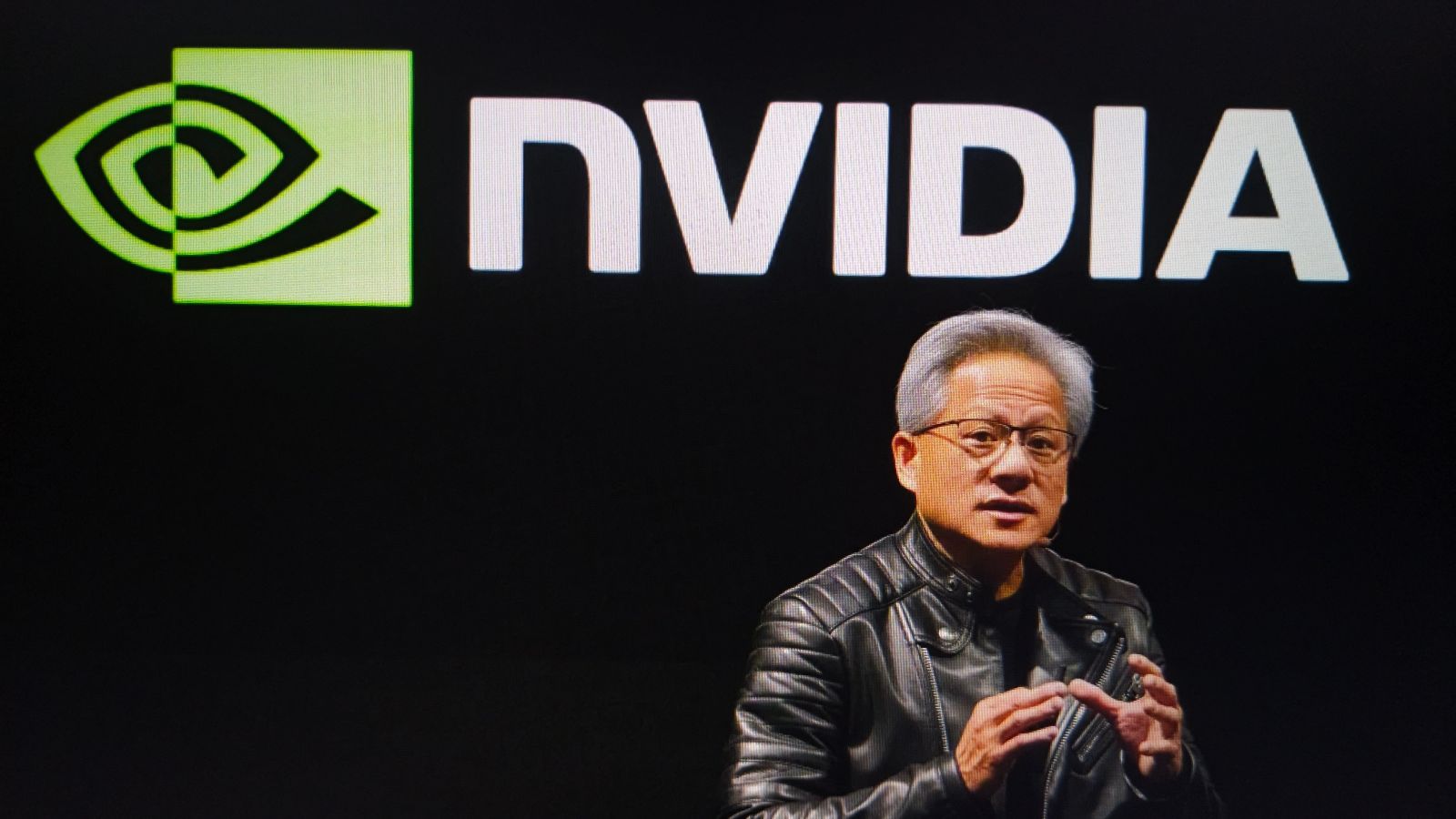
Jensen Huang was asked about Anthropic's standoff with the Pentagon. He answered with a line about his own phone. "CEOs who are not elected officials, I'm not an elected official, and when the United States goes to war, I would really appreciate not getting a phone call asking whether my technology ought to be used," the Nvidia (NVDA) chief executive said.
Huang said it at the Milken Institute Global Conference in early May 2026, in a fireside conversation with CNBC's Becky Quick.
More Top Stocks Daily: Go behind Wall Street’s hottest headlines with Barchart’s Active Investor newsletter.
It is a genuinely unusual position for a technology CEO to take out loud, and it went almost entirely unreported at the time. Coverage of that appearance focused on two other moments: Huang's line that everyone in the room needed AI but "none of you should have a nuke," and his shrug at a California wealth tax proposal that Quick told him could cost him $8 billion. The passage about military authority, arguably the most consequential thing he said, slid past.
Not Indifferent, Just Not His Call
The argument he was making is narrow and specific. Huang was not saying he is indifferent to how his chips get used. He was saying that the decision does not belong to him. "I would defer to their judgment, and if I don't agree with them, I can apply and exercise my rights as a citizen to vote next time," he said. "And that's how I can protest; I can speak out loud, I can vote as a citizen, I could encourage other people to speak up, but the one thing that we will not do is get in the way of the United States defending our families."
He also attached a condition, which belongs in any fair account of the remark: he framed it as applying where the government uses the technology "in a constitutional way, in a legal way, and in defense of our nation." That is a limit, not a blank check, and the distinction is the whole substance of his position: a CEO should not be an extra veto point on lawful state action because nobody elected him to be one.
The reason this lands as a real disagreement rather than a bland civics lecture is what prompted the question. Quick had asked about reporting that Anthropic was "caught up with the Pentagon," and whether resolving it mattered for American competitiveness. Huang said it did: "I hope that the US government and Anthropic work it out." He then went out of his way to praise the company, "Anthropic is an incredible company. They have an incredible culture. They have a belief system that's really deep-rooted," before drawing the line.
The two companies have arrived at visibly different answers to the same question. Anthropic has maintained restrictions on how its models may be used, including in military contexts, and its dispute with the Pentagon flowed from exactly that kind of limit. Huang's view is that an unelected executive should not hold that lever at all. Both are defensible. They cannot both be right about who decides.
Agree to Disagree
Notably, Huang declined to turn any of this into a fight. "I don't agree with all of their posture, and Dario and I are very clear that we don't have to agree on any of that and still be civil working with each other, and so we are able to keep all of that separate," he said, referring to Anthropic CEO Dario Amodei. Nvidia sells to Anthropic; Nvidia has also invested in it. The disagreement is philosophical, and the commercial relationship continues.
He then spent a moment on how large that customer has become, though the figures were his own rough estimate rather than reported numbers: to go "from zero to nearly a trillion dollars in value at the business rate that they have, they're currently probably $40, $50 billion annualized run rate." He called it "historic in many ways." (Although Anthropic is privately held and does not publish those figures, so it's likely just a quick estimate from Huang.)
The wider point Huang kept returning to across the session was that fear is the real risk to American AI leadership, that the "worst outcome for AI, for our nation, is not that another country gets AI" but that Americans get frightened enough to disengage. The phone-call line is the same argument pointed at a harder target: not the public's anxiety, but the discretion of the executives who build the technology. He was arguing his own discretion should be smaller.
On the date of publication, Caleb Naysmith did not have (either directly or indirectly) positions in any of the securities mentioned in this article. All information and data in this article is solely for informational purposes. For more information please view the Barchart Disclosure Policy here.
More news from Barchart
Billionaire Jensen Huang Says That When America Goes to War He Would Rather Not Be Asked About His Own Technology: ‘I Would Really Appreciate Not Getting a Phone Call…' Why Warren Buffett Called This Investment His ‘Most Gruesome’ Mistake — ‘Deserves a Spot in the Guinness Book’ As the Market Crashed in 1987, Paul Tudor Jones Made $100 Million in a Single Day: ‘The Most Important Rule of Trading Is to Play Great Defense, Not Great Offense’ Wall Street Can't Agree on Palantir. Here's What Investors Should Do Next