

Apple's (AAPL) Sept. 9 event focused on mobile devices, but its 2026 product plans extend well beyond the iPhone. According to Bloomberg News’ Mark Gurman, the company is preparing a major smart-home push for Tuesday, Oct. 13. The move would be one of the first significant category expansions under new Chief Executive Officer John Ternus.
Leading that push is a smart-home hub internally code-named J490, Gurman reported. Apple is also expected to unveil the first HomePod mini update since its 2020 debut and its first new Apple TV set-top box since 2022. The three products would give the company a more coordinated presence inside the home.
More Top Stocks Daily: Go behind Wall Street’s hottest headlines with Barchart’s Active Investor newsletter.
The hub is expected to feature a compact, roughly square display measuring about 6 to 7 inches. Apple reportedly plans versions for either countertop placement or wall mounting. Designed as a household control point, the device would use facial recognition to identify users and personalize the interface, content, and responses accordingly.
The refreshed HomePod mini and Apple TV are expected to retain their familiar designs while gaining faster processors. Those upgrades should allow them to run the same more capable Gemini-trained Siri models. Combined with the new hub, the devices could create a more connected Apple experience across the home.
That would put the Cupertino, California-based tech pioneer directly into a smart-home market long dominated by Amazon (AMZN) and Alphabet's (GOOG) (GOOGL) Google. Until now, the company has largely relied on HomeKit and third-party accessories. If these products launch as planned, Apple will make its clearest attempt yet to turn the home into another core hardware environment.
About Apple Stock
Apple remains a global technology leader spanning devices, digital platforms, and services for communication, entertainment, productivity, payments, and more. With a market cap of about $4.8 trillion, its portfolio includes iPhone, Mac, iPad, Apple Watch, AirPods, Apple Vision Pro, Apple TV, HomePod, Beats products, and accessories.
Its ecosystem reaches well beyond hardware, covering the App Store, AppleCare, cloud services, advertising, and subscriptions such as Apple Music, Apple TV, Apple Arcade, Apple Fitness+, and Apple News+. Apple also operates Apple Pay and Apple Card, serving consumers, businesses, education, enterprise, and government markets across major markets worldwide.
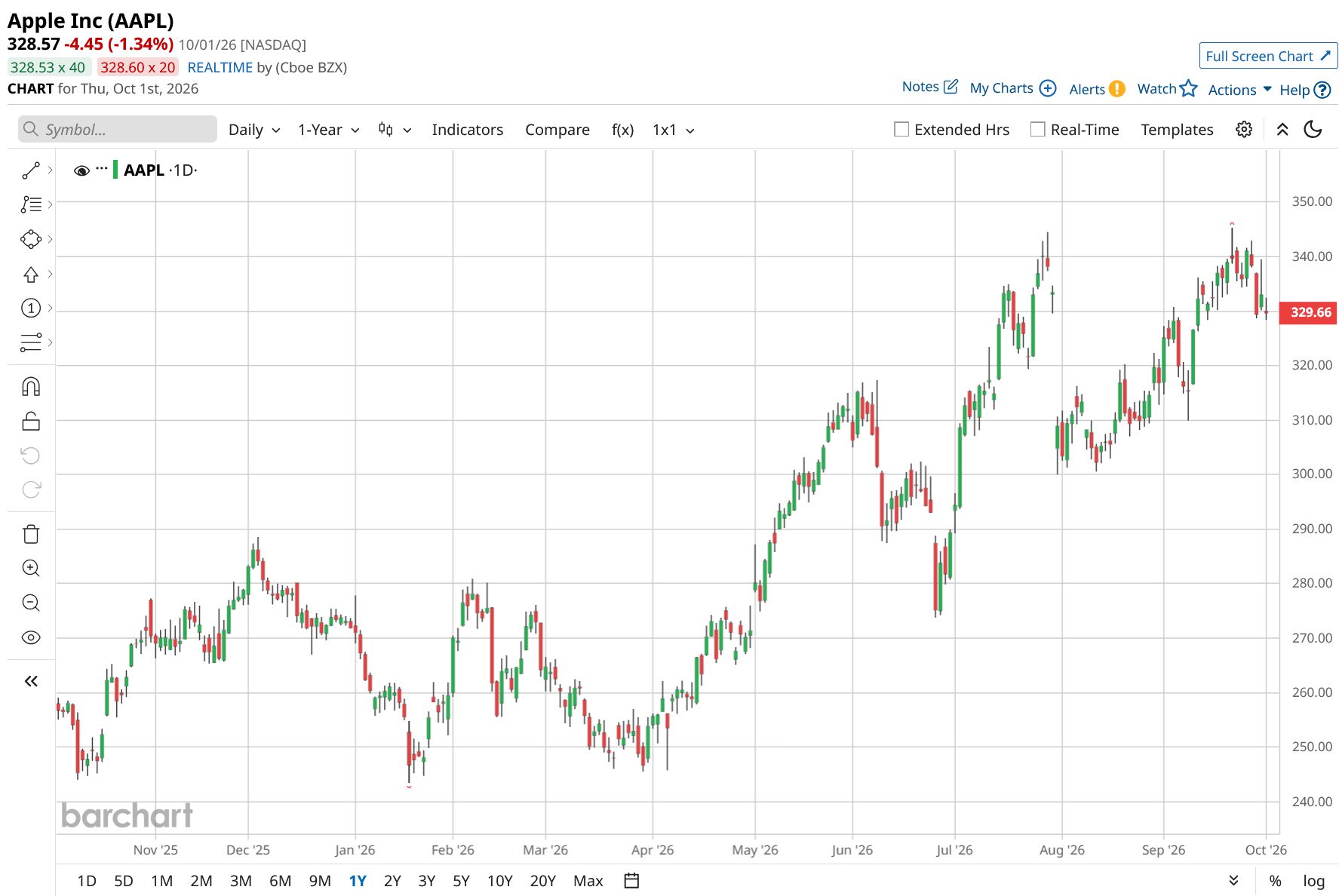
That breadth has supported positive investor returns. AAPL stock has gained 29% over the last 52 weeks and climbed 21% year-to-date (YTD). The momentum has remained intact over the shorter term, with shares up 12% in the past three months.
 www.barchart.com
 The strong performance, however, comes with a valuation trade-off. AAPL stock currently trades at 37.30 times forward adjusted earnings and 10.06 times sales. Both multiples exceed industry averages and sit above Apple’s own five-year historical multiples, meaning investors are paying a premium for the company’s current momentum.
Shareholders are also benefiting from Apple’s long-running dividend policy, which has produced 13 consecutive years of increases. The current dividend stands at $1.08 per share annually, representing a yield of 0.33%. The latest payment was $0.27 per share, distributed on Thursday, Aug. 13, to shareholders recorded as of Monday, Aug. 10.
Surpasses Q3 Earnings
On July 30, the company reported Q3 FY2026 results that surpassed Wall Street expectations for revenue and earnings. Revenue jumped 16.4% year-over-year (YoY) to $109.4 billion, topping the $108.65 billion estimate, while adjusted EPS reached $1.91 versus the Street’s $1.89 forecast.
The iPhone remained the quarter’s biggest growth driver. Revenue surged 21.7% YoY to $54.3 billion, helped by strong demand for the iPhone 17 lineup. Mac also delivered a notable surprise, generating $10.4 billion in revenue compared with the $8.74 billion forecast and giving the quarter another source of upside.
Services continued to expand, though the segment missed expectations. Revenue increased to $30.7 billion from $27.4 billion in the year-ago quarter, below the $31.22 billion estimate. The iPad performed less strongly, with revenue slipping to $6.2 billion from $6.6 billion, highlighting the uneven performance across Apple’s product categories.
Profitability, nevertheless, improved meaningfully. Gross margin climbed to $54.8 billion from $43.7 billion, producing a 50.1% rate. Operating income rose to $35.7 billion from $28.2 billion in the prior year’s period, while net income reached $29.8 billion, strengthening the overall financial picture despite weaker results in some segments.
Looking ahead, analysts expect Q4 FY2026 EPS to grow 7% YoY to $1.98. Full-year FY2026 EPS estimates stand at $8.74, implying 17.4% annual growth. For FY2027, analysts expect EPS to reach $9.53, which would add another 9% growth.
What Do Analysts Expect for AAPL Stock?
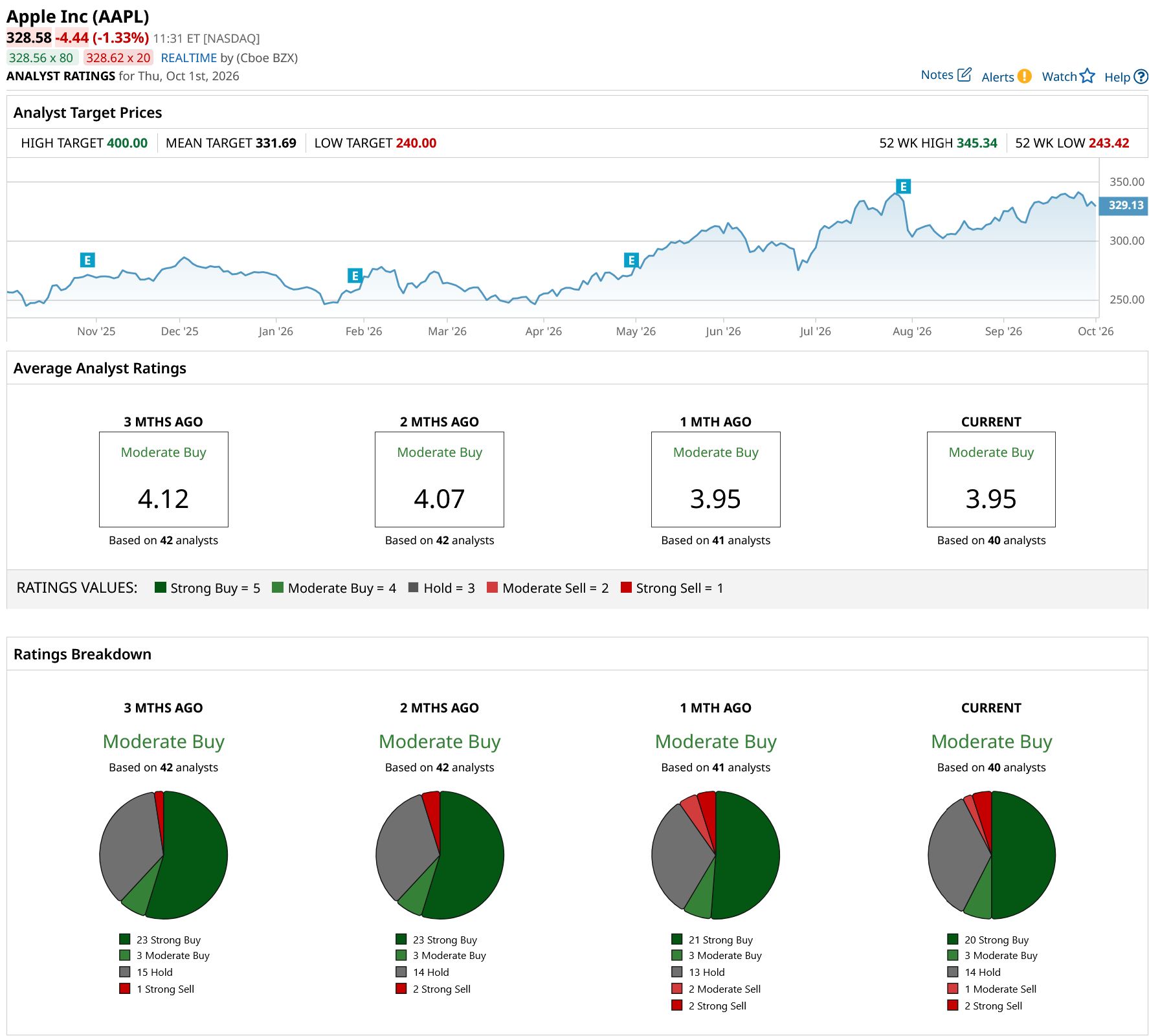
Wall Street currently gives AAPL stock an overall “Moderate Buy” rating. Among 40 analysts covering the stock, 20 rate it a “Strong Buy,” three give it a “Moderate Buy,” 14 recommend “Hold,” and one assigns a “Moderate Sell,” while two analysts carry a “Strong Sell” rating.
AAPL stock is trading just below its average price target of $331.69. Meanwhile, the Street-high target stands at $400 and points to a gain of 22% from current levels.
 www.barchart.com
 On the date of publication, Aanchal Sugandh did not have (either directly or indirectly) positions in any of the securities mentioned in this article. All information and data in this article is solely for informational purposes. For more information please view the Barchart Disclosure Policy here.
More news from Barchart
Dear Apple Stock Fans, Mark Your Calendars for October 13 A Nearly $12 Billion AI Deal Could Be Another Reason to Buy Nvidia Stock UiPath Gets Hit With Downgrade Following Investor Day. Why Analysts Weren’t Impressed. Does S&P Stand for SPooky During October?