


MicroStrategy (now Strategy) founder Michael Saylor has a new way of explaining Bitcoin: think of money like food, and Bitcoin like a freezer.
In an essay published on August 15, Saylor argues that money stores the value created by your time and work. The real test, he says, is how much of that value survives over decades.
Why Saylor Thinks Bitcoin Stops Money From “Melting”
Cash is easy to spend, but inflation can gradually reduce what it buys. Gold has historically served as a store of value, though storing, moving, and verifying large quantities creates costs.
Saylor’s “deep freeze” analogy is his answer to both problems. Bitcoin has no physical weight, can move globally, and follows a supply schedule set by its protocol rather than a central bank.
In his framework, that means less value “leaks” away while wealth moves through time.
To understand Bitcoin, first understand money.
— Michael Saylor (@saylor) August 15, 2026
Money is energy. Bitcoin is digital monetary energy. https://t.co/qDFjo2hf6c
The Big Catch: Bitcoin Can Still Lose Value Fast
A deep freeze sounds stable. Bitcoin is anything but stable in the short term.
BTC currently trades near $63,000. So Saylor is making a long-term scarcity argument, rather than claiming Bitcoin works like a stable savings account. That doesn't seem true in a real-time market context.
His question is essentially this: over several decades, would you rather store wealth in money whose supply can expand, a physical asset that is costly to move, or a digital asset with programmed scarcity?
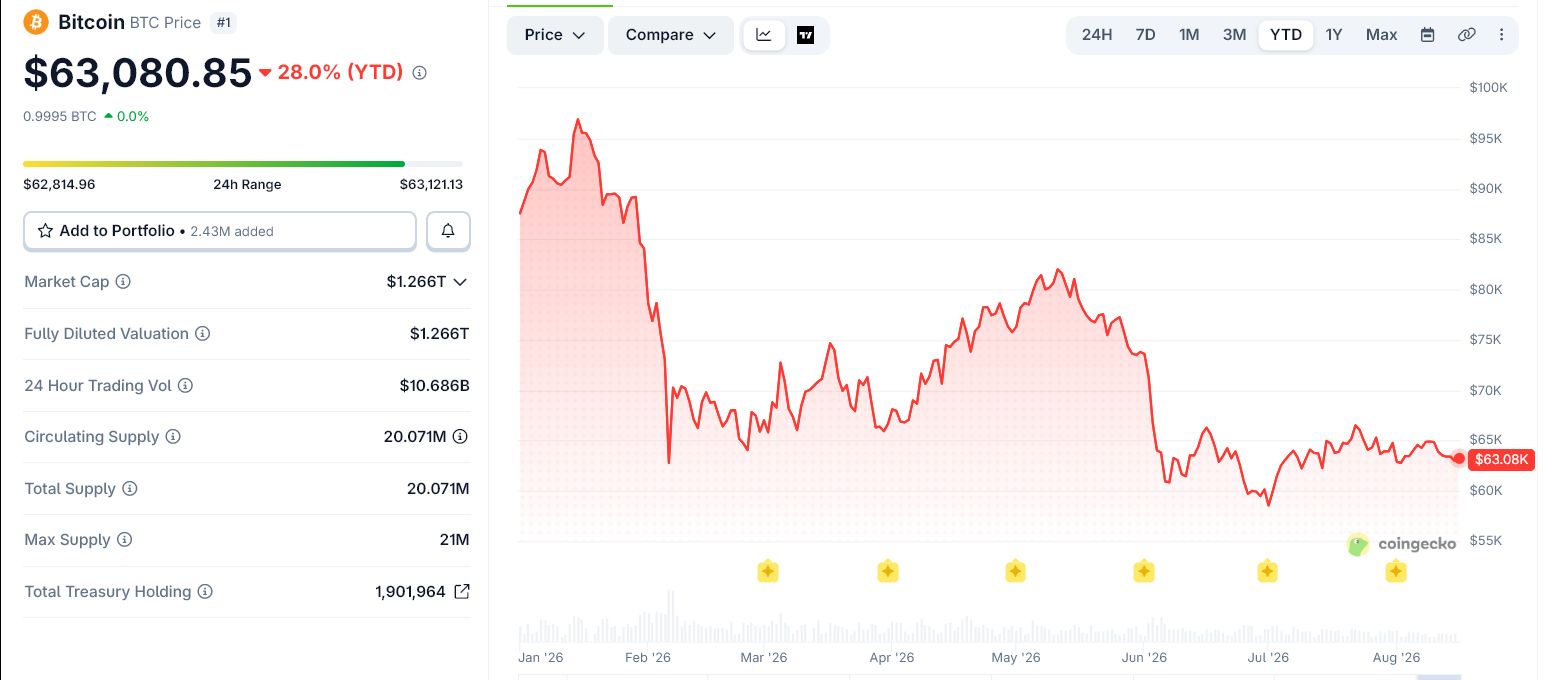 Bitcoin Price Year-to-Date. Source: CoinGecko
 Bitcoin has not existed long enough to pass Saylor’s 100-year test. Still, the analogy explains the investment thesis clearly: Bitcoin’s main pitch here is preserving purchasing power across time without relying on an issuer.
Read the Original story Bitcoin Is a ‘Deep Freeze’ for Money. What Does That Actually Mean? by Phil Haunhorst at beincrypto.com