


A few years ago, the playbook for a crypto wallet was simple. List the coin everyone was chasing before your competitors did. Support the hyped token only you carried, and users came to you.
Last year, more than 11.5 million tokens died, most of them meme coins. Anyone can mint a token on a platform like Pump.fun in minutes for almost nothing.
When assets are infinite and disposable, and any of them is one integration away, a long asset list is just a commodity.
So if every wallet can hold the same coins now, why do a few become household names while most never find their users?
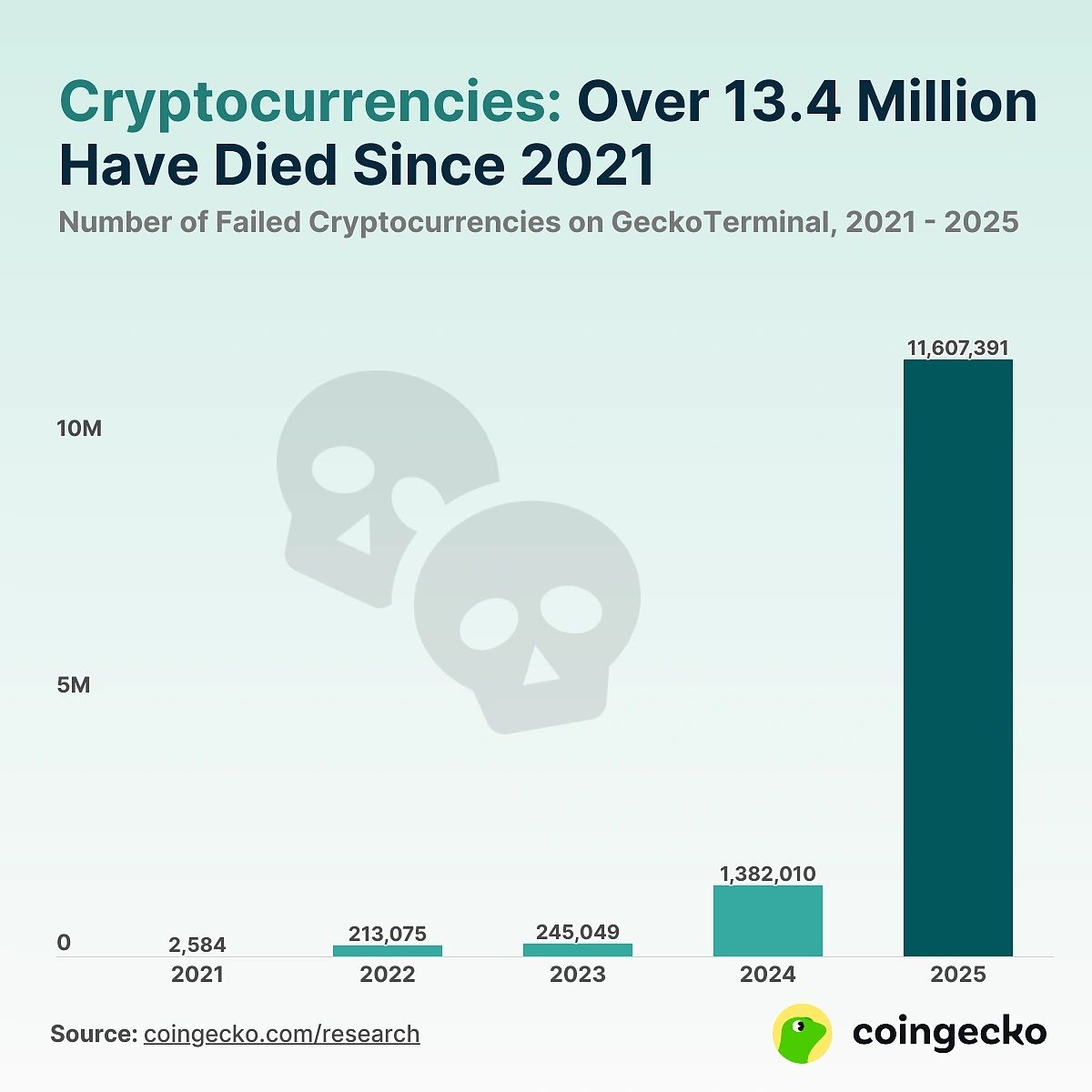 How Many Cryptocurrencies Died Between 2021 and 2025. Source: CoinGecko
Storage Is Just the Starting Point
The answer is what happens after the coin lands in the wallet. Storage used to be the whole product. Now it's the entry point.
After years of centralized-exchange failures, most wallet users now prefer holding their own keys, and they expect that self-custody wallet to do everything the exchange used to do.
One app to manage assets end to end: buy and sell, swap across chains, stake, earn on idle stablecoins, and spend with a card. Few wallets ship all of it at once, but all of it belongs on the roadmap now.
D'CENT shows the shift better than any slide. It started as a South Korean hardware wallet. Its function was mainly “just storage,” a device built to keep keys safe and little else. Then the team hit a wall.
Users had assets sitting there. To do anything with them, they had to leave. So D'CENT turned the device into what it calls an "action wallet," with swaps built in, by integrating the ChangeNOW exchange API.
And almost immediately, you could see the numbers move. By 2025, D’CENT passed a million registered users and over 40,000 daily actives, with device sales nearly tripling year over year.
A wallet that could hold 70+ chains, but couldn’t swap them!
— ChangeNOW (@ChangeNOW) October 23, 2026
In 2021, @zelcore_io was scaling fast. Users could store assets across dozens of blockchains, but to trade they had to leave the wallet.
Building an exchange in-house meant KYC, AML, and licensing, which clashed with… pic.twitter.com/45TbAMRwhx
Stablecoins Became the Daily Habit
Stablecoins show the same pattern, only bigger. They've quietly become the one use case that actually sticks. Stablecoin settlement ran into the trillions in 2025 and is closing in on the old card networks.
You can send a dollar in under a second for less than a cent. Wallets that make it easy to hold, spend, and earn on stablecoins are the ones capturing daily use.
This is the best bridge to people outside crypto, and the clearest sign of where the market is heading.
Usability Decides Who Wins
All of this depends on the wallet being easy to use. This is the real battleground now, and most of the industry still loses it. Seed phrases scare people off. Picking the right chain confuses them.
Account abstraction is starting to fix that. New standards let a wallet sponsor gas, batch transactions, and hide the chain entirely, so it feels like a normal app.
MetaMask now lets you grant a dapp narrow permission: spend up to 10 USDC a day, or run a strategy over 30 days, all from a single approval. The wallet a newcomer can open without a tutorial is the one that spreads.
Winners Plug In the Hard Parts
A full-management wallet is really several companies in one. Swaps, staking, on- and off-ramps, card rails, cross-chain routing: each is its own hard problem in liquidity and compliance. Building all of it from scratch takes years no team has.
Only the largest wallets can afford to build even part of it in-house, and even they buy the rest as ready-made pieces — an exchange API for swaps, a card program for spending.
Cake Wallet made that call early. Its users had moved from one asset to many and needed a way to trade inside the app.
Building an exchange engine would have swallowed the team, so they plugged in a swap API and kept their people on security and the interface.
The base grew 117 times, from 15,000 downloads to 1.75 million users, with 300,000 monthly actives.
ChangeNOW has worked with wallets of every size, and their experts see a clear pattern. The only wallets that survive are the ones that move fast and build strong partnerships early.
From 15K downloads to 1.75M users, Cake Wallet scaled with in-wallet swaps powered by the ChangeNOW API.
— ChangeNOW (@ChangeNOW) June 3, 2026
In this case study, ChangeNOW CBDO Yana Mar shows how lean infrastructure helped turn storage into action.
👇 https://t.co/Ay9x5A9AGy
Usage Is the Business Model Now
By now everyone knows installs can be bought, so let's skip the obvious part. The real change is what a wallet earns money from.
In the hype era you monetized attention: installs, listings, the coin of the week, etc. Today the revenue lives in what people actually do: swaps, stablecoin flows, staking, card spend. That rewires who you build for.
The Trust Wallet team optimizes for the share of users who come back, because the returning user is the one who transacts. Deep, active use is the product now, and the money follows it.
The Next Wallet Winners
The next generation of successful crypto wallets will likely be defined by how often people use them, rather than how many tokens they support.
That means making everyday transactions easier, keeping users inside the app, and finding sustainable ways to earn from that activity.
Services like ChangeNOW's exchange API give wallet developers one way to add those features without building the infrastructure themselves.
As token listings become less of a selling point, the wallets that make crypto genuinely useful have a better chance of keeping their users. And in an increasingly crowded market, that may be the advantage that matters most.
Read the Original story Why Having More Tokens Is No Longer Enough for Crypto Wallets by Yana Mar at beincrypto.com