


Speaking on the Schwab Network, Saylor said the cryptocurrency was entering a new bull market and predicted that the broader rally could last four years. His outlook comes as Bitcoin trades near $83,700, with technical indicators showing a positive trend but mixed short-term momentum.
Saylor’s forecast reflects his long-standing confidence in Bitcoin’s limited supply and its potential role in financial markets. However, the $100,000 target remains a projection rather than a confirmed outcome. Monetary policy, institutional demand, regulatory developments, and market liquidity could all influence the cryptocurrency’s next move.
Key Facts
Bitcoin price prediction: Saylor expects BTC to return above $100,000 within the next 12 months but did not guarantee that the target would be reached by the end of 2026. Four-year bull market: The Strategy executive chairman described the current phase as the beginning of a bull run that could last four years. Current BTC price: Bitcoin was trading around $83,700 in the supplied market snapshot, leaving it approximately 19.4% below $100,000. Strategy’s Bitcoin holdings: The company reported holdings of 848,517 BTC, alongside approximately $5.2 billion in cash reserves, according to the supplied source report. Technical outlook: TradingView’s technical summary indicated a Buy rating, supported by moving averages, while oscillators remained broadly neutral. Corporate strategy: Strategy is pursuing a proposal for daily dividend payments on its credit instruments, with a shareholder vote scheduled for October 28.Bitcoin Clears Its 200-Week Average as Headwinds Fade
Saylor said Bitcoin had rebounded from its 200-week moving average and climbed approximately $20,000 above that level. He views the recovery as evidence that the previous downturn has run its course and that the market may be entering a new expansion phase.
“I feel like we're at the beginning of a bull run,” Saylor told the Schwab Network. He also said he expected Bitcoin to return to six-figure valuations within 12 months, while acknowledging that he could not be certain it would happen before the end of 2026. When asked how long the bull market might last, he replied, "Four years.”
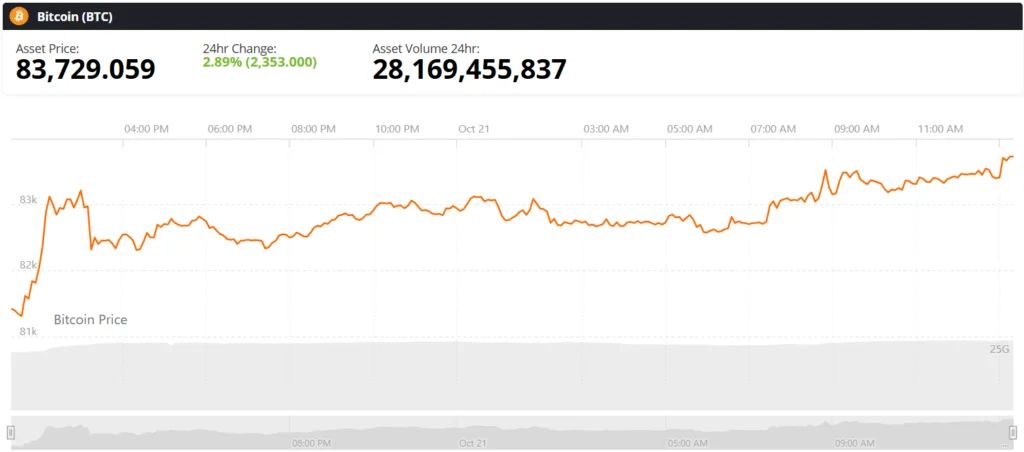
Bitcoin (BTC) price chart. Source: Brave New Coin
The forecast comes as Bitcoin remains below its October 2025 all-time high of approximately $126,198, according to the supplied market report. At around $83,700, BTC would need to gain roughly 19.4% to reclaim $100,000. A move to that level would represent a meaningful recovery, although it would not establish a new record.
Saylor attributed recent market pressure to restrictive monetary, foreign, and trade policies, alongside competition for investment capital from artificial intelligence. He argued that these forces had weighed on Bitcoin without necessarily undermining its underlying investment case.
He also pointed to the potential expansion of Bitcoin-backed lending, regulatory guidance from US financial authorities, and the development of tokenized securities as factors that could support wider adoption. These developments could improve access to digital assets, although their effect on Bitcoin's price will depend on actual demand and market conditions.
Bitcoin Price Prediction: What Technical Indicators Show
The TradingView snapshot placed BTC near $83,729, with the overall technical assessment at Buy. Moving averages were classified as Strong Buy, while oscillators remained Neutral. This combination suggests that the prevailing trend is constructive, but short-term momentum has not confirmed a strong breakout.
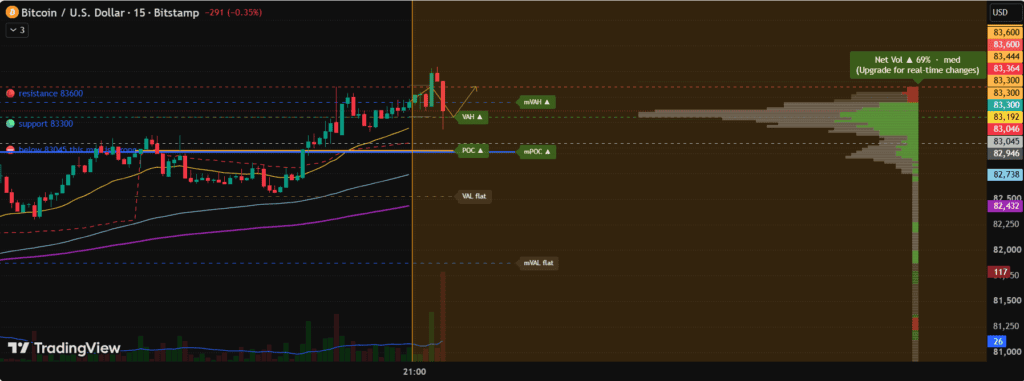
A close above $83,600 could push the price toward $84,000, while a drop below $83,300 may trigger a pullback toward the $82,950 point of control (POC). Source: kenkemdayfx on TradingView
Bitcoin was trading above several short- and medium-term moving averages, including the 10-period exponential moving average near $82,519 and the 20-period exponential moving average around $82,613. The 50-period EMA stood near $80,733, while the 200-period EMA was approximately $76,071. These levels provide reference points for assessing whether the recent recovery remains intact.
The relative strength index was around 54, a neutral reading that does not indicate an overbought market. The Average Directional Index was near 19, suggesting limited trend strength. Together, these indicators point to a market with a positive moving-average structure but without decisive confirmation of accelerating momentum.
Key price levels also offer a framework for monitoring the BTC price . The $82,000–$83,000 area forms an important near-term support zone, while resistance begins around $84,700 and extends toward $89,000. A sustained move above this resistance region could strengthen the case for a continued recovery. Conversely, a breakdown below the support cluster could expose lower levels, including the mid-$70,000 range.
Saylor Calls the CLARITY Act a Bill of Restrictions
Saylor also discussed the stalled CLARITY Act , a proposed US legislative framework for digital assets. He argued that the legislation placed excessive emphasis on restrictions rather than establishing clear permissions for innovation.
“If you want to create a great economy or a great nation, what you want is a bill of rights, not a bill of restrictions,” Saylor said during the interview. He criticized the proposal's length and argued that its provisions would have imposed substantial constraints on the digital asset industry.

Michael Saylor argues that the CLARITY Act’s potential failure could benefit Bitcoin by reducing regulatory uncertainty and allowing the market to develop in ways that support a stronger bull run. Source: @AltcoinDaily via X
Instead, Saylor pointed to guidance and initiatives involving the Securities and Exchange Commission, the Commodity Futures Trading Commission, and the US Treasury. He said developments involving tokenization, digital derivatives, and digital currency issuance could provide a more favorable environment for financial innovation.
Regulatory clarity can influence institutional participation by helping businesses understand the rules governing custody, trading, issuance, and other digital asset activities. However, the precise effects on Bitcoin demand will depend on how policies are implemented and whether they encourage additional investment.
Saylor also emphasized monetary policy as a central influence on financial markets. Lower borrowing costs and improved liquidity can support demand for risk assets, while restrictive financial conditions may limit investment. Bitcoin remains sensitive to these shifts, despite its fixed maximum supply of 21 million coins.
The distinction matters for the current Bitcoin price prediction. A more supportive regulatory environment may encourage participation, but it cannot guarantee a sustained rally if liquidity tightens or investors reduce exposure to volatile assets.
Strategy's 845,000 Bitcoin and the Oct. 28 Dividend Vote
Strategy's substantial Bitcoin holdings remain central to Saylor's long-term outlook. The company's reported position of 848,517 BTC, valued at roughly $70 billion at the prices cited in the source report, makes it one of the largest corporate holders of the cryptocurrency. Its cash reserves of approximately $5.2 billion provide additional financial resources as the company manages its capital structure.
Saylor said Strategy had acquired approximately 160,000 BTC during 2026, describing the company as the world's largest Bitcoin buyer. Its approach, however, extends beyond simply accumulating and holding the asset. Strategy also manages equity and credit instruments to support its financing activities and maintain access to capital.
That approach is particularly relevant to the company's preferred securities, including STRC. These instruments form part of Strategy's digital credit strategy, which Saylor views as an important component of its broader business model. Their performance and liquidity can influence financing costs and the company's ability to continue acquiring Bitcoin.
Shareholders are scheduled to vote on October 28 on a proposal to move dividend payments on certain credit instruments to a daily calendar-day schedule. Saylor said the proposed securities would be the first in the world to pay dividends every calendar day. The plan is intended to align payments more closely with digital markets that operate around the clock, including weekends and holidays.
Daily distributions could change how investors manage cash flows and trade these securities. However, the proposal's approval, implementation, and eventual effect on trading behavior remain important considerations.
Strategy's financial structure also creates exposure to Bitcoin's volatility. A rising BTC price can increase the value of its holdings, while a prolonged decline can pressure the company's market valuation and financing conditions. Its cash reserves and capital-management policies therefore matter alongside the size of its Bitcoin position.
Institutional Forecasts Add Context to Bitcoin's Long-Term Outlook
Saylor's bullish outlook comes as traditional financial institutions increasingly examine Bitcoin's potential role in investment portfolios. J.P. Morgan Asset Management's 2027 Long-Term Capital Market Assumptions report , released on October 19, introduced a range of long-term return expectations for Bitcoin. The report assesses asset classes over a 10- to 15-year horizon rather than attempting to predict short-term price movements.
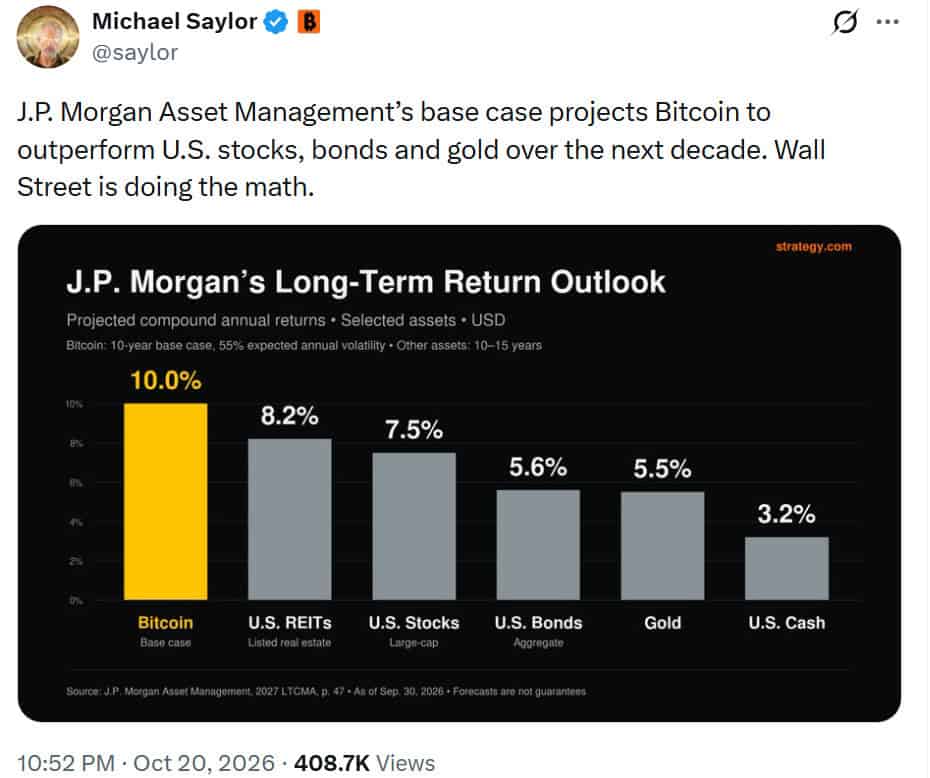
Michael Saylor cites J.P. Morgan’s 10-year forecast, which projects Bitcoin’s 10% annualized return to outperform REITs, stocks, bonds, gold, and cash. Source: Michael Saylor via X
This distinction is important when evaluating Bitcoin predictions. Long-term portfolio assumptions do not establish where BTC will trade over the next 12 months, and they should not be interpreted as confirmation of Saylor's $100,000 target.
Bitcoin's limited supply remains central to the investment argument advanced by Saylor. He has argued that artificial intelligence may generate substantial corporate wealth but cannot increase Bitcoin's predetermined supply. In his view, that scarcity distinguishes BTC from assets whose supply can expand through additional production or issuance.
Even so, scarcity alone does not determine market value. Investor demand, liquidity, regulation, and broader economic conditions remain significant influences on the price of Bitcoin. Institutional participation can support demand, but it can also change as portfolio managers reassess risk.
BTC Price Prediction: Can Bitcoin Reach $100K Within 12 Months?
Bitcoin's near-term outlook combines a constructive moving-average structure with resistance that the market must overcome. At approximately $83,700, the cryptocurrency needs a gain of about 19.4% to reach $100,000. That move is possible, but the technical indicators supplied do not establish that it will occur within Saylor's proposed timeframe.
A sustained move above the $84,700–$89,000 resistance area would provide stronger evidence of improving momentum. Beyond that range, traders would monitor whether buying activity remains sufficient to carry BTC toward the psychological $100,000 level. Failure to hold the $82,000–$83,000 support region, meanwhile, could weaken the short-term structure and shift attention toward lower support levels.
Saylor's four-year bull-market outlook is a longer-term thesis, not a guarantee that Bitcoin will rise continuously. The cryptocurrency could experience sharp corrections even if a broader upward trend develops. Changes in monetary policy, institutional flows, and investor appetite for risk could all influence its path.
For now, the Bitcoin price prediction rests on two distinct considerations: Saylor's expectation that the next bull market has begun and the market's ability to confirm that view through sustained price gains. His forecast provides a clear target and timeframe, while technical indicators offer a framework for tracking progress.
Whether BTC reaches $100,000 within 12 months will ultimately depend on market conditions rather than any single executive's prediction. Investors following the latest Bitcoin price news should distinguish between an optimistic long-term outlook and evidence of a confirmed breakout. Technical indicators and price targets can help frame that assessment, but neither guarantees future performance.