

The broader crypto market pulled back as Bitcoin (BTC) briefly slipped below the $67,000 level on Tuesday, and that weakness quickly spread to other major chains. In the weekly timeframe, Solana (SOL) and Cardano (ADA) each recorded a 10% retrace.
Against that backdrop, market expert Anders Bylund of The Motley Fool published a fresh comparison of the two networks—followed by a clear call on which one he believes is the better pick at this stage.
Solana’s Quick History
Bylund frames Solana as a network built for speed first. In his account, Solana’s ledger is designed to handle a large number of transactions per second and to finalize them under sub-second deadlines .
He also notes that the user experience on Solana has been shaped by very low costs, with transaction fees coming out in fractions of a cent. But speed can come with complications, and Solana’s history includes them.
The report points out that the network has gone down more than once, with outages that reportedly lasted as long as 19 hours. Bylund also references headline-grabbing problems from earlier years, including ledger congestion in 2022 and a data-cleaning error in 2023.
Since then, the narrative has improved. Solana has stabilized, and the expert notes that the network hasn’t reported an incident since January 2024. Even so, he argues that “we’re more reliable now” is not as persuasive as a track record of consistent reliability over the long term.
Key Contrasts Between Solana And Cardano
Cardano, in contrast, represents a different philosophy. Bylund says every upgrade on Cardano goes through academic peer review, and the platform’s Haskell-based codebase is designed for formal verification. The result, in his description, is a chain that tends to break less often, but also one that may not ship new features as rapidly.
Solana’s supporters emphasize that speed is what attracts users. Cardano’s advocates argue that correctness and verification matter more, especially for long-term trust.
The comparison then shifts from ideology to activity—what these networks are actually doing in practice. Here, Bylund says Solana shows clearer signs of real-world usage. He highlights that Solana-based decentralized exchange (DEX) platforms have more than 400 times the DEX volume of Cardano.
Cardano also has activity, but Bylund portrays it as less visible in on-chain metrics. He describes the Cardano community as loyal and engaged, but suggests that loyalty doesn’t show up in the same measurable way as Solana’s usage does.
Risks Could Deepen If Bitcoin FallsFrom there, Bylund’s decision is direct: Solana is the stronger pick right now. He acknowledges that no crypto bet is guaranteed, but he says the usage lead is difficult to ignore.
In his view, Cardano’s research-first approach is intellectually appealing, but investors will be judged—two years from now—less by the “elegance of the research process” and more by whether people are actually building and using the network in real applications.
The report also includes a reality check on risk. Neither Solana nor Cardano, Bylund says, should be viewed as a “calm ride.” If Bitcoin drops 30%, he argues that these altcoins can be expected to fall by roughly 50% to 70%.
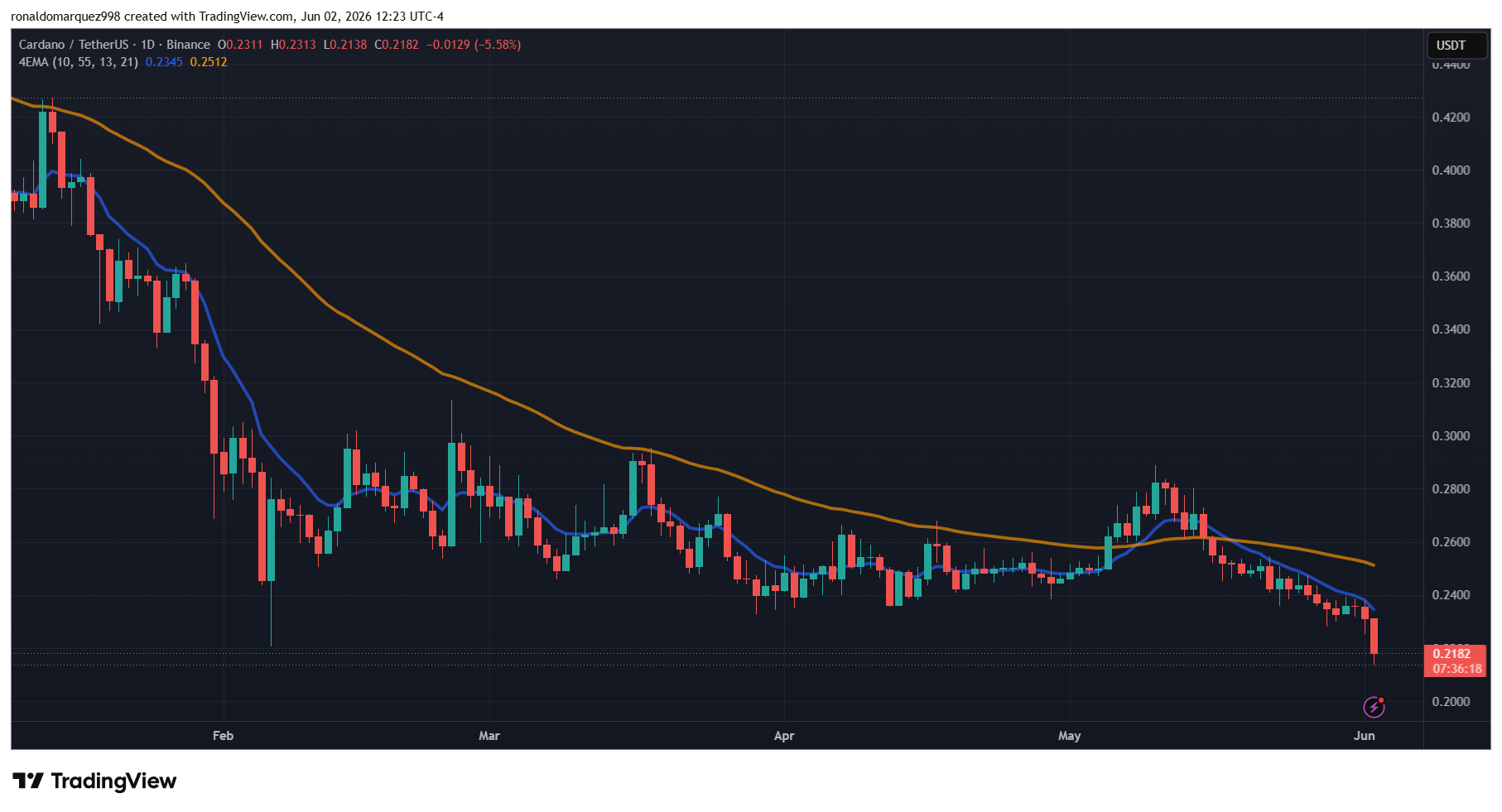
At the time of writing, Cardano’s native token, ADA, was trading at $0.21, while SOL was trading at $76. Over the past 24 hours, both assets recorded losses of a little over 5%. However, the longer-term view shows that ADA is currently 92% below its all-time high, whereas SOL is 73% below its peak.
Featured image created with OpenArt; chart from TradingView.com