


Bitcoin has experienced significant selling pressure following a 16% drop since Monday — a decline that has shaken the confidence built during the recovery from the April lows and forced participants to reassess where genuine structural support exists in the current market structure. Against that backdrop, CryptoQuant data has identified a specific development in the miner flow data that adds a supply-side dimension to the current weakness that experienced on-chain analysts will recognize immediately.
On June 2, Bitcoin miner inflows to Binance reached 24,716 BTC — the highest reading since February 5, when the metric recorded 23,151 BTC. The latest spike surpassed that February high by approximately 1,565 BTC, or roughly 6.8%, making it one of the strongest miner-to-exchange flow events recorded this year. This marks only the second time in nearly four months that miner flows to Binance have crossed the 20,000 BTC threshold — a level that has historically attracted market attention when breached.
The concentration of the move is the structural detail that makes the reading more significant than a broad market-wide increase would be. The spike was not distributed evenly across exchanges — it landed specifically on Binance, establishing the world’s largest crypto exchange as the primary venue where miner-linked Bitcoin supply is reappearing. When supply concentrates on a single venue at this scale, that venue’s order book dynamics become the critical variable for how the market absorbs or fails to absorb what has arrived.
24716 BTC From Miners on One Day
The CryptoQuant analysis applies the honest framework that prevents the miner inflow spike from being automatically read as a sell signal. Large miner deposits to exchanges do not confirm immediate selling intent — the motivations behind a 24,716 BTC transfer to Binance can include hedging against price risk, operational liquidity management, internal rebalancing between custody solutions, or preparation for selling that may or may not materialize in the near term.
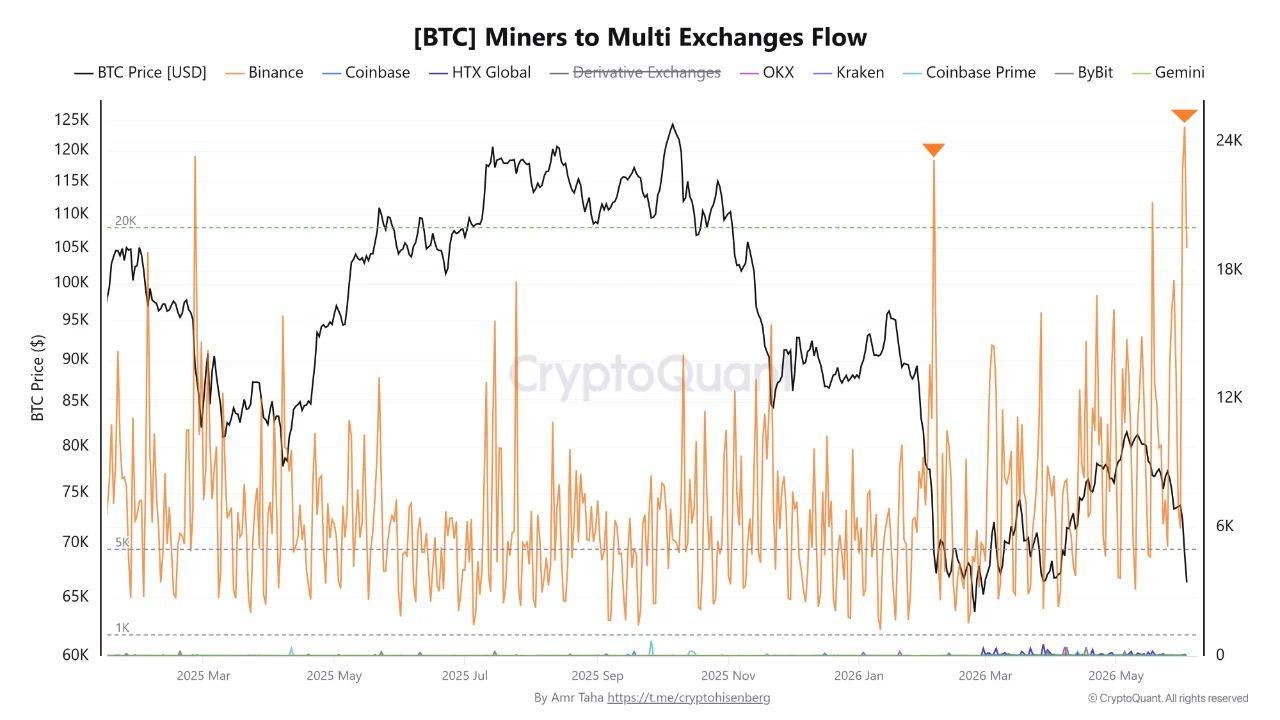
What the transfer does confirm is a state change. Bitcoin that was held in miner custody — removed from exchange order books and unavailable for immediate market sale — has now moved to a venue where it can be converted to other assets within seconds. The distance between that supply and the sell side has collapsed. Whether miners exercise that proximity immediately or hold the coins in exchange wallets without selling, the supply overhang exists, and the market must account for it.
The forward signal the report identifies is duration-dependent. Miner inflows remaining elevated across multiple sessions would confirm a sustained distribution or sell-side pressure pattern — the behavioral signature of miners making a deliberate decision to reduce holdings at current price levels. A spike that fades quickly would suggest a one-day liquidity event rather than the beginning of a broader trend.
Bitcoin’s price reaction in the sessions immediately following the June 2 spike is the data point that will determine which interpretation the market ultimately assigns to the largest miner-to-exchange flow event of the year.
Bitcoin Tests the 200-Week Moving Average After Violent BreakdownBitcoin has suffered a major technical deterioration on the weekly timeframe, with price collapsing more than 15% this week and falling from the $74,000 region to nearly $62,000. The move has erased the entire May recovery and pushed BTC back into the critical support area that defined the February cycle low.
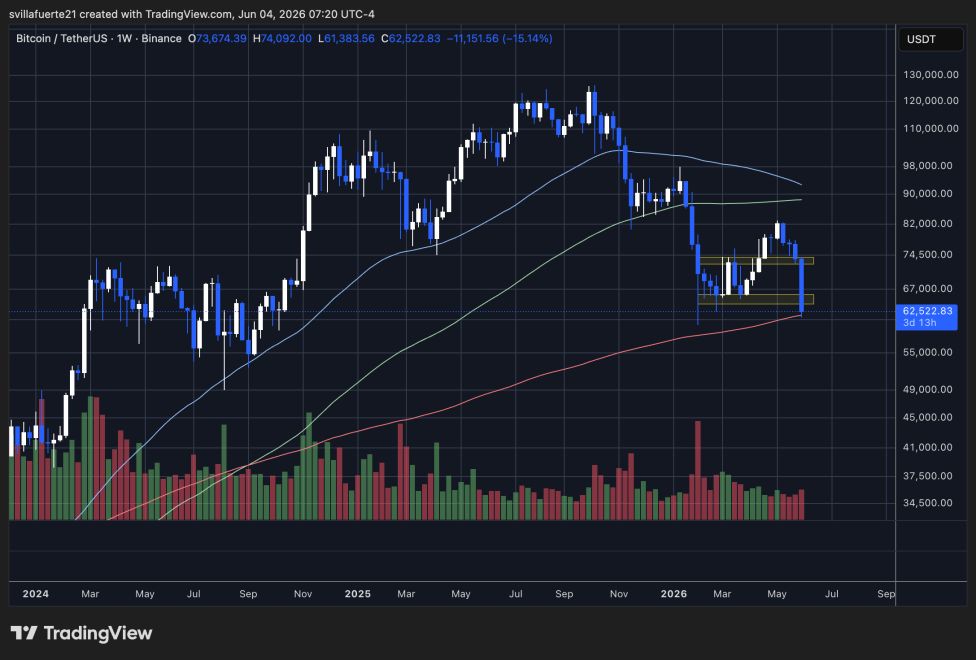
The most important development on this chart is Bitcoin’s return to the $61,000-$63,000 support zone. This region marked the bottom of the February capitulation event and triggered the rally that eventually carried BTC above $80,000. Bulls are once again attempting to defend the same level, making it one of the most significant areas on the chart.
The breakdown below the $65,000 and $73,000 resistance zones confirms that sellers remain firmly in control. Both former support areas have now been lost and are likely to act as overhead resistance on any recovery attempt. The sharp rejection from the $80,000 region also established a clear lower high relative to the late-2025 peak, reinforcing the bearish structure.
However, a critical technical factor is beginning to emerge. Bitcoin is now trading directly on top of the rising 200-week moving average near $62,000. Historically, this moving average has acted as one of the strongest long-term support levels in Bitcoin’s history and has often marked periods of extreme value during major corrections.
If buyers successfully defend the 200-week moving average and the February low region, Bitcoin could attempt to build a base for a recovery. Failure to hold this area would expose the psychologically important $60,000 level and potentially open the door to a deeper correction toward the mid-$50,000 range.
Featured image from ChatGPT, chart from TradingView.com