


AI agents already pay for data, computing power, and web searches on their own. The law, however, still assumes a human approves every transfer. That gap now sits at the center of the AI agent identity debate.
Members of BeInCrypto's Legal & Regulatory Council argue that blockchain can close it.
Who Pays When a Machine Pays?
The market is still young. A recent BeInCrypto Intelligence report tracked 6.4 million x402 payments in 35 days, mostly tiny sums for data and API calls.
Banks are nervous all the same. JPMorgan now blocks outside AI agents from customer accounts, and CEO Jamie Dimon cites the risk of rogue agents.
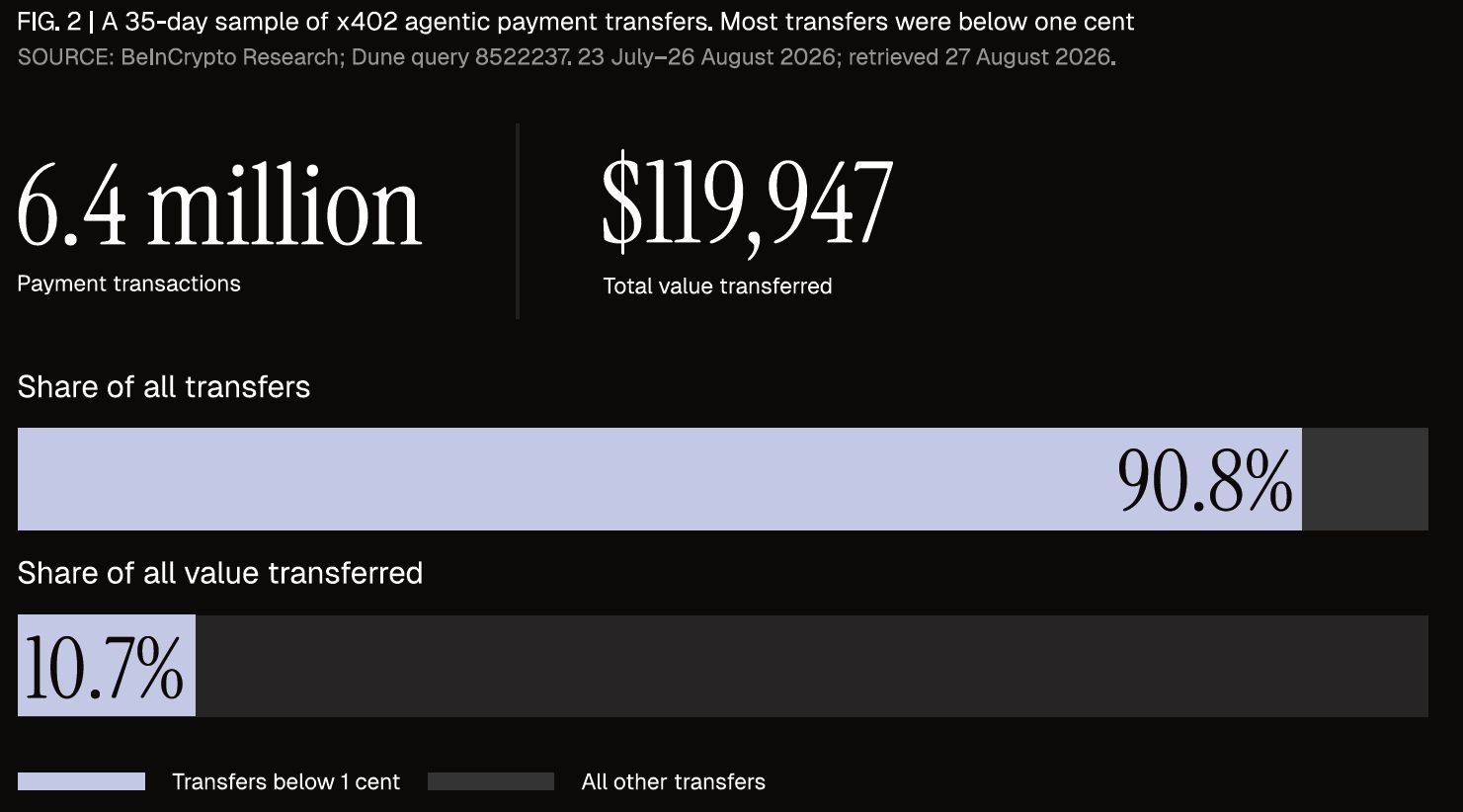 x402 agent payments, July 23–August 26, 2026. Source: BeInCrypto Research
US law offers little guidance. The Electronic Fund Transfer Act still governs unauthorized transfers. Congress wrote it in 1978 for a world where a human authorizes each one. The GENIUS Act, in turn, sets rules for stablecoin issuers but says nothing about the agents that spend those coins.
As a result, nobody can say for sure who pays when an agent books the wrong flight. That is a question of AI agent identity as much as of liability.
Why AI Agent Identity Needs a Blockchain Layer
Vyara Savova, a senior policy expert at the European Crypto Initiative, expects most people to use agents for routine tasks that involve payments. In her view, blockchain bundles everything those agents lack.
"So then we have the payment rails, the identification rails, basically the trust layer, all in one, which would to a very large extent solve this."
Lawyer Anja Blaj Zajc rejects the idea that users must pick between privacy and accountability. Zero-knowledge (ZK) proofs, she argues, remove that choice. A ZK proof confirms a fact without revealing the data behind it.
"You would have the ZK proof that proves that there's indeed a human behind that agent, that there's going to be somebody responsible for that agent," Blaj Zajc said.
That point carries legal weight. Liability law needs a person to hold to account, and an anonymous wallet offers none. A ZK credential could tie an agent to a responsible owner without exposing that owner to every merchant.
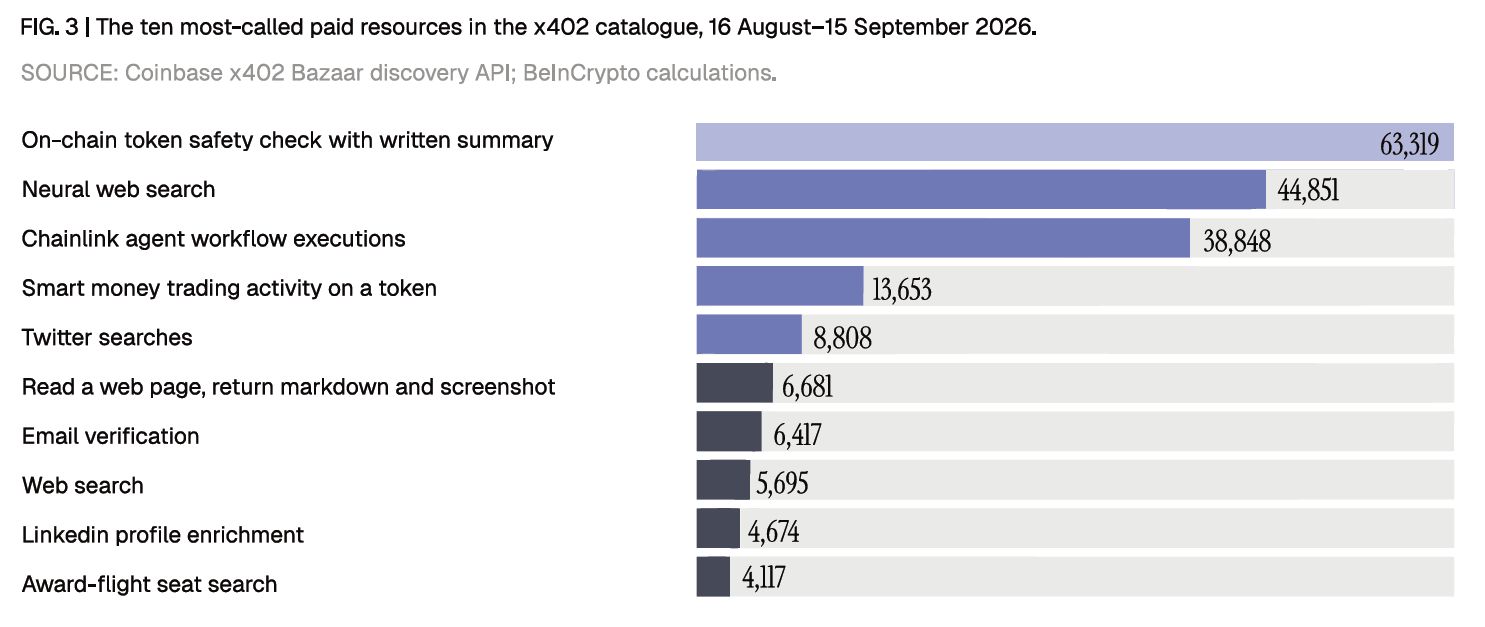 The ten most-called paid resources in the x402 catalogue, August 16–September 15, 2026. Source: BeInCrypto Research
Transparency Is Already the Law in Europe
Lord Chris Holmes puts disclosure first. He is a Conservative member of the UK House of Lords and sponsored a private member's bill on AI regulation.
"It always needs to be clear AI was used, how it was used, for what purpose, and that consent and trust and transparency were in that mix," Holmes said.
The EU already demands part of that. Since August 2, 2026, Article 50 of the EU AI Act obliges chatbot providers to tell people they are dealing with an AI system. National authorities can enforce the rule.
Notably, the AI Omnibus pushed high-risk deadlines to 2027 and 2028 but left this duty in place.
Still, the AI Act covers disclosure, not payments. No EU or US rule yet tells a merchant how to verify the human behind a paying agent.
Until lawmakers fill that gap, banks will likely keep their doors shut to outside agents. For now, ZK-based AI agent identity is the council's preferred fix: prove that a human is accountable, and reveal nothing else.
Read the Original story AI Agent Identity Needs Blockchain, Legal Experts Say by Phil Haunhorst at beincrypto.com