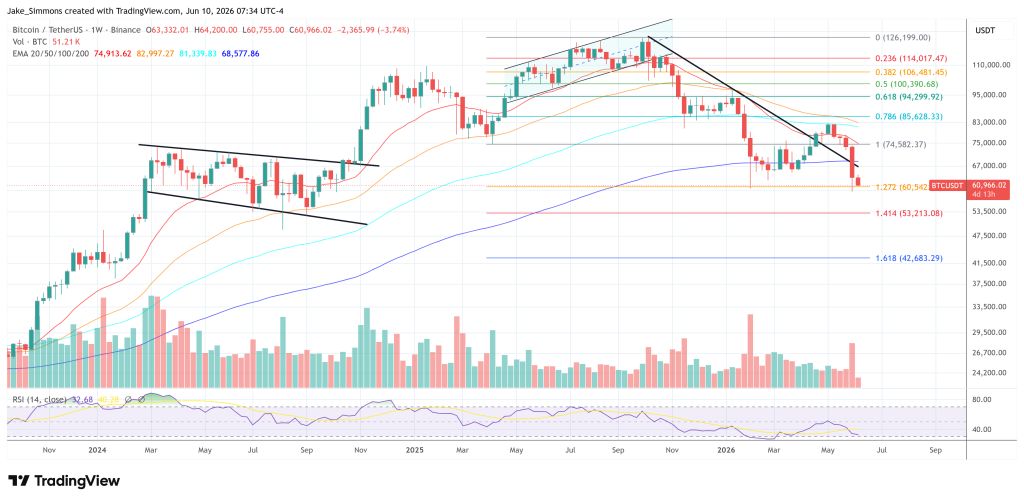
Luke Gromen says Bitcoin’s failure to break decisively higher may reflect more than weak spot demand, arguing that paper instruments can temporarily absorb buying pressure in the same way derivatives have shaped the gold market for years.
Speaking with Nathalie Brunell in a June 6 interview, the macro analyst said he has not materially rebuilt the Bitcoin position he previously reduced. “I nibbled a little bit,” Gromen said, but added that he has “not really bought back in in any real way.” The reason, he suggested, is that Bitcoin’s recent price action may be signaling something important about liquidity, market structure and the political sensitivity of hard-asset signals.
Paper Bitcoin And The $58K-$72K Frustration Zone
Brunell asked Gromen about his prior remark that Bitcoin could remain stuck in what she described as a “$58K to $72K gang for a while,” and whether BTC and gold prices could be suppressed. Gromen clarified that the comment was partly “tongue-in-cheek,” but said there is a serious mechanism behind the idea.
“I think the way they would do it is the expansion of derivatives, the way they’ve done it with gold historically,” he said. “I think you can in the long run. I don’t think you can do it with Bitcoin, but to the extent that you can expand derivatives, in the short run they can matter.”
Gromen’s argument is not that Bitcoin’s supply can be changed, but that demand can be diverted. A buyer that otherwise would need to purchase spot BTC can instead buy a call option or another synthetic instrument. That still expresses bullish exposure, but it does not necessarily remove coins from the market in the same way self-custodied spot accumulation would.
“Somebody wants to own Bitcoin, but they’re not buying Bitcoin. They’re buying a call on Bitcoin,” Gromen said. “If you didn’t have those derivatives there, then if you want to own Bitcoin, you got to own Bitcoin. Now, you can buy a derivative on Bitcoin, and it starts to get sloppier, looser.”
For Gromen, that distinction matters most over shorter windows. He argued that policymakers can manage optics “to a lot of things” in the near term, even if they cannot do so indefinitely.
Luke Gromen on why Bitcoin might keep stalling around $58k-72K: big players can satisfy demand with paper bets instead of buying real #Bitcoin , which holds the price back.
It’s worked on #gold for years, but he doesn’t think it lasts forever with Bitcoin… https://t.co/yPAuJA3dKI pic.twitter.com/CwZ2cGwwW6
— Natalie Brunell
(@natbrunell) June 9, 2026
Bitcoin As A Liquidity Smoke Alarm
The derivative-suppression thesis sits inside a broader macro framework. Gromen described Bitcoin as “one of, if not the last functioning smoke alarm of liquidity,” and said its recent weakness is “telling us not good things.” In his view, liquidity is being absorbed elsewhere, most visibly by AI-related equities and by energy and commodities after the Iran war .
“AI is sucking all the oxygen out of the room, all the liquidity out of the room, and it’s all in one area,” Gromen said. “And I think that’s happening to Bitcoin as well. I think it’s a victim of that as well.”
He argued that the equity rally is narrower than headline indices suggest, with AI-linked names carrying much of the move. That makes Bitcoin’s lag more relevant to him: if BTC is a liquidity-sensitive asset and it is not confirming the strength in stocks, the market may be less healthy than the index level implies.
Gromen linked the issue to the US effort to run the economy hot, weaken the dollar and reshore production. Those forces, he said, should be positive for gold and Bitcoin in a freer market. But they also risk sending an uncomfortable message.
“There are elements in the US that don’t want to see that because those things will be communicating to the world, hey, you’re just inflating,” he said. “Hey, you’re just inflating. And that creates some issues on the financing side with the Treasury market.”
His base case is not a conventional crash, but a shift in the measuring stick. He expects equities to rise in dollar terms while falling when priced in gold and Bitcoin. In that scenario, hard assets outperform nominal claims, while 10-year Treasury yields remain broadly contained in the 4% to 4.5% area.
That is why Gromen does not see any potential suppression of Bitcoin as permanent. Paper markets can delay a move. They can blur the signal. But in his framework, they cannot eliminate the underlying macro pressure.
“In the short run, they can manage the optics,” he said. “In the long run, they can’t.”
At press time, BTC traded at $60,966.