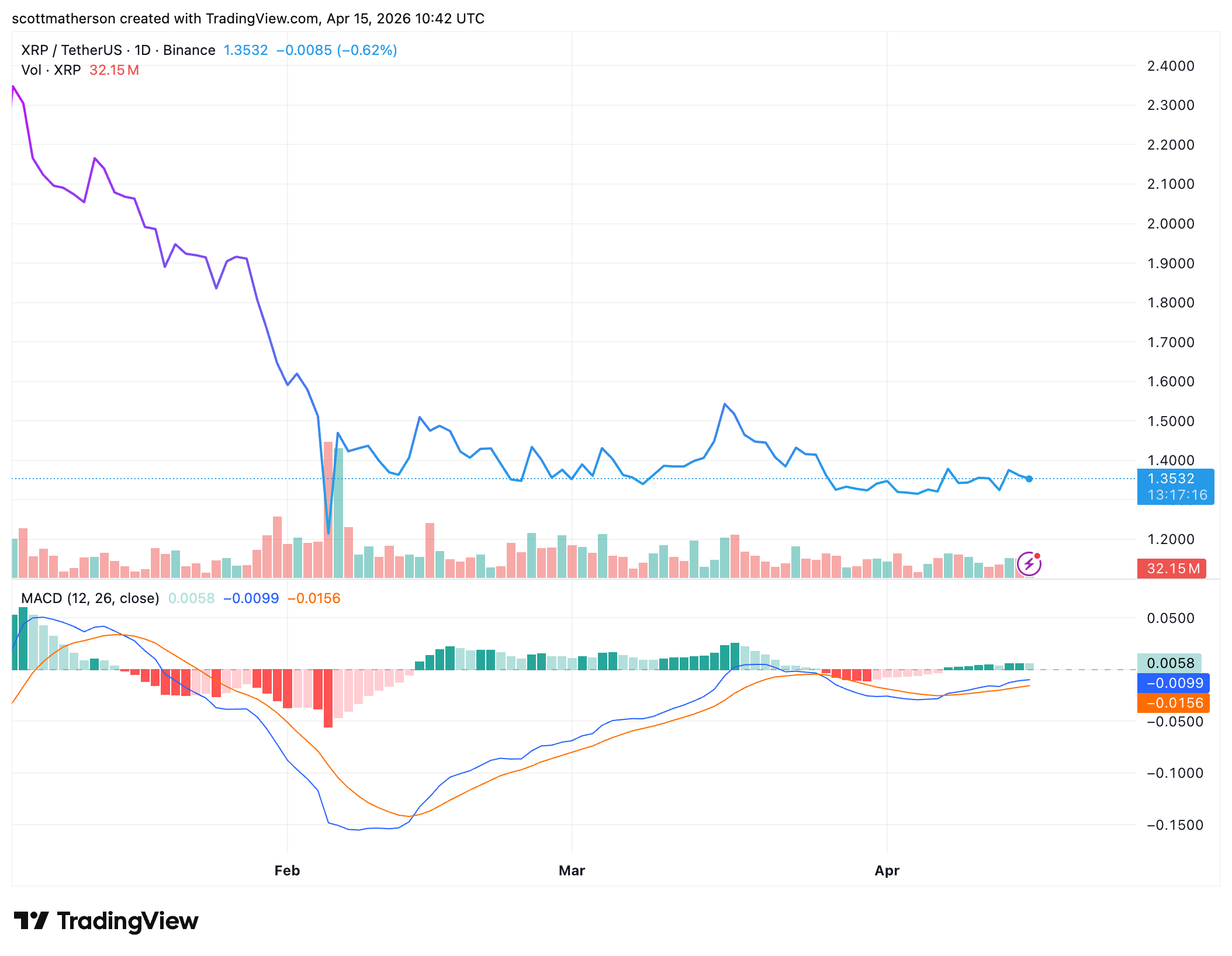
Market analyst Luke Suther has issued a detailed report challenging the traditional reliance on charts to determine XRP’s valuation. The analysis, posted on X, suggests that th price action on charts does not account for its role in broader liquidity systems and, as a result, fails to capture its true long-term value .
Analyst Rejects Chart-Based XRP Price Assessments
Rather than relying on technical chart patterns, Suther shifts the focus toward XRP’s underlying utility and the massive financial rails established around it. He argued that the cryptocurrency’s real value can be accurately measured only by its role as a settlement layer in the global financial sector and its functionality across institutional networks.
Notably, Suther revealed that the altcoin is currently positioned within a global finance infrastructure worth multiple quadrillions of dollars. This infrastructure includes a diverse array of traditional banking institutions and payment processors worldwide.
In his analysis, he outlined key segments of the global financial system and their estimated valuations, arguing that the altcoin’s price outlook lies in its potential to handle large-scale settlement demand across these markets. He noted that:
All Japanese banks manage approximately $25 trillion The DTCC processes roughly $3 quadrillion SWIFT handles about $1.5 quadrillion The top 10 US banks hold over $12.5 trillion Tokenized assets account for $2 trillion Mastercard manages around $9 trillion Visa processes up to $16 trillion The derivatives market represents about $1 trillion American Express handles roughly $1 trillion Hidden Road, now rebranded as Ripple Prime, manages approximately $3 trillionAccording to Suther, the combined value of these financial segments is estimated at roughly $5.53 quadrillion. The report highlights this as the total volume of transaction activity moving through settlement networks, a portion of which XRP could potentially support.
Within this context, the analyst argued that market capitalization and technical chart patterns fail to capture the demands of high-volume settlement systems. Instead, he emphasized that the token’s value should be assessed based on its throughput capacity and its ability to facilitate faster, cheaper transfer of value across international financial systems.
XRP Pricing Structure Tied To Institutional Flow
In his post, Suther noted that many people made the same mistakes when assessing XRP’s value. They try to directly match the $5.53 quadrillion flow of global finance to XRP’s market capitalization . He explained that the token is not designed to hold that value, but to move it.
From this standpoint, the analyst stated that the more relevant question is not whether it can handle trillions in flow, but what price is required for billions to move instantly without friction. He added that if XRP’s price is too low, liquidity would remain thin and slippage would rise, making large-scale settlement inefficient. In his view, a higher XRP price is a functional requirement for the system to operate effectively at a global scale.