


Japan’s stock market was the envy of the world in the mid-1980s. I know, I was there. Not in Japan, but in my first job out of college, at a big Japanese bank in NYC’s World Trade Center. It was the best introduction to Wall Street I could ever hope for.
At the time, Japanese banks were highly sought after by Wall Street brokerages. Japan’s economy was a juggernaut, and U.S. investment firms all wanted a piece. Then, Japan’s market fell down, and yada yada yada. After treading water for more than three decades, it’s finally breaking out again.
More Yield, Less Trap: Sign up free to get Barchart’s daily Dividend Investor newsletter straight to your inbox.
Wow, you say? Yes, wow.
Meanwhile, China took over as the low-cost production hub of the U.S. and much of the globe. You know the story. Its economy went from being an emerging market to the second-largest on the planet.
But enough of my history lesson. What about now?
It appears investors are friendly to not only Japan and China, but nearly all of the Asian continent. Let’s explore, and then check out opportunities through a pair of ETFs I’ve used for many years.
There are bigger Asia-focused ETFs than the iShares Asia 50 ETF (AIA), but the iShares MSCI Japan ETF (EWJ) is roughly the largest fund that tracks Japan’s equity market.
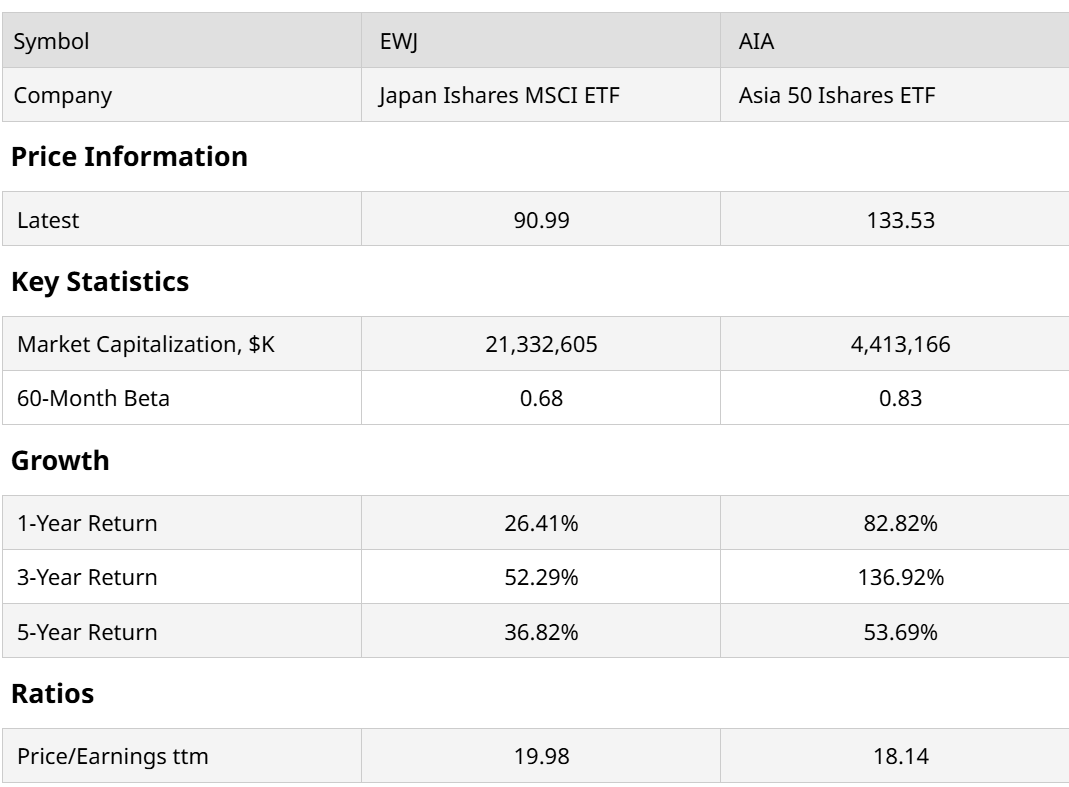 www.barchart.com
 EWJ is more diversified than the typical U.S. large-cap equity ETF. That’s because it does not have a “Magnificent 7.” That said, Japanese multinationals are at the top of EWJ’s holdings list, including many that are familiar to U.S. consumers.
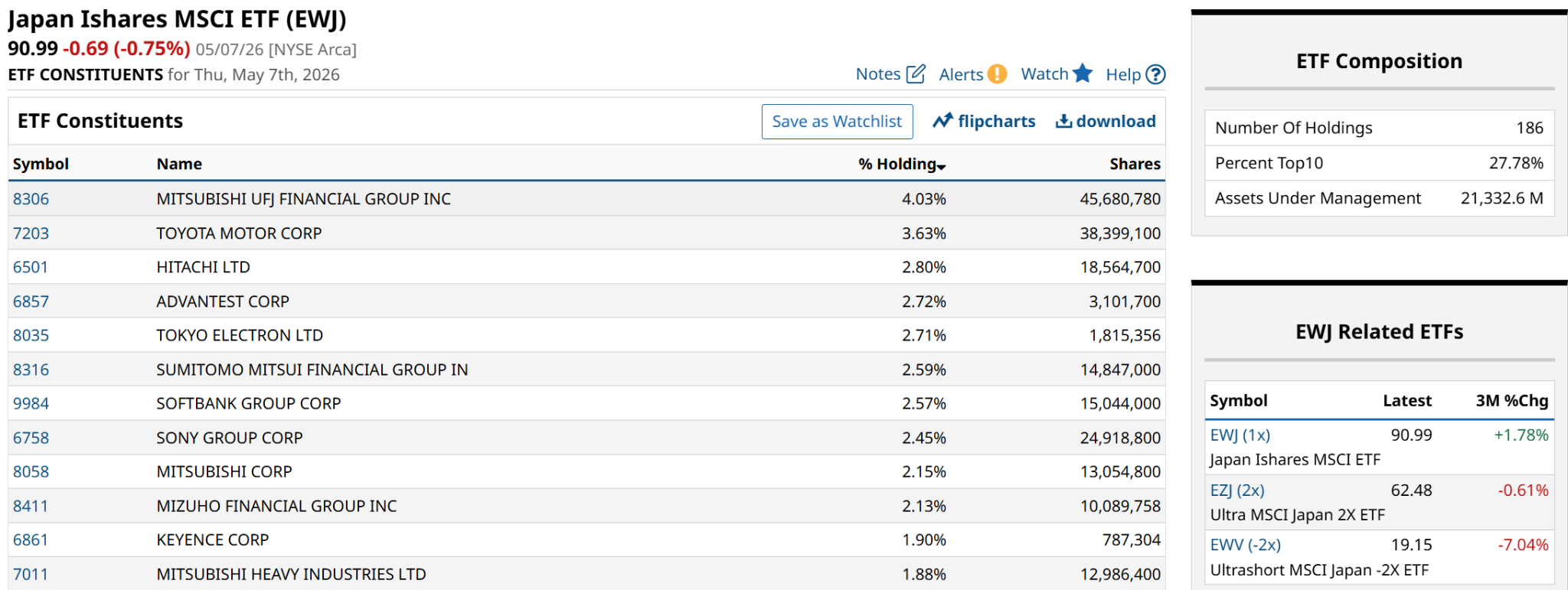 www.barchart.com
 AIA, by contrast, is very top heavy. 10 stocks comprise nearly two-thirds of the ETF, and just four companies account for about half. That makes AIA a convenient way to own market leaders with just a bit of “cover” via the other 60-plus stock holdings.
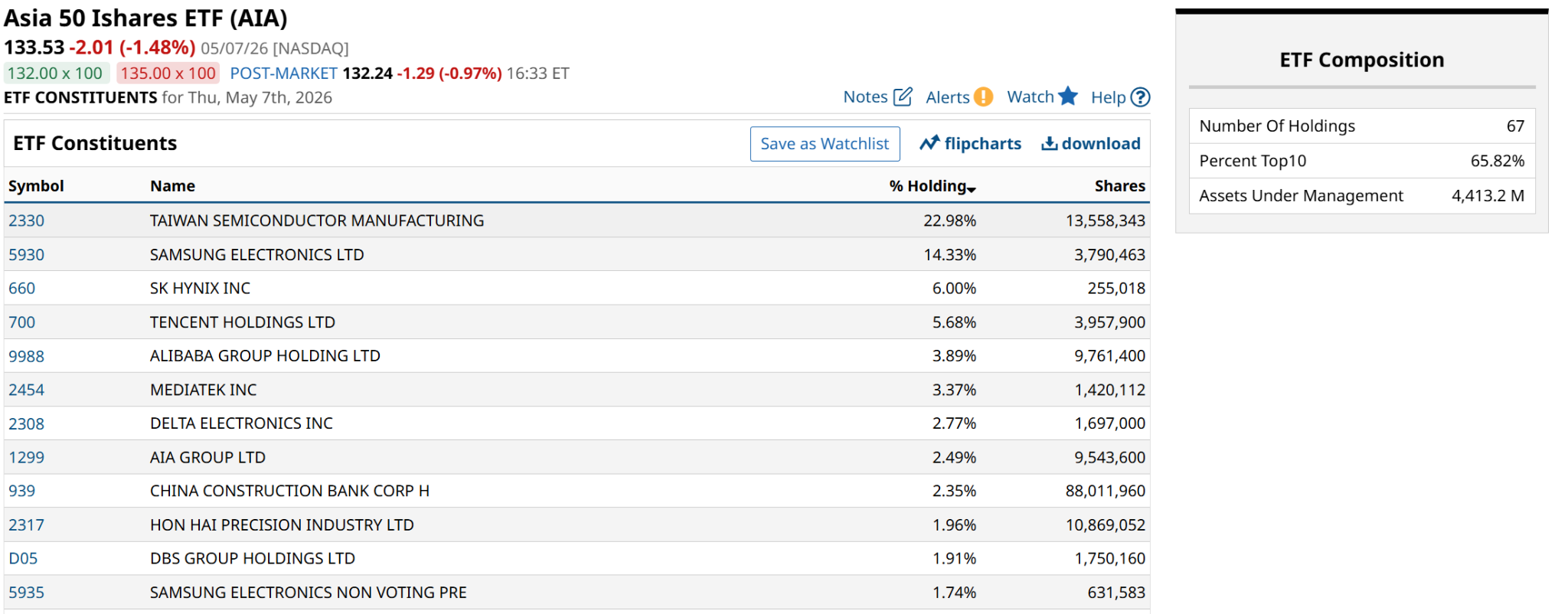 www.barchart.com
 The concurrent rally in these two ETFs represents a significant shift in global capital allocation. While historically China and Japan have often moved in opposite directions — frequently due to the “yen carry trade” or capital flight from one to the other, this year has seen a rare alignment of interests.
Why Are Asia Stocks Rising?
The primary common driver is a structural re-rating of Asian growth prospects. Both ETFs are heavily weighted toward the semiconductor and hardware infrastructure sectors, which are the primary beneficiaries of the ongoing global artificial intelligence expansion. As global investors look for alternatives to high-valuation U.S. mega-cap tech, the integrated supply chains across Japan, Taiwan, and South Korea have become a magnet for catch-up trades. Additionally, a broader stabilization in the U.S. dollar has historically acted as a tailwind for both developed and emerging Asian equities, reducing the cost of dollar-denominated debt for regional corporations.
However, the individual drivers for each market remain distinct. For Japan and EWJ, the rally is fundamentally about normalization. The Bank of Japan’s move to raise interest rates to 0.75% in late 2025 signaled the definitive end of the deflationary era. This has fundamentally improved the earnings outlook for the massive financial sector within the ETF. Furthermore, the Tokyo Stock Exchange’s ongoing governance reforms have forced Japanese companies to prioritize shareholder returns through buybacks and dividends, attracting long-term institutional investors who previously avoided the region due to poor capital efficiency.
Conversely, AIA, which represents Asia ex-Japan with heavy concentrations in China, Taiwan, and South Korea, is being driven by a recovery in sentiment toward Greater China and the North Asian tech corridor. After a period of extreme pessimism, Chinese innovation in healthcare and semiconductors has led to a rebounding Hang Seng and Shanghai Composite. For the Taiwan and South Korea components of AIA, the rally is a pure cyclical play on the “silicon cycle,” with foundries and memory providers seeing a surge in demand that is finally manifesting in top-line revenue growth.
The risk of this joint rally is the potential for currency volatility. EWJ is unhedged, meaning its returns are amplified by a strengthening yen but suppressed by yen weakness. AIA is sensitive to the stability of the yuan and the won. If the Bank of Japan tightens too aggressively or if trade tensions resurface in Greater China, the current correlation could break.
What Do the Charts Tell Us?
AIA, in terms of its percentage price oscillator (PPO) indicator (lower part of chart), is literally in uncharted territory. That means it is so extended, it is in dangerous territory after its 30% move the past six weeks. But that doesn’t mean it can’t melt up from here.
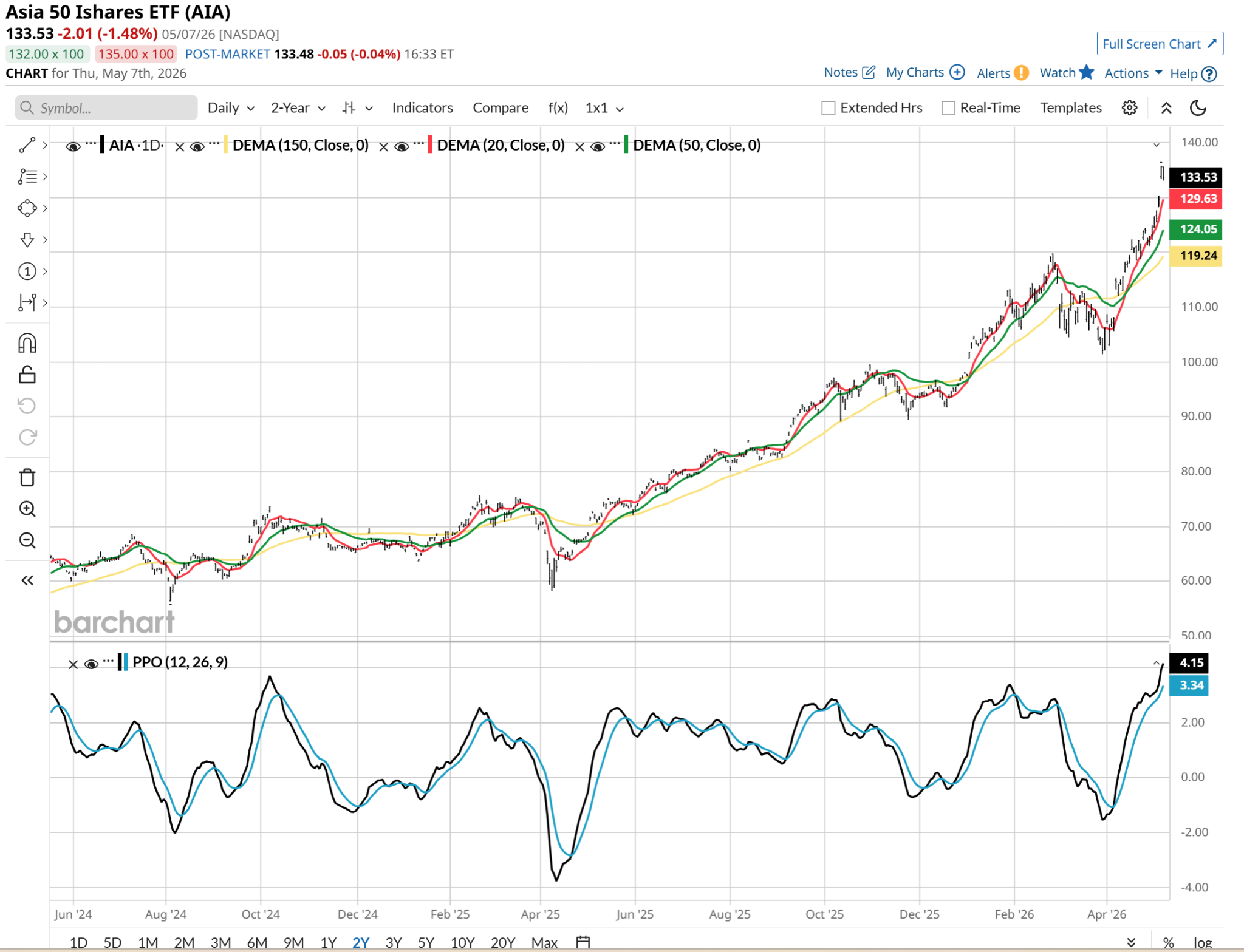 www.barchart.com
 True to form, AIA’s ROAR Score was in the green/lower risk zone throughout most of its rally. However, it is clearly stretched, which naturally takes the score down. It now sits in the neutral/yellow risk zone.
 Chart courtesy of Rob Isbitts via PiTrade.com
 EWJ is the better-postioned of the pair. The chart shows it, via a more trading range picture. Granted, it’s a 20% trading range, so be careful, traders.
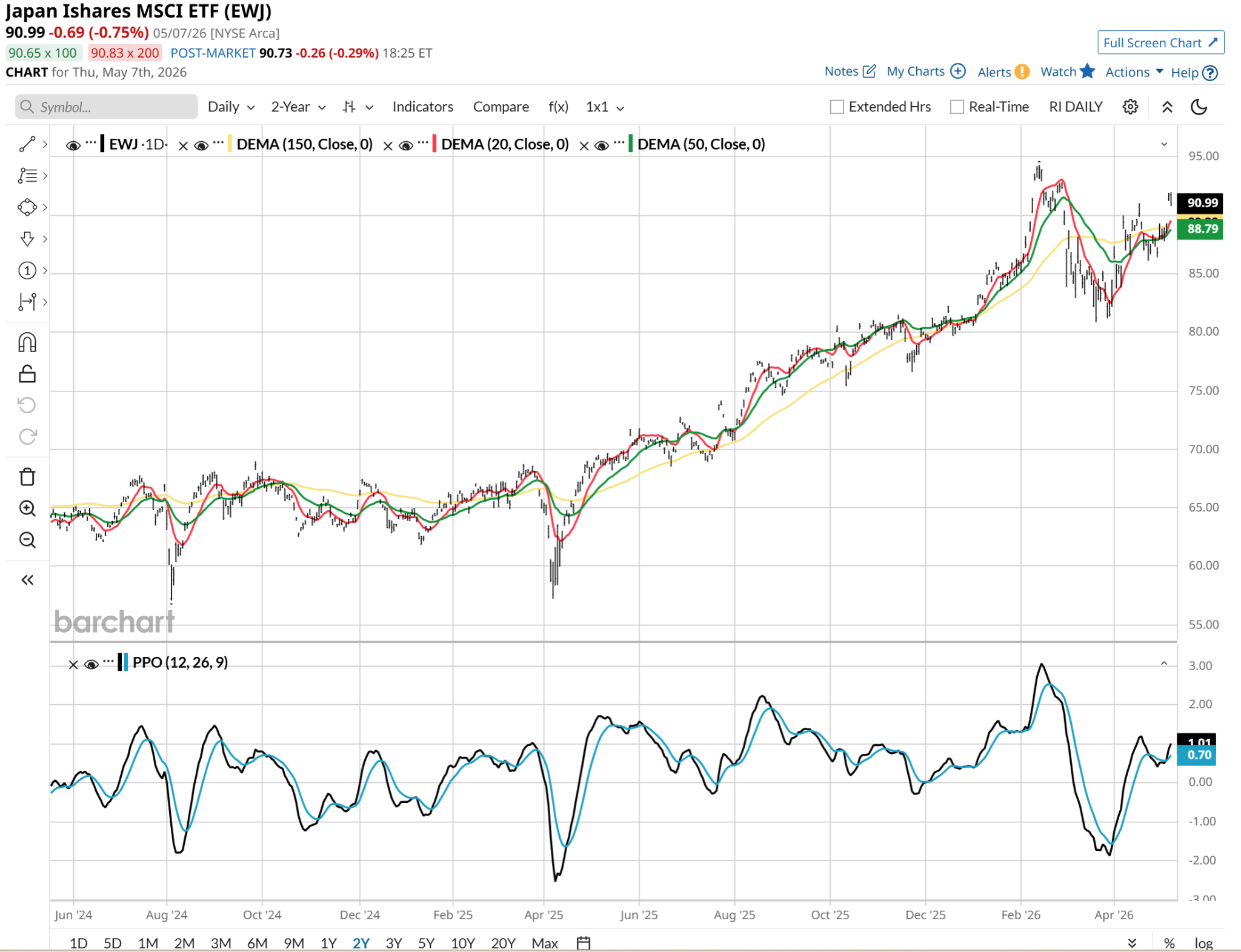 www.barchart.com
 EWJ’s ROAR Score, currently at 60, reflects that assessment. Since entering the green zone a couple of weeks ago, it is up about 7%.
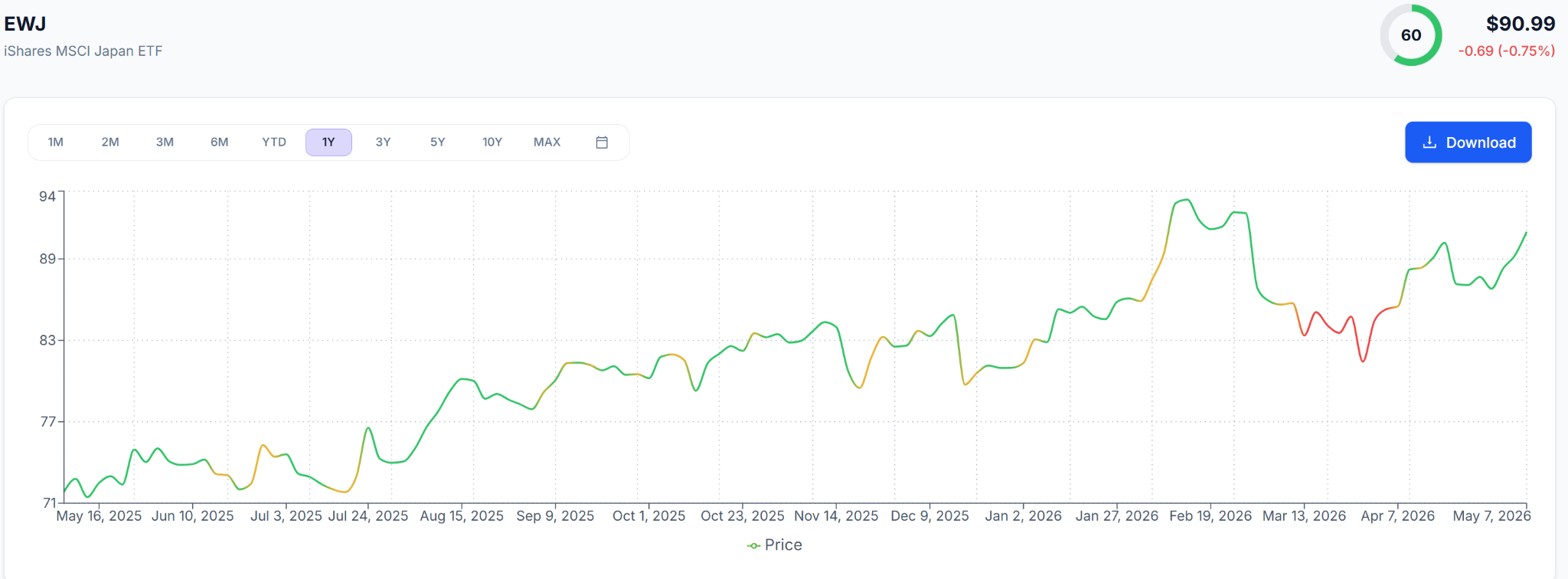 Chart courtesy of Rob Isbitts via PiTrade.com
 These ETFs are back, from an investing standpoint. But the sharp moves up often signal more of a period of elevated volatility than assured gains. International diversification can be very useful. But avoid chasing, here and elsewhere, in the big wide world of ETFs.
Rob Isbitts created the ROAR Score, based on his 40+ years of technical analysis experience. ROAR helps DIY investors manage risk and create their own portfolios. For Rob’s written research, check out ETFYourself.com.
On the date of publication, Rob Isbitts did not have (either directly or indirectly) positions in any of the securities mentioned in this article. All information and data in this article is solely for informational purposes. For more information please view the Barchart Disclosure Policy here.
More news from Barchart
Wall Street Is Bullish on These 2 Asia ETFs. It’s Time to Party Like It’s the 1980s. Solar ETFs Are Shockingly Cheap Now. Politics Will Decide If They’ll Burn You to a Crisp. This ETF Is Flying High Again. Here's How to Tell If It Will Continue. Don’t Trust This Top-Heavy Stock Market, Hedge It. Here’s Your Roadmap.