

Inflation is proving stubborn again. Fuel prices are climbing, consumers are growing selective, and retailers are walking a tightrope between protecting margins and keeping shoppers loyal. That balancing act has become even tougher as investors demand growth and profitability at the same time.
So when a retail giant like Walmart (WMT) posts solid quarterly results but still sees its stock tumble 7%, it raises a fair question: What exactly does Wall Street want now?
More Top Stocks Daily: Go behind Wall Street’s hottest headlines with Barchart’s Active Investor newsletter.
The answer may come down to valuation. But buried inside Walmart’s latest earnings report was another story entirely — one that suggests the company is evolving into something far larger than a traditional retailer.
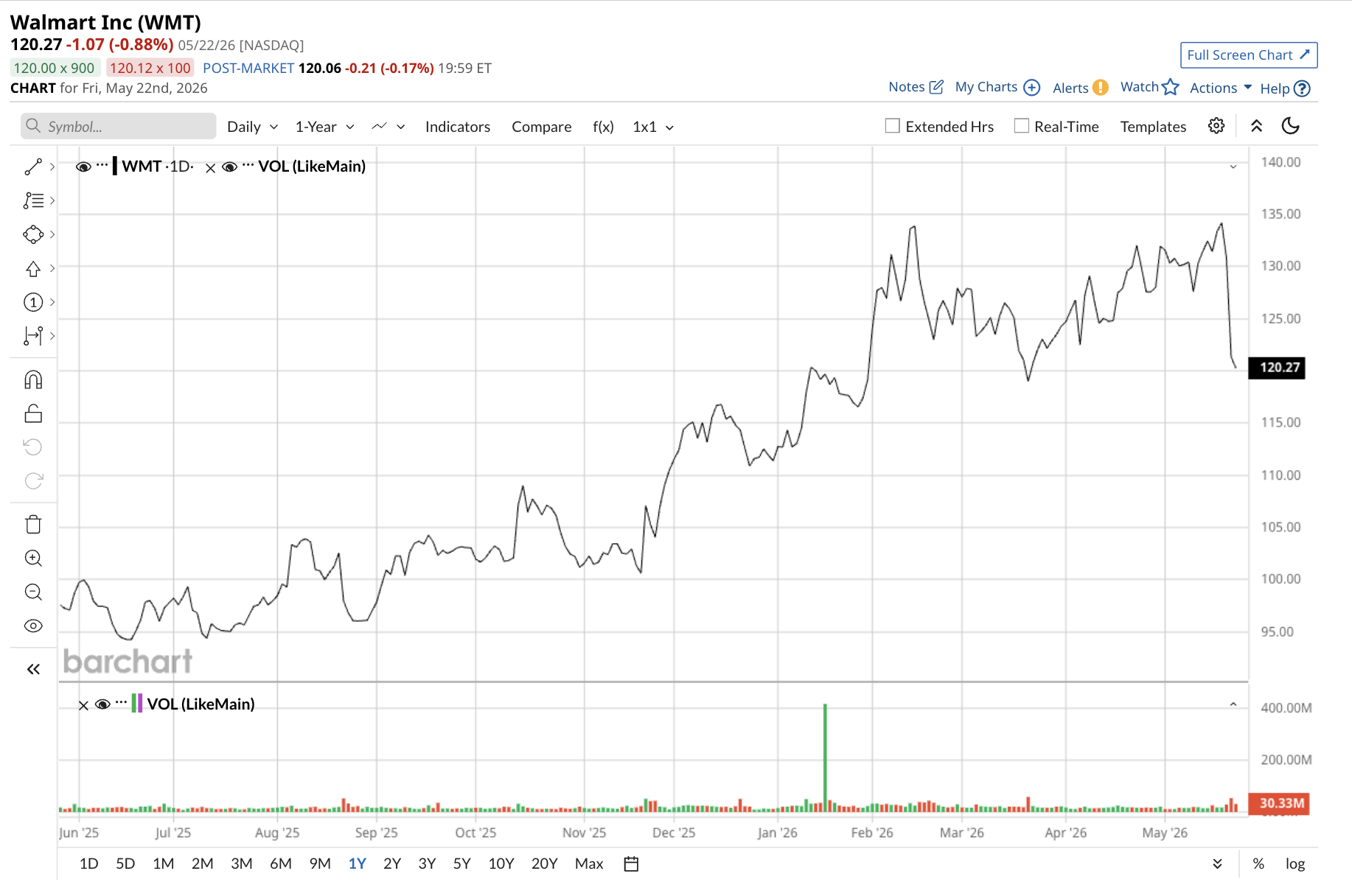 www.barchart.com
Walmart’s Quarter Was Good — Just Not Good Enough
Walmart’s Q1 earnings saw revenue rise 7.3% year-over-year to $177.8 billion, while adjusted earnings-per-share came in at $0.66, up 8%. U.S. comparable sales climbed 4.1% at its Walmart stores and 3.9% at Sam's Club, showing shoppers are still spending despite economic pressure.
Those are healthy numbers for a company with a market capitalization of nearly $1 trillion. Yet investors focused less on what Walmart delivered and more on what management warned could happen next.
Q2 guidance reflected caution around inflation and rising fuel costs, two factors that directly pressure consumer spending and transportation expenses. Walmart CFO John David Rainey noted during the earnings call that economic uncertainty remains elevated, particularly among lower-income households.
That caution mattered because Walmart stock entered earnings trading at roughly 38 times forward earnings, far above peers like Target (TGT) at about 15 times earnings, though Costco Wholesale (COST) goes for 51 times. When valuation climbs that high, even strong results can disappoint investors looking for perfection.
Granted, Walmart still generated $4.7 billion in operating cash flow during the quarter and maintained its position as America’s dominant grocer. But regardless of how you look at it, expectations were elevated.
The Hidden Growth Engine Inside Walmart
But here is the part many investors may be underestimating. Walmart’s membership and other revenue segment rose 27% year-over-year to $2.07 billion — the first time the business crossed the $2 billion threshold. The gains came from two particularly attractive areas:
Membership fee revenue rose 17% Advertising revenue jumped 37%That matters because these businesses carry far higher margins than traditional retail.
During the earnings call, Rainey said, “Membership [and] advertising ... combined comprise roughly a third of our earnings today.”
That single statement may have been the most important takeaway from the entire report.
Walmart is a massive retailer, logistics network, and tech platform that has added an important advertising component. Its Walmart Connect ad business allows brands to pay for premium placement across Walmart’s website, app, and in-store ecosystem. In plain English, Walmart is monetizing the traffic generated by the 280 million weekly customers visiting its stores and digital platforms globally.
That model increasingly resembles what Amazon (AMZN) built with its advertising segment, which generated more than $56 billion in ad revenue last year.
Walmart’s ad business remains much smaller today, but the growth trajectory matters more than the current size. Advertising revenue growing 37% inside a company already generating more than $76 billion annually in sales is no small detail.
Key Takeaway
In short, Walmart’s latest quarter showed two competing realities.
First, the stock looks expensive. Even after the recent 7% decline, investors are paying a premium multiple for a company facing inflation pressure, fuel cost risks, and slowing consumer demand.
Second, Walmart is quietly building a higher-margin ecosystem around memberships, advertising, logistics, and digital commerce. That hidden growth driver could reshape how investors value the company over the next decade.
That said, WMT may not be the stock savvy investors rush to buy today. Valuation still matters. But when all is said and done, Walmart remains one of the few companies with the scale, customer base, and infrastructure to compound steadily for the next 20 years.
For long-term shareholders, that may matter far more than one rough week on Wall Street.
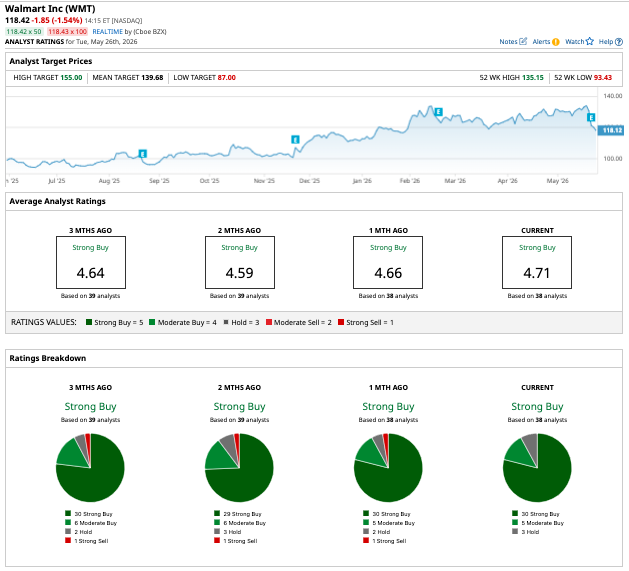 www.barchart.com
 On the date of publication, Rich Duprey did not have (either directly or indirectly) positions in any of the securities mentioned in this article. All information and data in this article is solely for informational purposes. For more information please view the Barchart Disclosure Policy here.
More news from Barchart
Walmart’s Fastest-Growing Business Isn’t Retail, but It Still Needs to Justify Its Premium Valuation Dear Nvidia Stock Fans, Mark Your Calendars for June 2 3 Reasons to Add NetApp Stock to Your Watchlist Now (Hint: Shares Are Undervalued Here) IREN Stock Is Already Up 58% in 2026. Nvidia Could Keep Taking Shares Higher.