

Nvidia Corporation (NVDA), the famous Silicon Valley chipmaker powering much of today’s artificial intelligence (AI) infrastructure boom, has become one of Wall Street’s biggest market stars. Even AI’s biggest superstar is not getting a free ride on Wall Street right now.
Despite another impressive quarter, the chip giant’s latest Q1 FY2027 report still triggered some profit-taking as investors worried about sky-high expectations, China restrictions, and whether the AI boom can keep growing at this insane pace forever. When a company becomes the face of an entire tech revolution, even great numbers sometimes stop being “good enough.” But while traders debate valuation charts, CEO Jensen Huang is already moving to the next battlefield – Taiwan.
More Top Stocks Daily: Go behind Wall Street’s hottest headlines with Barchart’s Active Investor newsletter.
Next week, the Nvidia CEO heads to Taipei for COMPUTEX 2026 and GTC Taipei, where the spotlight may shift from quarterly earnings to the growing “AI semiconductor triangle alliance” between Nvidia, SK Hynix, and Taiwan Semiconductor Manufacturing Company (TSM). Together, these three companies sit at the center of the AI supply chain powering everything from massive data centers to next-gen supercomputers.
The timing is no coincidence. Nvidia is reportedly preparing to deepen ties with both partners as AI infrastructure demand keeps exploding globally. Huang is also making Nvidia’s long-term Taiwan commitment crystal clear. He recently called Taiwan the “epicentre” of the AI revolution and revealed Nvidia could eventually spend as much as $150 billion annually there. The chip giant is even building a new Taiwan headquarters that could employ thousands.
Taiwan is becoming the center of the global AI supply chain, drawing massive investments and partnerships across the semiconductor industry. With Huang heading back to Taipei, investors are watching closely to see how this growing AI alliance could shape NVDA’s next growth chapter.
About Nvidia Stock
Known to almost everyone as the company leading the AI boom, Nvidia has come a long way from just making gaming chips. Founded in 1993 and based in Santa Clara, California, the tech giant now powers everything from AI data centers and robotics to self-driving cars and advanced computing systems.
Its GPUs have become the backbone of the AI race, helping Nvidia grow its market cap to nearly $5.15 trillion and become one of the world’s most valuable companies. The company has also focused on energy-efficient technology and building a more diverse workforce as its influence across the tech world keeps getting bigger.
NVDA stock has spent the past few years behaving less like a normal tech stock and more like the scoreboard for the entire AI revolution. Every time Wall Street gets excited about AI, NVDA seems to race higher, and with doubts creeping in, the stock quickly reminds investors of the volatility of AI excitement.
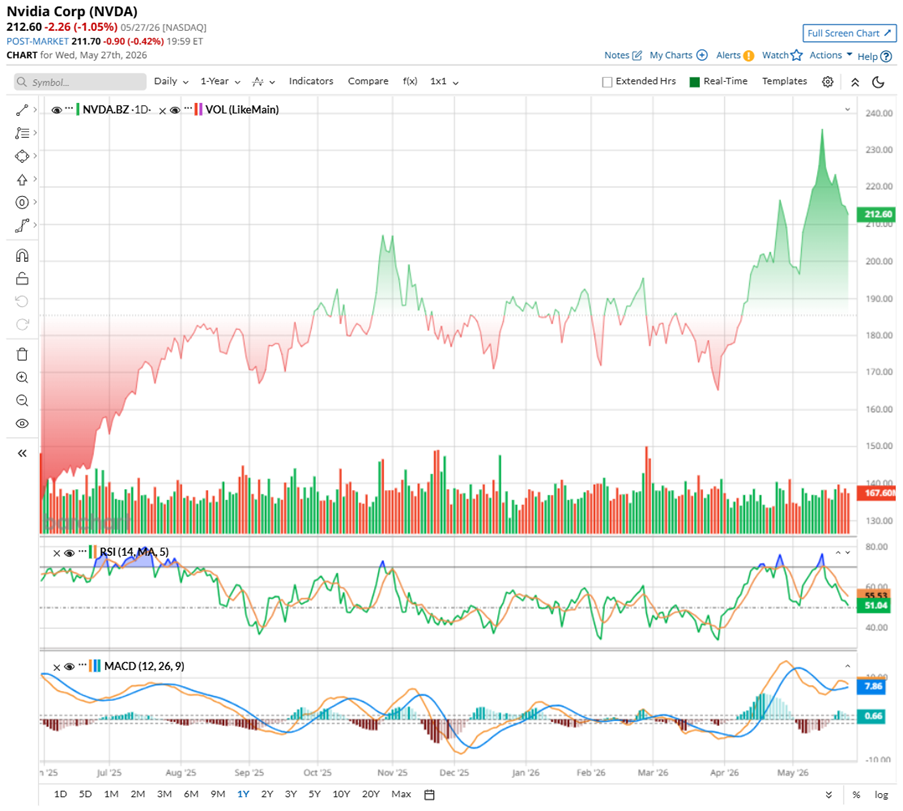
That push-and-pull has been on full display lately. The chip stock has repeatedly smashed records over the past 52 weeks, hitting fresh highs multiple times as investors poured into the AI trade. The rally reached another peak on May 14, when shares touched $236.54 before cooling 9%, showing that even the market’s biggest winner occasionally needs to catch its breath.
The selling pressure became even more visible after Nvidia's first-quarter report on May 20. While the company again delivered blockbuster numbers, the market reaction stayed surprisingly cold, and every trading session since the earnings release has finished in red.
Still, the bigger trend remains hard for bulls to ignore. Over the past 52 weeks, NVDA has surged 59.77%, while adding another 15.49% gain in 2026 alone. Massive spending by tech giants on AI infrastructure continues feeding demand for Nvidia's chips, keeping the company firmly at the center of the boom.
Technically, though, the mood has clearly cooled. The recent red volume bars suggest sellers have started gaining short-term control as traders lock in profits after the massive rally. Momentum indicators are also flashing mixed signals. The 14-day RSI has eased back 51.47 after earlier entering overbought territory, showing the earlier buying frenzy is calming down. Meanwhile, the MACD line remains above the signal line – usually a bullish sign – but the narrowing gap hints that bullish momentum is slowly losing steam for now.
 www.barchart.com
 In terms of valuation, NVDA stock does not look as expensive as many investors might expect. It is priced at around 24 times forward adjusted earnings, which is lower than the sector average and even below NVDA’s own historical levels. Yes, its price-to-sales ratio of 13.15 times sits higher than many peers, but investors seem comfortable paying extra because Nvidia keeps growing faster and printing stronger profits than almost everyone else in the industry.
And the company is sharing some of that success too. It recently boosted its quarterly dividend from just $0.01 to $0.25 per share – a massive jump that shows just how much cash the AI giant is generating right now.
A Closer Look at Nvidia’s Q1 Numbers
Nvidia's Q1 FY2027 results, which was delivered last week, made it very clear that the AI spending frenzy is nowhere close to slowing down. The company generated revenue of $81.6 billion, which grew 85% year-over-year (YOY), while adjusted EPS surged 140% annually to $1.87, easily beating Wall Street’s projections once again.
The company also changed how it reports its business, simplifying things into two major platforms – Data Center and Edge Computing – showing how AI is spreading far beyond just tech companies. Data Center business revenue soared 92% to $75.2 billion as cloud giants, enterprises, governments, and industrial players kept pouring billions into AI systems. Demand for Nvidia's new Blackwell chips and networking products stayed extremely strong. Hyperscale customers alone generated $37.9 billion in revenue, up 115% YOY, while Nvidia's AI Clouds, Industrial and Enterprise segment climbed 74% to $37.4 billion. Edge Computing grew 29% to $6.4 billion, mainly supported by workstation demand despite weaker consumer PC trends.
The company ended the quarter with $80.6 billion in cash and investments while generating an enormous $48.6 billion in free cash flow. That allowed Nvidia to return billions back to shareholders through $19.3 billion in stock buybacks and another $243 million in dividends during the quarter.
Looking ahead, Nvidia's management anticipates revenue for the second quarter to be around $91 billion, plus or minus 2%, suggesting about 12% sequential growth and about 95% YOY growth at the midpoint.
Meanwhile, analysts estimate fiscal Q2 2027 EPS to jump 89.9% YOY to $1.88. For fiscal year 2027, the bottom line is expected to surge 75.9% annually to $8.04 per share, before rising by another 35.3% YOY increase in fiscal 2028 to $10.88 per share.
What Do Analysts Expect for Nvidia Stock?
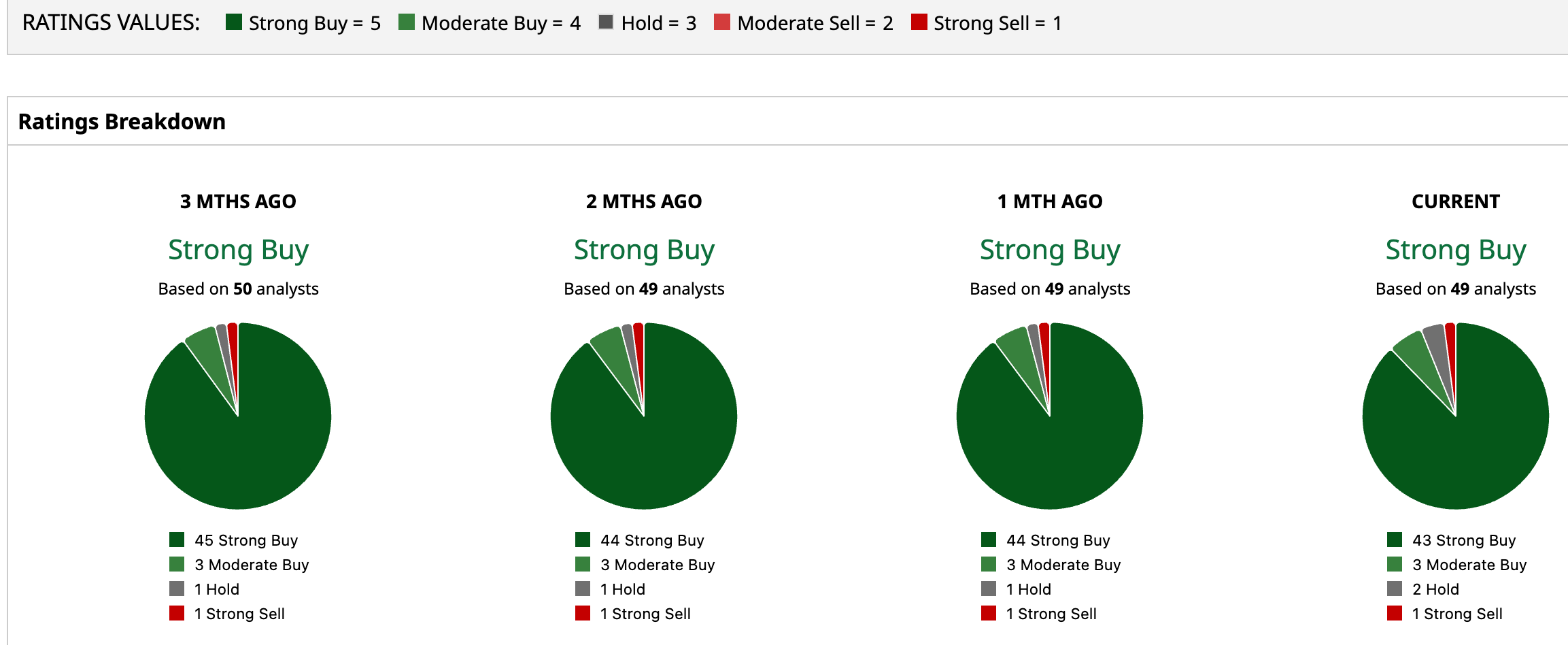
Overall, analysts are optimistic about NVDA’s growth potential, giving the stock a consensus rating of “Strong Buy.” Of the 49 analysts covering the stock, 43 advise a “Strong Buy,” while three suggest “Moderate Buy,” two advise a “Hold,” and only one suggests a “Strong Sell.”
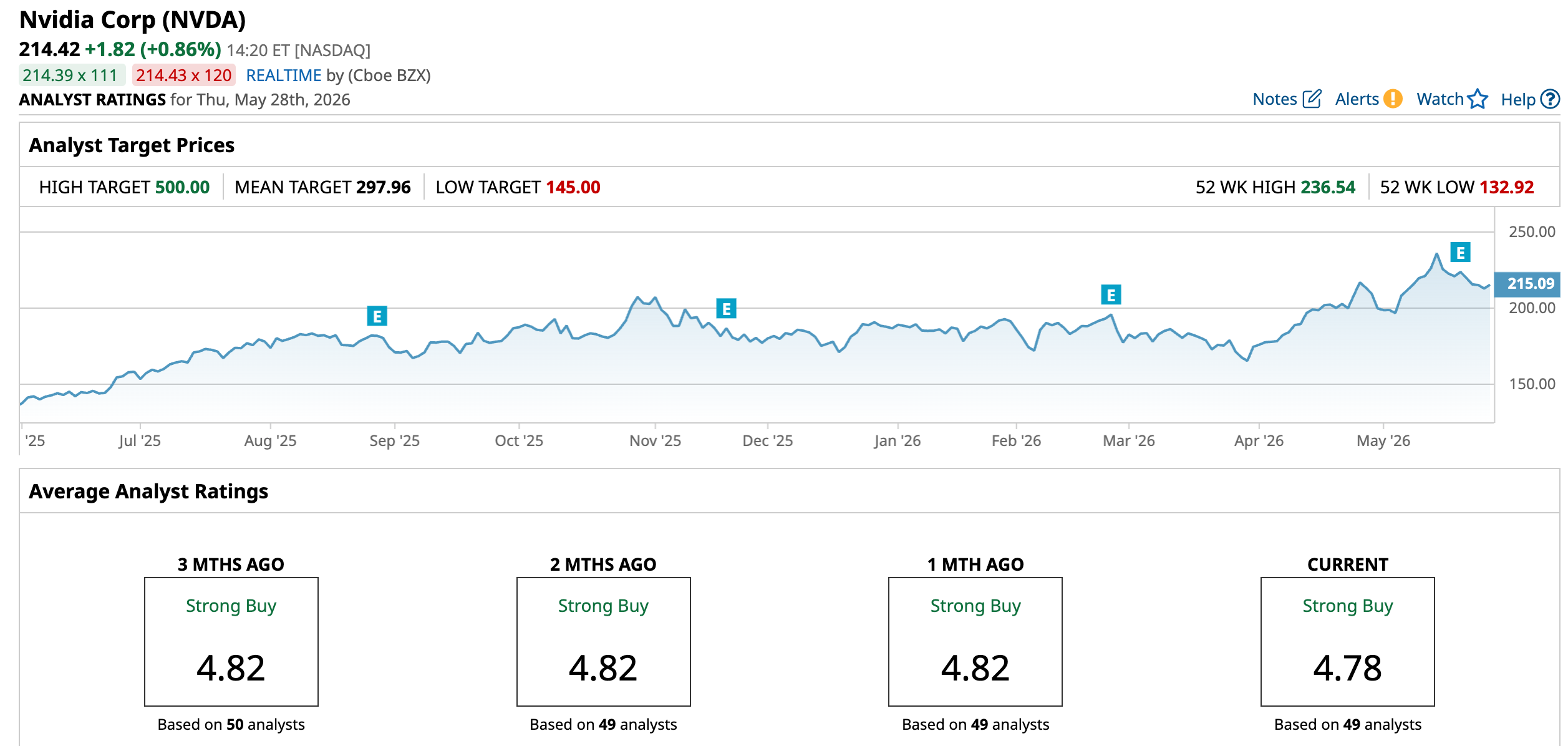
The average analyst price target for NVDA is $297.96, indicating potential upside of 39%. The Street-high target price of $500 suggests that the stock could rally as much as 133.2% from here.
 www.barchart.com
  www.barchart.com
 Conclusion
Taiwan is becoming the place where Nvidia's next big growth story could take shape. While Wall Street keeps focusing on NVDA’s swings, CEO Jensen Huang is focused on making sure the company has enough chipmaking and memory support to keep up with non-stop AI demand.
That is where partners like TSMC and SK Hynix become critical. TSMC builds Nvidia's advanced AI chips, while SK Hynix provides the high-bandwidth memory needed to run massive AI systems like Blackwell.
With AI companies, cloud giants, and governments rushing to build AI infrastructure, supply chains are becoming just as crucial as the chips themselves. Any new updates from Taipei around production, partnerships, or expansion plans could give investors fresh clues about how aggressively Nvidia plans to scale from here.
On the date of publication, Sristi Suman Jayaswal did not have (either directly or indirectly) positions in any of the securities mentioned in this article. All information and data in this article is solely for informational purposes. For more information please view the Barchart Disclosure Policy here.
More news from Barchart
RBC Just Upped Its Price Target on Marvell Technology Stock. Here's Why Why is the VIX So Low? Nvidia CEO Jensen Huang Is Heading to Taiwan. Get Ready for Updates on an ‘AI Semiconductor Triangle Alliance.’ The AI Trade Is Getting Overcrowded. Here’s Why You Should Opt for the iShares Semiconductor ETF Instead.