

Quantum computing has spent the past year riding one of the market’s wildest hype cycles. Investors piled into tiny quantum stocks in late 2025 on hopes the technology would rewrite computing itself. Then reality hit. Industry leaders warned practical systems could still be years or even decades away, and many of those same stocks gave back huge gains almost overnight.
Now the sector is heating up again. Governments are spending billions. Big Tech is expanding research budgets. And the race to commercialize quantum computing is no longer just a science project. The question for investors is simple: which company can actually afford to survive long enough to win?
More Top Stocks Daily: Go behind Wall Street’s hottest headlines with Barchart’s Active Investor newsletter.
Surprisingly, the answer may not be one of the flashy pure-play quantum names at all. It may be IBM (IBM).
IBM Has One Thing Most Quantum Stocks Lack -- A Real Business
Many quantum-focused companies remain early-stage ventures with minimal revenue and no profits. Firms like IonQ (IONQ), Rigetti Computing (RGTI), and D-Wave Quantum (QBTS) have generated excitement, but their financials still depend heavily on investor capital rather than sustainable operations.
Yet IBM enters the race from an entirely different position. It generated $14.7 billion in free cash flow in 2025, while producing adjusted operating margins above 59%. Its consulting, software, and infrastructure businesses give it the kind of balance sheet support most quantum rivals simply do not have.
The numbers speak volumes:
| Company | 2025 Revenue | Net Income | Free Cash Flow |
| IBM | $67.5 billion | $10.6 billion | $14.7 billion |
| IonQ | $130 million | -$510.4 million | Negative |
| Rigetti | $7.1 million | -$216.2 million | Negative |
| D-Wave | $24.6 million | -$355.1 million | Negative |
Granted, IBM is not a pure-play quantum stock. It has deep roots in cloud computing, AI, consulting, and enterprise software. But that exact diversification gives IBM the critical quality of staying power.
Quantum computing may take longer than investors want. But IBM can afford to wait.
IBM Is Spending at a Scale Few Competitors Can Match
That patience is now turning into a massive capital commitment. IBM just announced plans to spend $10 billion over the next five years advancing quantum technology while reaffirming its target of delivering the world’s first large-scale fault-tolerant quantum computer by 2029.
That matters because “fault tolerance” is the industry’s holy grail. Today’s quantum systems remain error-prone and unstable. A fault-tolerant system could finally unlock real-world applications in drug discovery, materials science, cybersecurity, logistics, and AI optimization.
Importantly, IBM is attracting government support. Just this week, IBM secured roughly $1 billion in public funding tied to quantum initiatives. That was about half of the total awarded under the latest federal quantum development package.
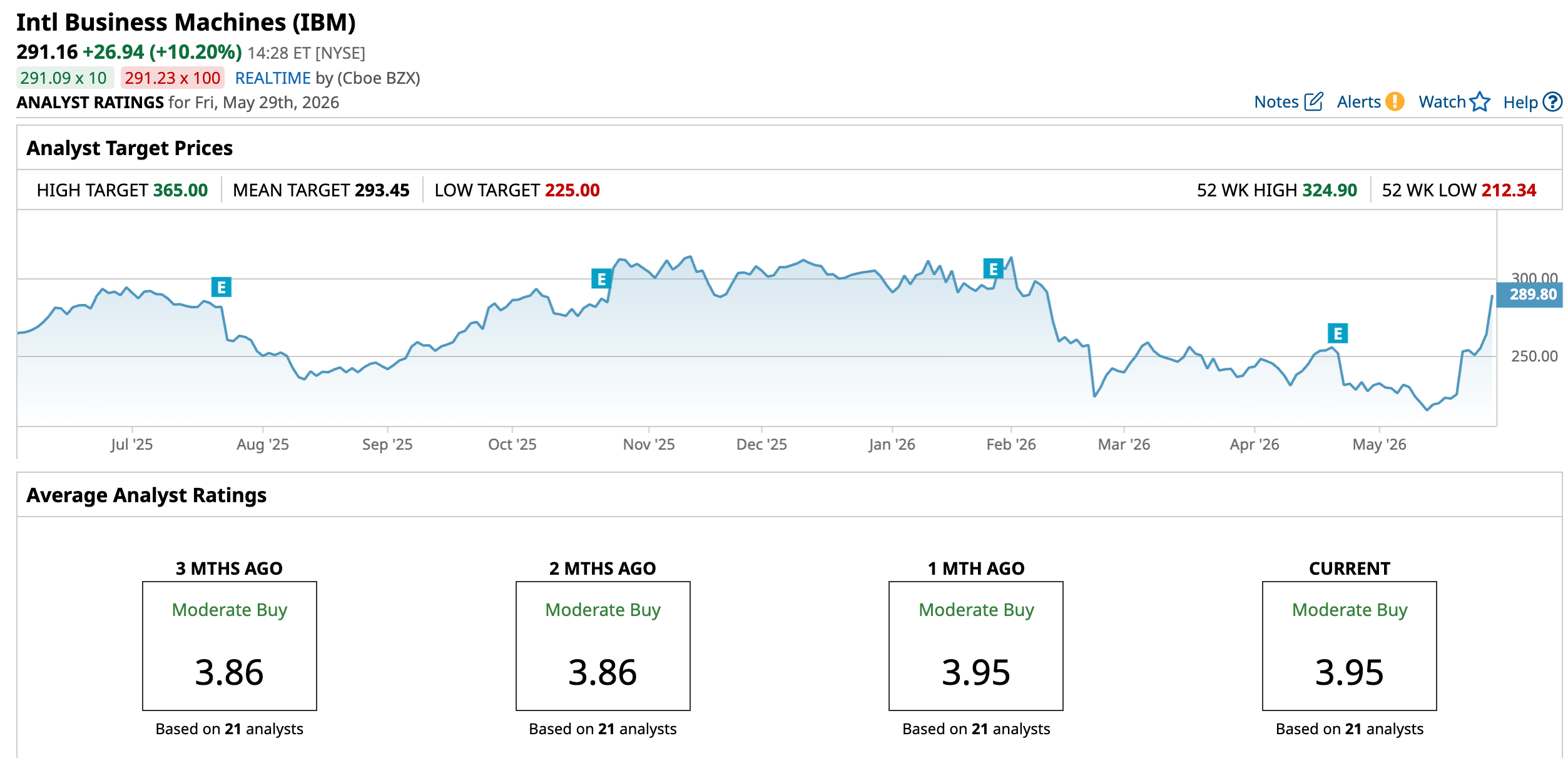
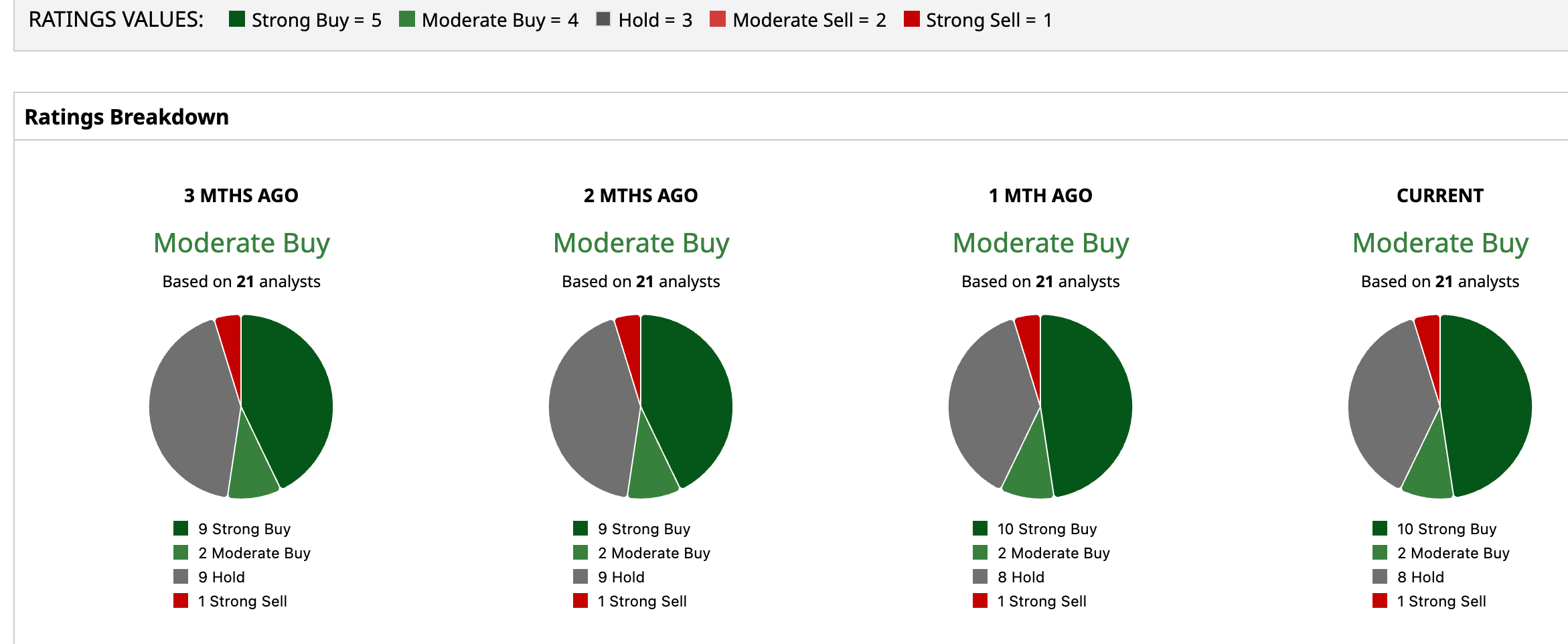
In short, governments increasingly view quantum computing as strategic infrastructure, much like semiconductors and AI data centers. Wall Street likes it, too, with 21 analysts giving it a "Moderate Buy" rating and assigning a mean price target of $293.45, implying a marginal 0.79% upside from its current level. However, the Street-high target of $365 implies IBM stock to gain 25.36% from here.
 www.barchart.com
 www.barchart.com
Nevertheless, IBM is not building in isolation. Last year, the company partnered with Advanced Micro Devices (AMD) to combine IBM’s quantum systems with AMD’s high-performance computing and AI accelerators. The goal is hybrid architectures that blend classical and quantum processing rather than replacing one with the other.
That approach could prove critical because quantum computers are unlikely to replace traditional systems outright. Instead, they may work alongside GPUs and AI accelerators to solve specialized problems classical systems struggle to handle.
The Quantum Trade May Still Be Early — But IBM Looks Built for It
Investors should be honest about where quantum computing stands today. Commercial revenue remains small. Practical applications are limited. And even IBM admits fault-tolerant systems are still several years away.
So no, quantum computing is probably not a trading story just yet. It remains more of a balance-sheet commitment story. But in the end, IBM stands apart because it is one of the few companies both able and willing to spend at the scale required to bring quantum computing into the real world.
That changes the risk equation for investors. Instead of betting on a company that may need constant capital raises just to survive, IBM shareholders gain exposure to quantum upside while still owning a profitable enterprise generating billions in annual cash flow and paying a dividend yielding roughly 2.6%.
With the stock down 2.38% in 2026 on AI disruption concerns, and trading at 20.59 times forward earnings estimates, it offers an attractive entry point.
Bottom Line
The quantum computing boom may still arrive slower than Wall Street hopes. Yet if fault-tolerant systems emerge around 2029 as IBM projects, the company could be one of the biggest long-term beneficiaries because it already has the infrastructure, enterprise relationships, and financial resources needed to commercialize the technology globally.
In any case, sharp investors do not always need the purest story. Sometimes the smartest investment is the company that can actually afford to finish the race.
On the date of publication, Rich Duprey did not have (either directly or indirectly) positions in any of the securities mentioned in this article. All information and data in this article is solely for informational purposes. For more information please view the Barchart Disclosure Policy here.
More news from Barchart
The Quantum Computing Boom Is Back. IBM Proves It Is the Smartest Stock to Buy AI Hyperscalers Are Taking on Debt, But the Broader Market Looks More Leveraged Wedbush Just Set a New Street-High Price Target of $325 on Palo Alto Networks. What This Means for PANW Stock. Billionaire Mark Cuban Asks Why Insurance Companies Pay $2,500 for an MRI When ‘a Center Down the Street’ Only Charges $350