

Navitas Semiconductor Corporation NVTS is reshaping its story around power conversion, where artificial intelligence (AI) workloads are forcing new architectures in the data center and beyond. Higher power density, tighter efficiency targets and new distribution approaches are lifting demand for wide-bandgap devices, particularly gallium nitride and silicon carbide.
That backdrop matters because Navitas is pushing designs that span both sides of the power chain, from rack-level conversion to higher-voltage modules positioned for the supporting grid. The opportunity is real, but so are the execution and scaling hurdles.
NVTS Tracks the Move to High-Voltage AI Power
AI data centers are migrating toward higher power density and higher-voltage direct-current architectures. That shift expands wide-bandgap content across both alternating-current to direct-current and direct-current to direct-current conversion, where efficiency gains translate into lower energy loss and reduced cooling needs.
Navitas is positioning its portfolio to capture more of that power chain. The company’s view is that high-voltage distribution and rising power-supply demands should broaden its content opportunity as conversion moves closer to the rack and power-density requirements rise.
Navitas Semiconductor Corporation Price and Consensus
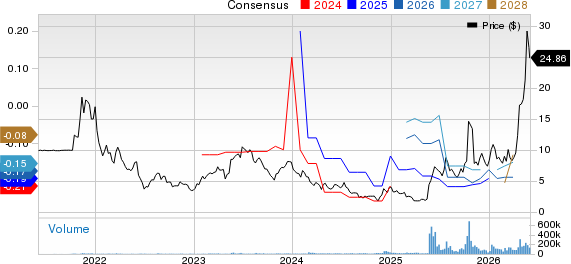
Navitas Semiconductor Corporation price-consensus-chart | Navitas Semiconductor Corporation Quote
Navitas Product Demos Point to Future Designs
Two recent proof points offer clear “what to watch” signals for the next design cycle. Navitas introduced a 20-kilowatt 800-volt to 6-volt direct-current to direct-current power delivery board using GaNFast technology. The platform is designed to support higher-density data center architectures and is cited with up to 97.5% peak efficiency at a 1 megahertz switching frequency.
Separately, the company unveiled a 10-kilowatt direct-current to direct-current power platform aimed at next-generation AI data centers. Navitas cited up to 98.5% peak efficiency and a 1-megahertz switching frequency, framing it as a path to unprecedented power density for large-scale deployments.
NVTS AI Infrastructure Momentum Is Early but Improving
The commercialization path in AI power is still defined by evaluations, qualification programs and system-level validation. Navitas has emphasized progress moving from device-level testing to system and board-level evaluation, along with delivered “final samples” intended to support production ramps and customer validation work.
That language points to an adoption curve that is building, not finished. The encouraging part is that engagement is translating into better mix and sequential growth. Management noted that “AI infrastructure,” which combines data center and grid efforts, grew 50% sequentially from the fourth quarter of 2025 to the first quarter of 2026.
Navitas’ SiC Pitch Expands Beyond the Data Center
The grid side can become the other half of the AI power narrative. Navitas has linked rising AI-driven electricity demand to upgrades in power grids and energy infrastructure, where higher-voltage silicon carbide devices can enable new distribution concepts and more compact, efficient systems.
A key example is the company’s demonstration of a 250-kilowatt solid-state transformer solution using its GeneSiC technology to enable scalable 800-volt direct-current distribution. Navitas has also positioned its 2.3-kilovolt and 3.3-kilovolt silicon carbide modules for energy infrastructure applications such as battery energy storage systems, utility solar projects and solid-state transformers.
NVTS News Flow That Can Shift Sentiment
The near-term catalyst list is tied to both leadership moves and product cadence. Navitas announced two board appointments, adding Davin Lee effective immediately and Gregory M. Fischer effective immediately.
On the operating side, the company named Tonya Stevens as chief financial officer, effective March 30. The same update cycle included new GeneSiC form factors, including a top-side cooled QDPAK and a low-profile TO-247-4L with asymmetrical leads, and a fifth-generation GeneSiC technology platform launch.
Navitas Supply Chain Choices Can Become a Theme
Navitas operates a fabless model, which supports scaling without the burden of building capital-intensive manufacturing facilities. The structure can also sharpen speed of execution by leaning on established foundry partners for wafer fabrication and related steps.
That model comes with dependency risk because external partners ultimately control capacity and production continuity. The company’s manufacturing relationships include Taiwan Semiconductor Manufacturing Company for gallium nitride products and X-Fab for silicon carbide manufacturing, with other partnerships that include GlobalFoundries. This blend can feed a supply-chain “security” narrative around U.S.-based partners, while still leaving Navitas exposed to third-party operational realities.
NVTS: What Could Derail the Trend Trade
The biggest fundamental risk is that Navitas remains deeply unprofitable with limited revenue scale. In the first quarter of 2026, the company generated $8.6 million in revenue and reported a non-GAAP net loss of $13.8 million, underscoring how far this Zacks Rank #4 (Sell) company must go before sustained profitability becomes realistic.
Timing risk is also material. AI and industrial projects can involve long design and qualification cycles, and management has stressed engagements and qualification programs rather than large production wins.
Competition is the final pressure point. Larger power and semiconductor players are investing aggressively, including Infineon Technologies AG, Texas Instruments Incorporated and ON Semiconductor Corporation, which can pressure pricing and slow share capture.
Investors looking for a cleaner near-term earnings backdrop may prefer established equipment names tied to the same AI buildout, such as Applied Materials AMAT and Lam Research LRCX, both carrying Zacks Rank #2 (Buy). You can see the complete list of today’s Zacks #1 Rank (Strong Buy) stocks here.
Research Chief Names "Single Best Pick to Double"
From thousands of stocks, 5 Zacks experts each have chosen their favorite to skyrocket +100% or more in months to come. From those 5, Director of Research Sheraz Mian hand-picks one to have the most explosive upside of all.
This company targets millennial and Gen Z audiences, generating nearly $1 billion in revenue last quarter alone. A recent pullback makes now an ideal time to jump aboard. Of course, all our elite picks aren’t winners but this one could far surpass earlier Zacks’ Stocks Set to Double like Nano-X Imaging which shot up +129.6% in little more than 9 months.
Free: See Our Top Stock And 4 Runners UpWant the latest recommendations from Zacks Investment Research? Today, you can download 7 Best Stocks for the Next 30 Days. Click to get this free report
Lam Research Corporation (LRCX): Free Stock Analysis Report
Applied Materials, Inc. (AMAT): Free Stock Analysis Report
Navitas Semiconductor Corporation (NVTS): Free Stock Analysis Report
This article originally published on Zacks Investment Research (zacks.com).