


Quantum Cyber (QUCY), the autonomous defense technology company, has announced that its subsidiary has booked orders worth $2.09 million. Quantum Drones Corp., the wholly owned subsidiary of Quantum Cyber, bagged the order as part of its acquisition of the 50,000-square-foot Bridgeport, CT, manufacturing facility.
The subsidiary was established to pursue the U.S. Department of Defense and homeland security procurement opportunities by developing and commercializing autonomous drone and counter-drone technologies.
More Top Stocks Daily: Go behind Wall Street’s hottest headlines with Barchart’s Active Investor newsletter.
About Quantum Cyber
In an age where a sneaker company becomes an AI infrastructure company, Quantum Cyber's transformation from a biotechnology company focused on cancer screening to a company focused on building defense technology platforms may not seem misplaced.
Tracing its origins to 2021, Mainz Biomed N.V. rechristened itself as Quantum Cyber after activist investor David Lazar acquired the company for $6 million. Today, Quantum Cyber describes itself as a company building a "System-of-Systems" autonomous defense platform. Rather than manufacturing a single drone or cybersecurity product, management intends to assemble a portfolio of technologies through acquisitions, licensing agreements, and partnerships spanning autonomous aerial vehicles, counter-drone systems, AI-enabled battlefield software, quantum-resistant cybersecurity, and national security technologies.
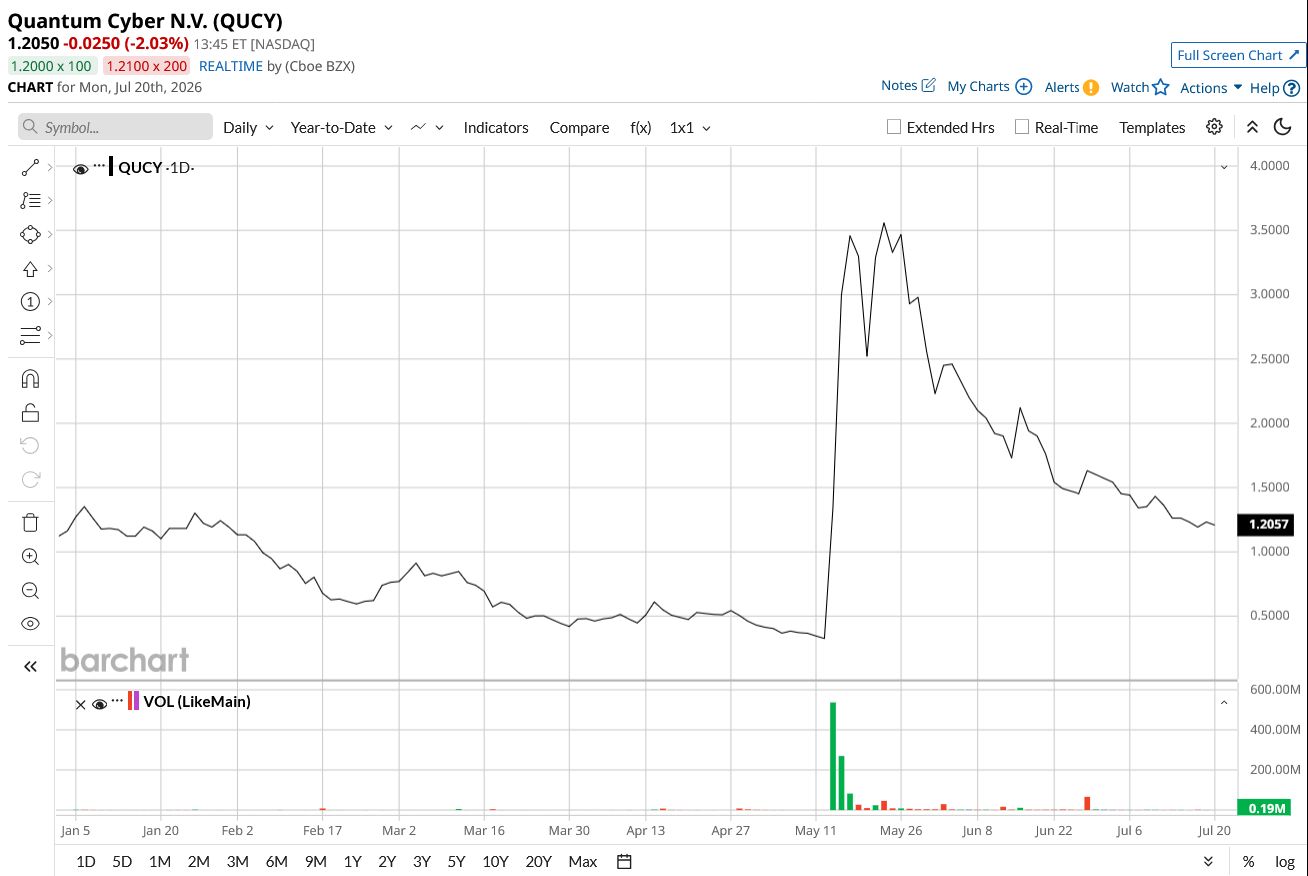
Valued at a modest market cap of $18 million, QUCY stock is up 8% on a year-to-date (YTD) basis.
However, is promise enough to warrant an investment in QUCY stock? Let's find out.
 www.barchart.com
 Platform for Doubt
Quantum Cyber's vision is to build an integrated platform that stitches together drone warfare, counter-drone defense, autonomous naval mine countermeasures, EMP shielding, anti-drone ammunition, command and control, and quantum antenna work across air, land, and sea. The chosen method is not to invent all of this from scratch but to acquire, license, and integrate combat-proven technologies, which is a faster and cheaper route than pure research if the pieces actually fit together.
On customer acquisition, the play is clearly government and defense procurement. It set up Quantum Drones Corporation as the vehicle for U.S. contracts and staffed it with heavyweight names, including a former Acting Secretary of Veterans Affairs and a former Homeland Security official, exactly the kind of connections that open Pentagon doors. In July, the company made a confidential submission to a U.S. Army technology program, filed a provisional patent for a canisterized drone launch system, and introduced the PHANTOM 950 long-range autonomous aircraft. It also shored up the balance sheet with over $15 million in financing in May.
However, the lack of clarity and vague assertions from the management as an ongoing assembly rather than a dated milestone make taking a bet on this microcap company even harder. Moreover, established names such as Palantir (PLTR), Anduril, AeroVironment (AVAV), and a wave of well-funded defense startups already dominate the ground Quantum Cyber wants to occupy, and they bring deep pockets, existing contracts, and years of battlefield credibility. Against that backdrop, the sheer scale mismatch is glaring.
In fiscal Q4 ended March 31, 2026, Quantum Cyber reported revenues of just $78 million. Although it was up 27% from the previous year, it was much lower than its competitors. However, net losses narrowed to $7.97 per share from $22.35 per share, which was a positive development.
Yet, for the full fiscal year, net cash outflow from operating activities increased to $37.9 million, compared to $23.6 million in 2025. Overall, Quantum Cyber ended the year with a cash balance of $15.6 million, much lower than its short-term debt levels of $54.8 million, raising liquidity concerns.
Finally, aside from its precarious financial position currently, integration may be a stumbling block for the company. Getting all the moving parts to fire on all cylinders efficiently and effectively seems like a tall ask for the company at the current juncture.
Analyst Opinion on QUCY Stock
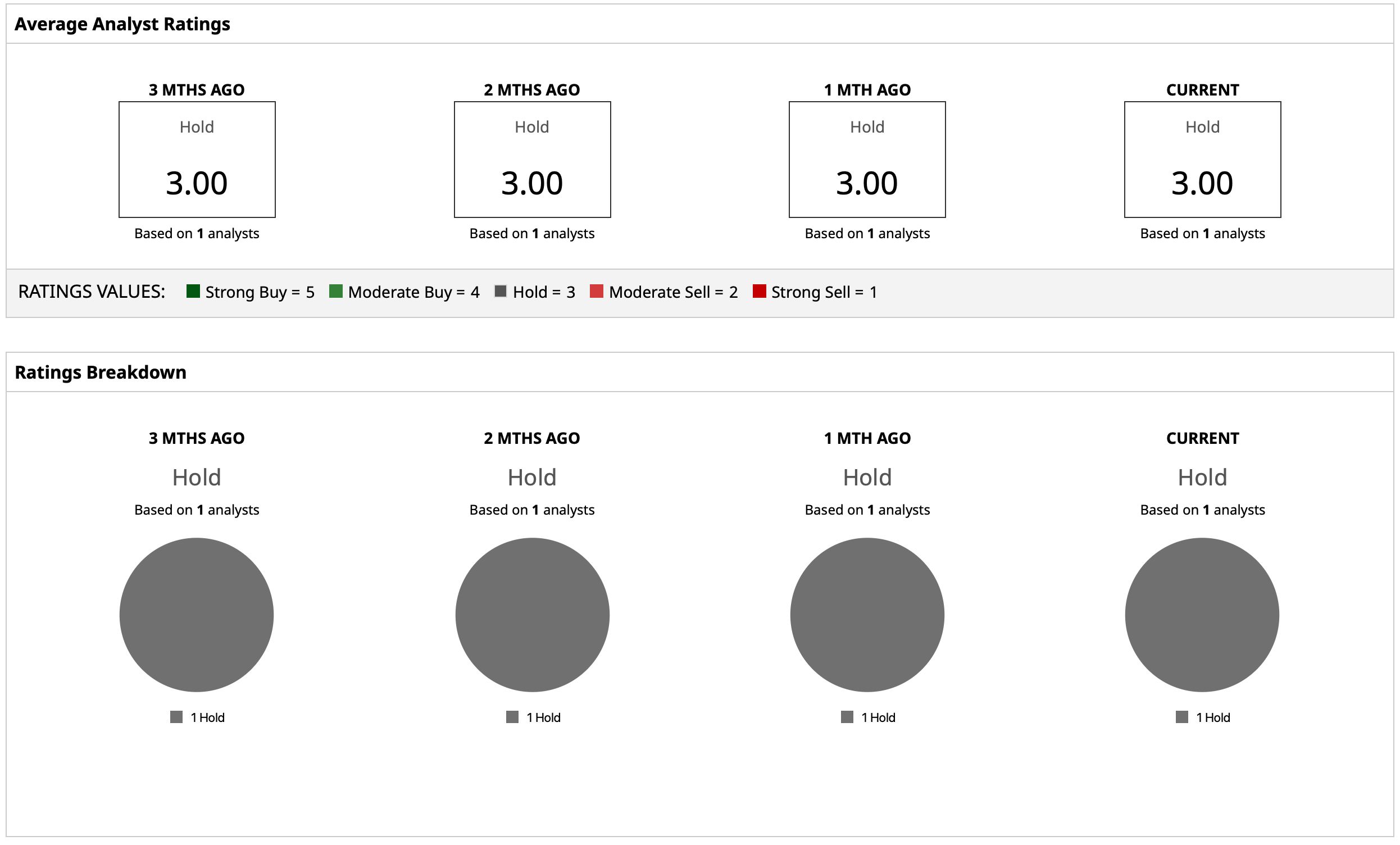
Analyst coverage remains limited on QUCY stock, with just one “Hold” rating, with no stated price targets. There are no stated analyst estimates for earnings either.
 www.barchart.com
 On the date of publication, Pathikrit Bose did not have (either directly or indirectly) positions in any of the securities mentioned in this article. All information and data in this article is solely for informational purposes. For more information please view the Barchart Disclosure Policy here.
More news from Barchart
Quantum Cyber Just Bagged $2 Million in Purchase Orders, But You Shouldn’t Rush to Buy QUCY Stock A $5 Billion Reason to Buy UnitedHealth Stock Here Analysts Are Turning Bullish on Intel Stock Ahead of Earnings. Here’s Why You Should Follow Their Lead. Huge, Unusual Intel Options Volume Today Ahead of Earnings This Week