

Soon-to-be former Amazon (AMZN) Web Services (AWS) veteran Dave Brown will be joining Facebook parent Meta (META) to bolster the latter's cloud ambitions. Brown, who was with AWS for 19 years, will leave his post in July, according to internal communications at AWS.
Notable broker Wedbush has given this a thumbs up and has opined that Meta's desire to be a material player in the cloud industry is serious. In a note to clients, Matt Bryson of the firm said, "This addition builds on the narrative that Meta is serious in building out its own AI cloud offering (though ostensibly Dave Brown's expertise could be used to support the build-out of infrastructure for internal Meta use as well)."
More Top Stocks Daily: Go behind Wall Street’s hottest headlines with Barchart’s Active Investor newsletter.
AI Retrospective & Brown's Relevant Expertise
Now, Wedbush may be right. Meta may have plans to sell excess compute to other enterprises to form a viable cloud business. However, the poaching of industry veterans to build an entirely new business line has a precedent, and one does not have to look too far in the past for that.
When Meta CEO Mark Zuckerberg assessed that his company was behind AI rivals like OpenAI, Anthropic, and Google's (GOOGL) (GOOG) Gemini, he went on a hiring spree from these very same companies to assemble his own AI superteam. And Meta was not shy of loosening its purse strings, with reports surfacing that AI researchers were being offered $300 million over four years to join Meta.
This was headlined by the $14.3 billion acqui-hire of Alexander Wang, who co-founded data labeling company Scale AI in 2016. Meta owns a 49% stake in the company for its multi-billion-dollar investment, with Wang heading Meta Superintelligence Labs (MSL), Meta's flagship AI organization.
However, until Muse Spark 1.1, Meta had not made a splash with its AI models so far, as it lagged behind OpenAI's ChatGPT, Anthropic's Claude, and Gemini. In fact, after some initial excitement, the hype around Muse Spark has died down within a week. Yet, the sheer scale (pun intended) of Meta's social media behemoths like WhatsApp, Facebook, and Instagram has resulted in 1 billion monthly active users for Meta AI, surpassing Gemini's 900 million monthly active users. Moreover, Muse Spark has entered the top 20 in the AI model race.
Thus, coming to the cloud business, Meta's AI journey so far may not be a cautionary tale, but investors should be mindful before building optimism around the same. More so because the established players have been at it for a long time now, with the top three (AWS, Azure, and Google Cloud) holding 63% of the market share as of Q1 2026. Moreover, Brown's former employer, AWS, is the market leader.
Regardless, Brown played a major role in AWS becoming a market leader, and his joining Meta should be a win for Meta's cloud operations.
Why, one may ask? Well, for that, one has to look at the Elastic Compute Cloud (EC2) service of AWS, which he helped launch and later oversaw. EC2 is the service that lets a customer rent virtual servers on demand rather than buying racks of hardware and incurring costs on maintaining them. Before EC2, an enterprise wanting to add capacity had to forecast demand, order machines, and wait for weeks. However, with EC2, enterprises could access computing power within minutes and pay only for what they used. For enterprise buyers, that meant turning a heavy upfront capital expense into a flexible operating one, scaling when required, and toning it down when not.
Thus, Brown, having built a service like EC2, brings that expertise to Meta along with his deep bench of relationships with enterprise customers.
 www.barchart.com
 Meta’s Financials in a Sweet Spot
Regardless of what the cloud business brings for Meta in the future, the here and now is its current financial position, and it looks solid.
Meta reported robust financial results for the first quarter of 2026, with revenue reaching $56.3 billion, reflecting a 33% increase from the year-earlier period. Earnings per share advanced 62% year-over-year (YoY) to $10.44, comfortably surpassing the consensus estimate of $6.70 and extending the company's streak of beating profit forecasts.
Average advertising price per ad grew 12% YoY, while daily active users across its platforms expanded 4% to 3.56 billion during the same timeframe.
Net cash from operating activities climbed to $32.2 billion from $24 billion in the prior year quarter. Free cash flow, which has drawn increased attention amid heavy AI-related capital spending among large technology firms, totaled $12.4 billion for the period. Meta ended the quarter with $23.4 billion in cash and no short-term debt on its balance sheet.
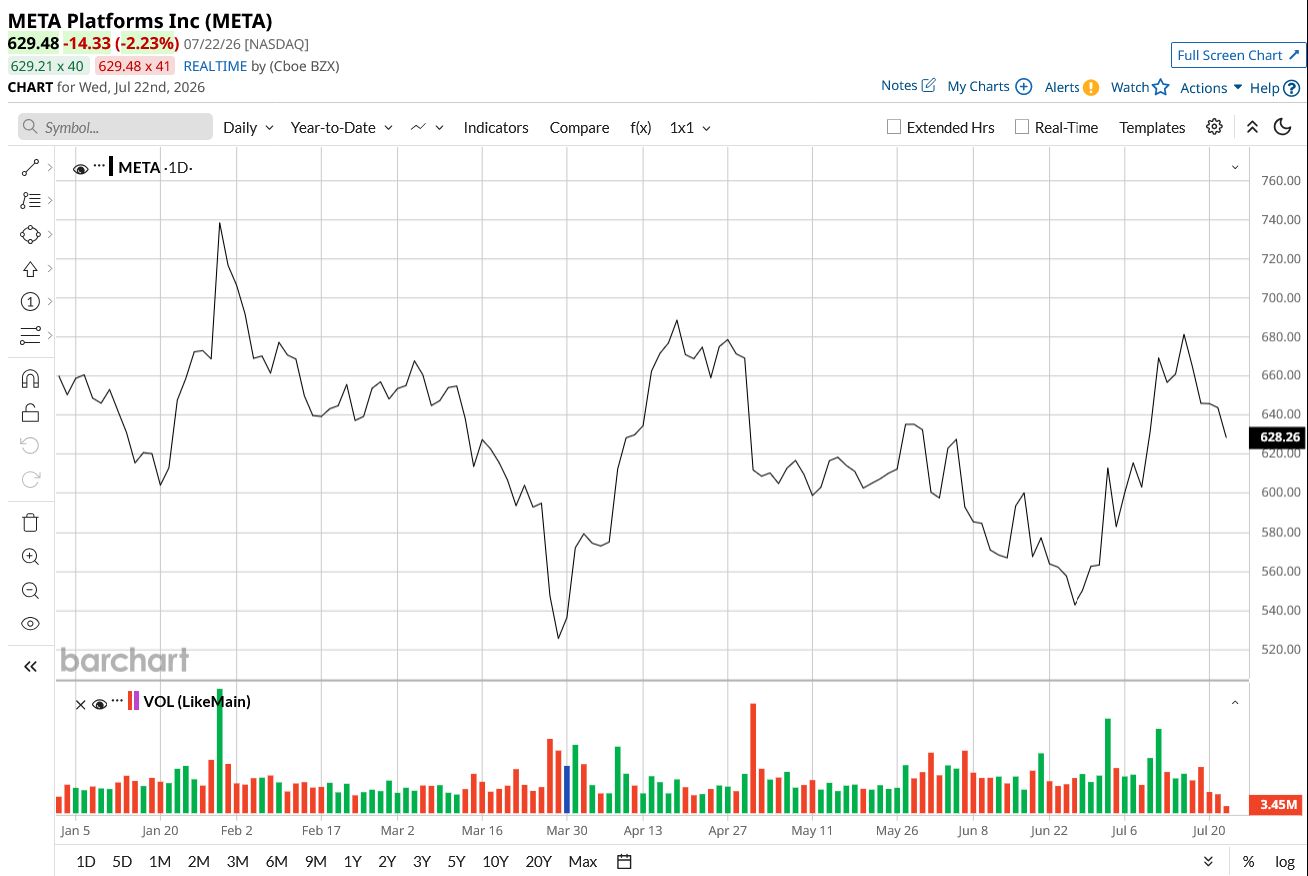
Despite a period of relatively subdued stock performance, META continues to trade at premium valuations. The forward P/E ratio of 21.92 times, P/S multiple of 8.13 times, and P/CF multiple of 17.20 times all sit above the corresponding sector medians.
Overall, the company commands a market cap of $1.63 trillion, with META stock down 2.5% on a year-to-date (YTD) basis.
Analyst Opinion on META Stock
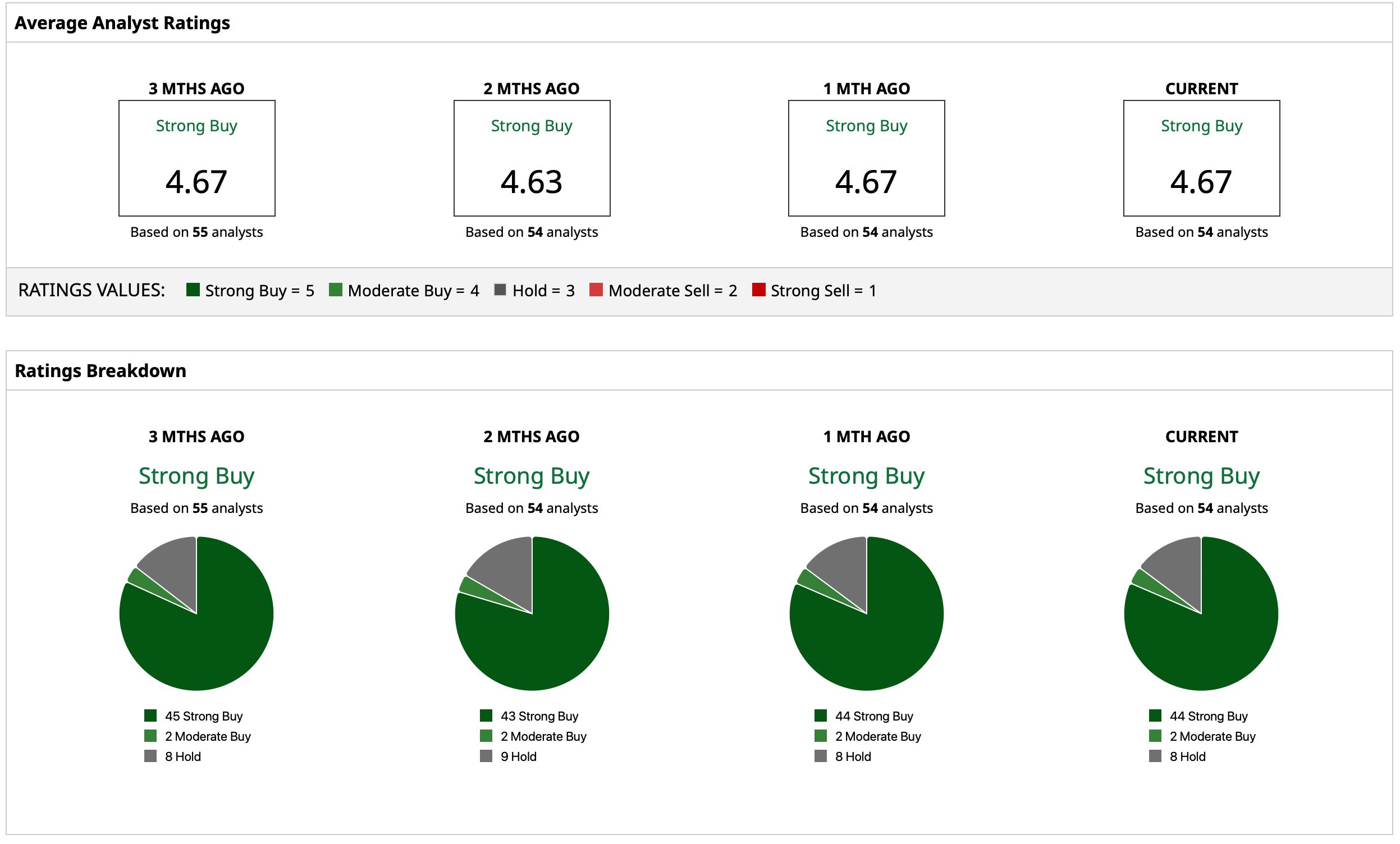
Overall, analysts have attributed META stock a rating of “Strong Buy.” The mean target price of $820.51 denotes a potential upside of about 27.4% from current levels. Out of 54 analysts covering the stock, 44 have a “Strong Buy” rating, two have a “Moderate Buy” rating, and eight have a “Hold” rating.
 www.barchart.com
 On the date of publication, Pathikrit Bose did not have (either directly or indirectly) positions in any of the securities mentioned in this article. All information and data in this article is solely for informational purposes. For more information please view the Barchart Disclosure Policy here.
More news from Barchart
AeroVironment Just Scored a New Army Contract. What It Means for AVAV Stock. RXO Stock Is Up 70% in the Past Year and Can Lead the Charge in Last-Mile Delivery Meta’s Latest AWS Hire Makes Wedbush Bullish on Its Cloud Ambitions. How to Play META Stock Here. How to Play BABA Stock as Alibaba Unveils New Qwen AI Model