


Alphabet (GOOG) (GOOGL) did almost everything investors had hoped for in its latest quarterly report. While the top and bottom line grew impressively, Google Cloud revenue generated an eye-popping annual growth as businesses continued pouring money into AI infrastructure and generative AI solutions. Under normal circumstances, those numbers would have fueled another rally. Instead, the stock headed in the opposite direction.
The sell-off was not driven by weak fundamentals – it was driven by what’s ahead. Investors zeroed in on Alphabet’s aggressive AI spending plans, with management signaling elevated capital expenditures this year and an even bigger investment push in 2027. As the artificial intelligence (AI) race intensifies, Wall Street is increasingly asking whether these massive investments will generate returns quickly enough.
More Yield, Less Trap: Sign up free to get Barchart’s daily Dividend Investor newsletter straight to your inbox.
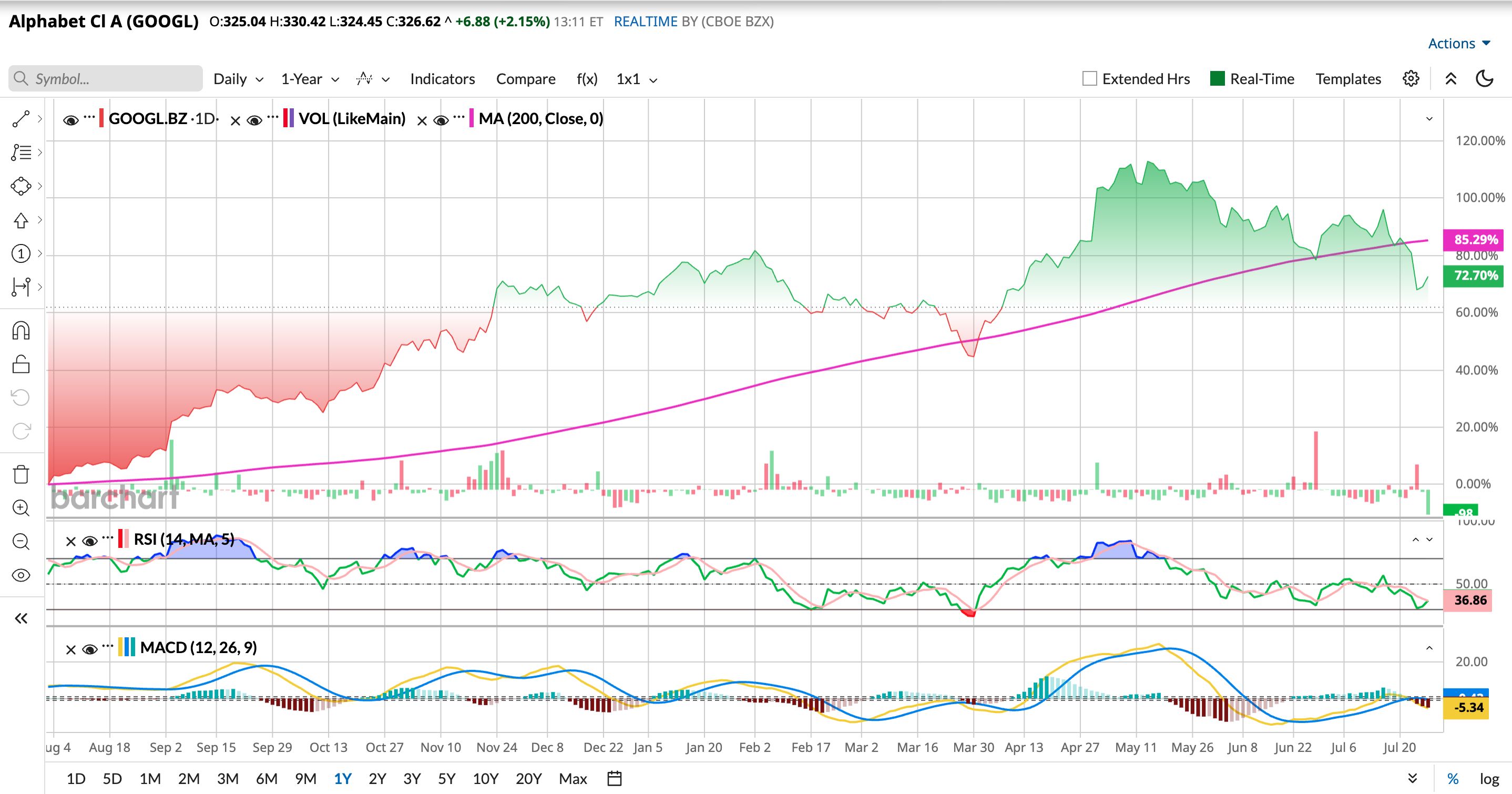
The sell-off also altered GOOGL’s technical setup. The stock closed below its 200-day moving average for the first time in more than a year, breaking a key support level that had held throughout the past 12 months. While many technical analysts typically wait for several sessions below that level before confirming a trend change, the move has undoubtedly put the stock under the microscope.
Meanwhile, the AI race refuses to slow down. Demand for computing capacity continues to exceed supply across the industry, while companies like Alphabet are under constant pressure to launch increasingly capable AI models. Reports that Google has delayed its Gemini 3.5 Pro model have only added to concerns that the competition is becoming even more intense.
With solid fundamentals colliding with technical weakness and rising AI costs, how should investors play GOOGL stock?
About Alphabet Stock
Hardly anyone needs an introduction to Alphabet. Headquartered in Mountain View, California, the technology giant is one of the world’s most valuable companies, with a market capitalization of $3.9 trillion. Best known for Google Search, Alphabet has grown into a leader in cloud computing, AI, digital advertising, and autonomous driving through Waymo.
It is also advancing AI with its Gemini models and DeepMind research. Backed by its dominant Search business, fast-growing Google Cloud segment, and aggressive AI investments, Alphabet remains one of the most closely watched companies on Wall Street and a key player shaping the future of technology.
Shares of the Google parent have rewarded shareholders handsomely over the past year, although the ride has not been without a few bumps. As excitement around AI gathered pace, investors piled into the stock, encouraged by Google’s AI-powered Search rollout, the remarkable growth of Google Cloud, and the company’s expanding AI ecosystem. That optimism helped lift GOOGL to a 52-week high at $408.61 in May.
More recently, though, sentiment has cooled. The stock has fallen 20% from its peak as Wall Street shifted its focus from strong earnings to the enormous amount of capital Alphabet plans to spend on AI infrastructure. Following its July 22 earnings report, GOOGL stock dropped 7.13% the very next day, accompanied by a sharp spike in selling volume that suggested many investors rushed to lock in profits. Over the past five trading sessions alone, the stock has slipped 6.81%. Even so, zooming out tells a different story, with Alphabet’s shares still up an impressive 69.8% over the past 52 weeks.
The technical picture has also weakened in the short term. The 14-day RSI has retreated to 38.06 after sitting in overbought territory in May, suggesting the recent rally has largely cooled off. Meanwhile, the MACD has turned negative, with the MACD line crossing below the signal line and red histogram bars indicating fading bullish momentum.
The biggest change, however, is the stock’s break below its 200-day moving average. This is one of the most closely watched long-term technical indicators and had provided reliable support for Alphabet throughout much of the past year. A move below it does not automatically mean the long-term uptrend is over, but it does suggest investors are becoming more cautious. Whether GOOGL quickly climbs back above that level or continues trading below it over the coming sessions could offer an important clue about the stock's future direction.
 www.barchart.com
 Alphabet does not look like a deep-value play at current levels, but its valuation still appears reasonable given its growth profile. The stock trades at 16.17 times forward adjusted price-to-earnings, which is above the sector average but below its own historical median. Its price-to-sales ratio of 7.86 times sits above both the sector average and its historical median, suggesting investors are already assigning a premium to its AI leadership.
With Google Cloud expanding rapidly, Search remaining a dominant cash generator, and AI creating new growth opportunities across its ecosystem, that premium still appears well supported.
Beyond growth and AI, Alphabet offers a modest but steadily improving income story. The company pays a quarterly dividend of $0.22 per share, or $0.88 annually, translating to an annualized dividend yield of just 0.28%. While that yield is not likely to attract income-focused investors on its own, its forward payout ratio of just 4.3% leaves significant room for future dividend increases. Combined with Alphabet’s robust cash generation, the dividend adds another layer of appeal without limiting the company's ability to invest aggressively in AI and long-term growth.
A Closer Look at Alphabet’s Q2 Earnings Report
Alphabet delivered impressive financial numbers for the second quarter of fiscal 2026 last week, reinforcing its position as one of the biggest beneficiaries of the AI boom. The Google parent generated revenue of $119.8 billion, up 24% year-over-year (YOY), which marked the 12th consecutive quarter of double-digit revenue growth. EPS surged 294% annually to $9.11, comfortably topping Wall Street’s expectations.
The company’s core Google Services segment revenue rose 15% YOY to $94.5 billion. Within the segment, Google Search and Other revenue climbed 17% to $63.3 billion, led by strength in the retail and financial services verticals. Management noted that AI-powered Search experiences continued to drive higher query volumes, while AI Mode surpassed one billion monthly active users following its global rollout.
Meanwhile, YouTube advertising revenue increased 13% to $11.06 billion, supported by healthy demand from both direct-response and brand advertisers. The platform also benefited from the FIFA Club World Cup, with more than 1.7 billion unique viewers watching tournament-related content.
Google Cloud remained the standout performer, with revenue soaring 82% annually to $24.8 billion. Growth was fueled by strong demand for Google Cloud Platform, enterprise AI solutions, AI infrastructure, and core cloud services, while the company also began recognizing revenue from TPU system sales to customer data centers. Cloud backlog expanded by more than $50 billion sequentially to $514 billion, with Alphabet expecting to recognize slightly more than half of that backlog as revenue over the next 24 months.
Alphabet’s AI ecosystem also continued to gain momentum. Gemini model APIs processed roughly 22 billion tokens per minute, up from more than 16 billion in the previous quarter. Over 9 million developers used its AI models each month, while nearly 500 Cloud customers processed over one trillion tokens each during the past year. The Gemini app reached 950 million monthly active users, and daily active users tripled annually. Adoption of Gemini-powered advertising products, including AI Max and Performance Max, also remained strong.
Alphabet finished the quarter with $242.5 billion in cash, cash equivalents, and marketable securities, alongside $98.2 billion in long-term debt. Operating cash flow totaled nearly $39.1 billion, while capex doubled to $44.9 billion as the company aggressively expanded AI infrastructure through investments in servers, data centers, and networking equipment. That spending resulted in negative free cash flow of $5.86 billion for the quarter, although trailing 12-month free cash flow remained a healthy $53.27 billion.
Looking ahead, management raised its 2026 capital expenditure guidance to $195 billion to $205 billion from the previous range of $180 billion to $190 billion, citing accelerating demand for AI infrastructure and Cloud services. The company expects capital spending to increase significantly again in 2027, although higher depreciation, energy costs, data center operating expenses, and greater reliance on third-party capacity are likely to weigh on profitability and Cloud margins in the near term.
Wall Street analysts tracking Alphabet anticipate fiscal 2026 EPS to rise 62.7% YOY to $17.59, but drop by 16.3% annually to $14.72 in fiscal 2027.
What Do Analysts Expect for Alphabet Stock?
Wall Street’s reaction to Alphabet’s latest earnings was mixed, but the broader message remained largely steady. While several brokerages trimmed their price targets to reflect higher AI spending and the near-term pressure it could place on margins and earnings, some maintained bullish ratings, suggesting they still see long-term upside for the stock.
Wells Fargo lowered its price target to $411 from $418, while Morgan Stanley reduced its target to $400 from $415, both maintaining “Overweight” ratings. The brokerages pointed to rising capex, pressure on Services and Cloud margins, and slower near-term earnings growth as AI investments accelerate. Oppenheimer also cut its target to $400 from $445 but reiterated its “Outperform” rating, citing lower Services margins and higher financing costs.
Others remained optimistic despite trimming their forecasts. JPMorgan reduced its target to $420 from $460 but called the post-earnings pullback a buying opportunity, highlighting strong revenue and Cloud growth. Piper Sandler analyst Thomas Champion trimmed its target to $395 from $445, noting that higher capital spending plans for 2026 and 2027 overshadowed an otherwise impressive Cloud performance.
Still, not every analyst grew more cautious. Barclays, which raised GOOGL’s price target to $425 from $405, argues that accelerating Cloud growth outweighed concerns over AI-driven spending.
Meanwhile, Wedbush maintained its $445 target and “Outperform” rating, adding Alphabet to its ‘Best Ideas List.’ The brokerage firm believes Alphabet’s integrated AI strategy is helping Google Cloud gain market share and expects those investments to create meaningful long-term value, even if they weigh on near-term profitability.
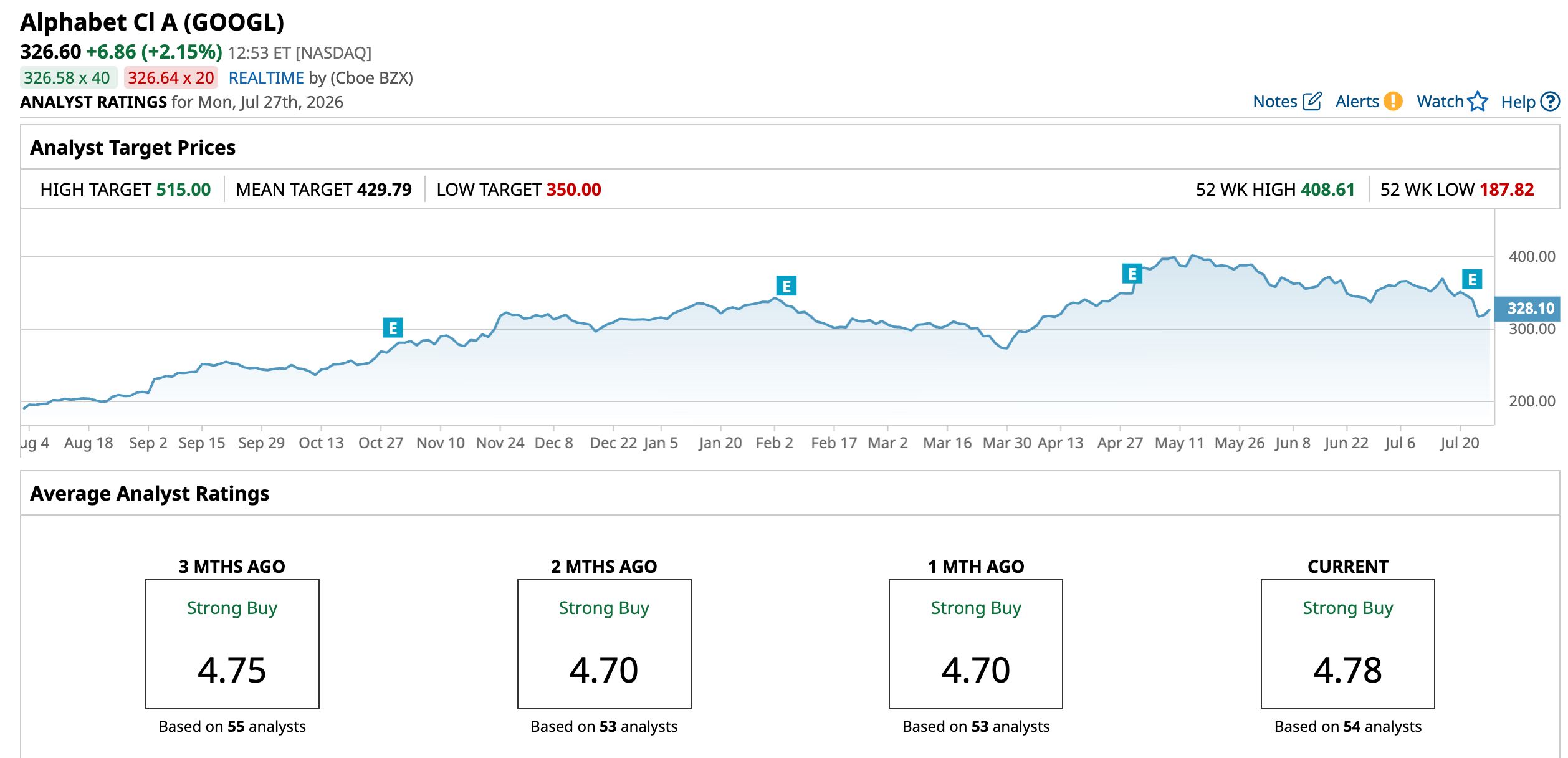
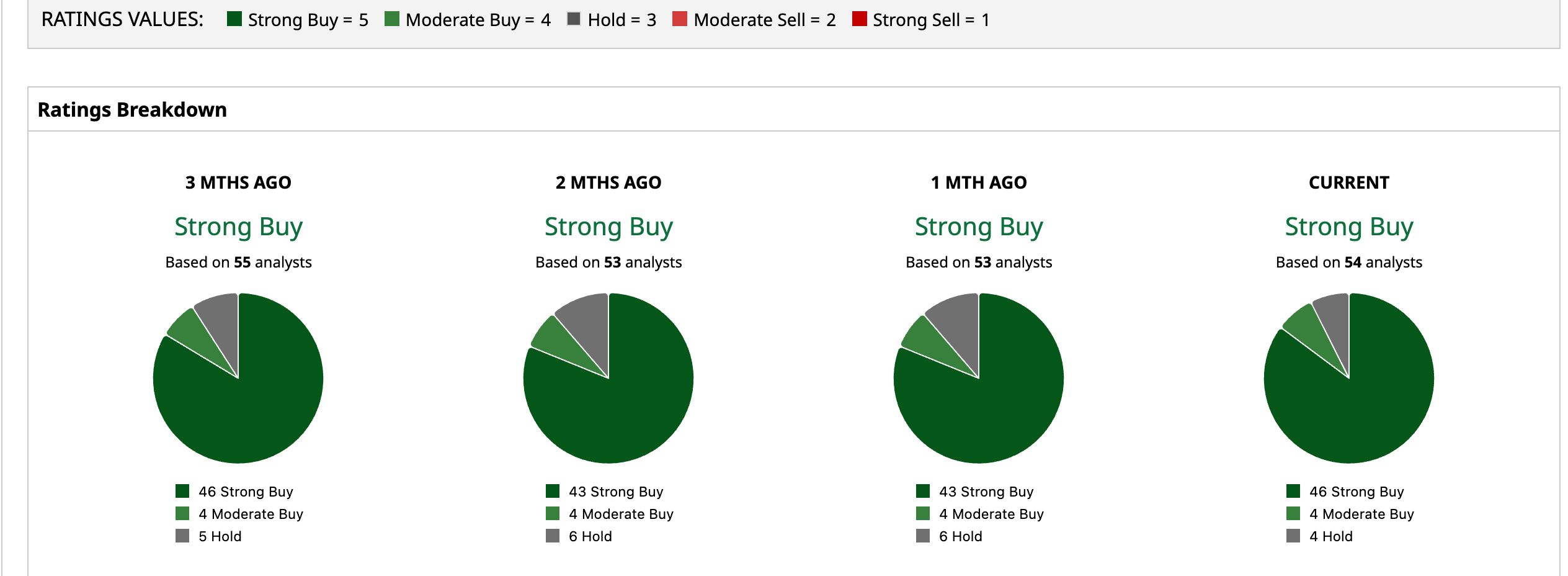
Analysts monitoring GOOGL are bullish, with a consensus rating of “Strong Buy” overall. Out of 54 analysts, 46 recommend a “Strong Buy,” four suggest a “Moderate Buy,” and four are playing it safe with a “Hold” rating. The average price target of $429.79 suggests a 31.6% upside potential from here. Meanwhile, the Street-high target of $515 suggests GOOGL stock could rise as much as 57.7%.
 www.barchart.com
  www.barchart.com
 On the date of publication, Sristi Suman Jayaswal did not have (either directly or indirectly) positions in any of the securities mentioned in this article. All information and data in this article is solely for informational purposes. For more information please view the Barchart Disclosure Policy here.
More news from Barchart
How to Play GOOGL Stock as Shares Fall Below Their 200-Day Moving Average Hedge Your Portfolio with This Real Estate Stock at New 5-Year Highs Texas Instruments vs. Qualcomm: One Pays Out 94% of Earnings. The Better Dividend Chip Stock Is Clear. How Nvidia Stock Could Be the Biggest Winner from Super Micro’s Preliminary Results