


As the earnings season enters its final stretch, Spotify Technology S.A. (SPOT) is among some of the last high-profile names set to report its earnings. The Swedish audio-streaming giant is scheduled to report its fiscal 2026 second-quarter earnings before the market opens on Tuesday, Aug. 4, with investors hoping the release will shed more light on the company's growth trajectory, profitability, and the health of the streaming business.
Since its founding in 2006 by Daniel Ek and Martin Lorentzon, Spotify has transformed the way the world consumes audio. Spotify set out to accomplish what once seemed impossible, which was making music streaming both legal and seamless. And now, nearly two decades later, the company has evolved far beyond music into one of the world's largest audio-streaming platforms, serving music, podcasts, audiobooks, and other audio content to a vast global audience. However, the road hasn't been without bumps.
More Top Stocks Daily: Go behind Wall Street’s hottest headlines with Barchart’s Active Investor newsletter.
While Spotify delivered a first-quarter earnings beat in late April, the market's attention quickly shifted to the company's softer-than-expected guidance, leaving investors disappointed and weighing on sentiment surrounding the stock. Even so, the company's scale is hard to overlook. According to its latest earnings report, Spotify now boasts more than 760 million monthly active users, making it the world's largest audio-streaming platform by reach.
That enormous user base remains one of the company's biggest strengths as it continues to navigate an increasingly competitive streaming landscape. With another closely watched earnings report just around the corner, investors will be looking for signs that Spotify can sustain user growth, improve profitability, and regain momentum following its cautious outlook last quarter. Thus, ahead of the upcoming results, here's a closer look at the music streaming giant.
About Spotify Stock
Headquartered in Stockholm, Sweden, Spotify has been reshaping the way people consume audio since launching its streaming platform in 2008. What began as a music-streaming service has evolved into the world's largest audio-streaming subscription platform, offering access to more than 100 million songs, seven million podcast titles, and 700,000 audiobooks across select markets.
Today, Spotify serves 761 million monthly active users, including 293 million premium subscribers, spanning 184 markets worldwide. A key driver of Spotify's success is the deep engagement it has built with its users. Over the years, listeners have created personalized playlists, curated extensive music libraries, and relied on recommendation algorithms that become increasingly accurate over time.
As a result, switching to a competing platform can be less appealing for many users, giving Spotify a meaningful competitive advantage in an increasingly crowded streaming market. But despite its industry-leading position, Spotify's stock has faced pressure this year. With a market capitalization of $105.32 billion, the shares have been weighed down by concerns over the potential impact of AI on traditional subscription models, along with signs of moderating user growth following the company's first-quarter earnings report.
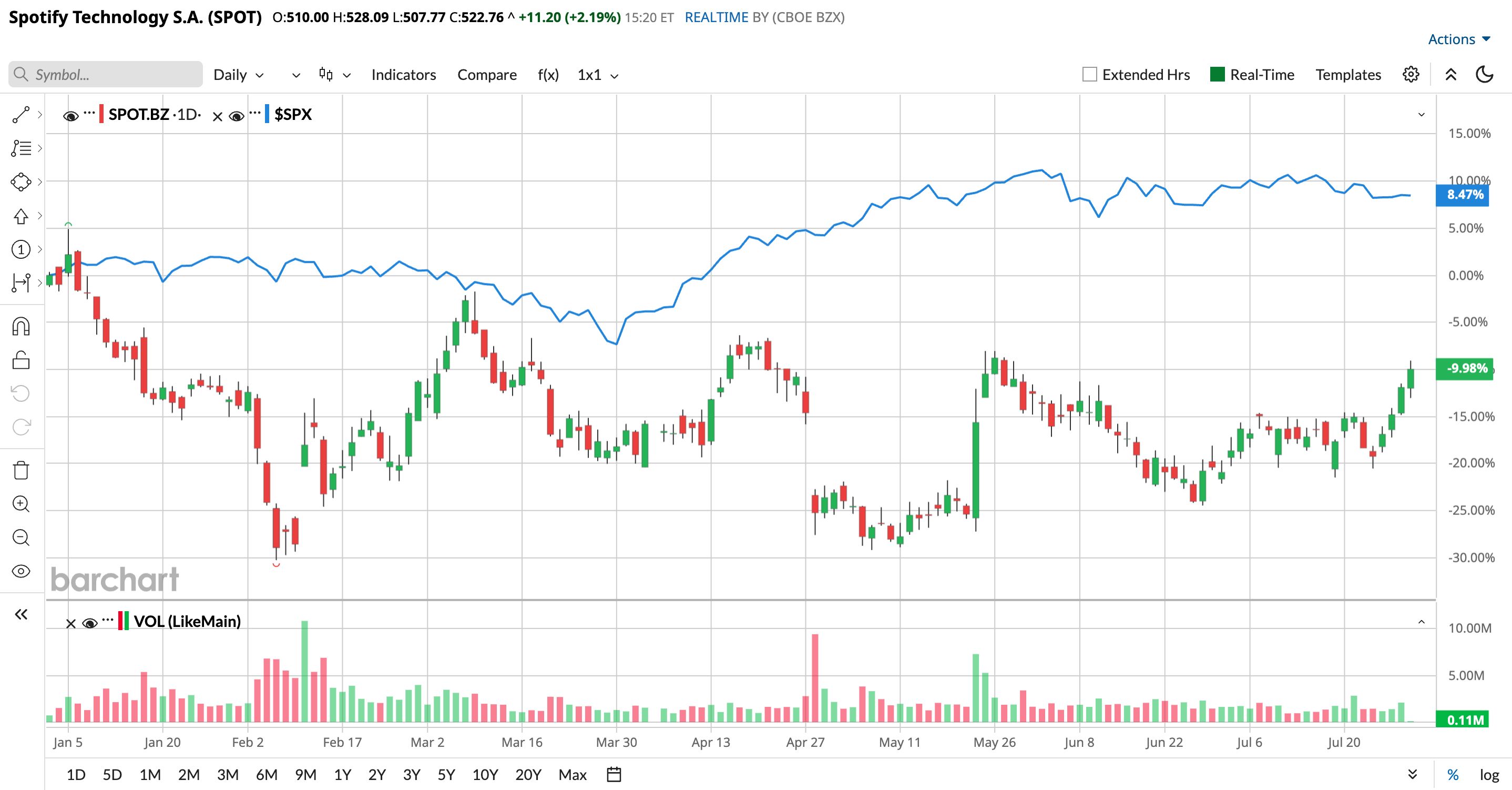
As a result, Spotify stock has fallen 9.33% so far in 2026, trailing the broader S&P 500 Index ($SPX), which has gained 8.2% year-to-date (YTD). However, investor sentiment has improved recently, with the stock outshining the broader market’s 0.45% loss and rebounding nearly 13.9% over the past month ahead of its upcoming earnings report.
 www.barchart.com
 Inside Spotify’s Q1 Earnings Report
Spotify kicked off fiscal 2026 with a quarter that looked strong on paper, but investors quickly discovered there was more to the story. When the Swedish audio-streaming giant reported its first-quarter results on April 28, it comfortably surpassed Wall Street's expectations on both revenue and earnings. However, a cautious outlook for the months ahead ultimately stole the spotlight.
The company generated 4.5 billion euros in revenue during the quarter, an 8% year-over-year (YOY) increase, fueled by continued momentum in premium subscriptions and a higher average revenue per user (ARPU). Premium revenue alone climbed 10% YOY, reflecting steady subscriber growth and improving monetization.
Spotify's user base continued to expand at an impressive pace. Monthly active users (MAUs) jumped 12% YOY to 761 million, up from 751 million in the previous quarter and 2 million above the company's own guidance. Premium subscribers rose 9% YOY to 293 million, compared to 290 million in the prior quarter, meeting management's expectations. Beyond user growth, Spotify continued to make meaningful progress on profitability.
Gross margin expanded by roughly 133 basis points YOY to 33%, marking one of the highest structural gross margins in the company's history. Earnings per share surged a massive 222.4% YOY to 3.45 euros, while operating income climbed to 715 million euros as ongoing efficiency initiatives, lower workforce costs, and optimized content delivery continued to boost operating leverage.
Free cash flow remained exceptionally strong at 824 million euros, and Spotify closed the quarter with a formidable balance sheet, holding 8.8 billion euros in cash, cash equivalents, restricted cash, and short-term investments. Looking ahead, management expects the momentum to continue in the second quarter, forecasting 778 million monthly active users, implying approximately 17 million net new MAUs.
Premium subscribers are projected to reach 299 million, representing 6 million net new additions. Spotify guided for 4.8 billion euros in revenue, a 33.1% gross margin, primarily supported by continued strength in its Premium business, and 630 million euros in operating income. Despite those growth projections, investors were left wanting more.
While Spotify's MAU guidance came in slightly ahead of Wall Street's expectations, analysts had been looking for more than 300.4 million premium subscribers. The company also warned that its outlook remains "subject to substantial uncertainty," while its 630 million euros operating income forecast fell well short of analysts' estimates of around 680 million euros. The cautious guidance overshadowed an otherwise impressive quarter, triggering a sharp 12.43% decline in Spotify shares on April 28.
What Do Analysts Think About Spotify Stock?
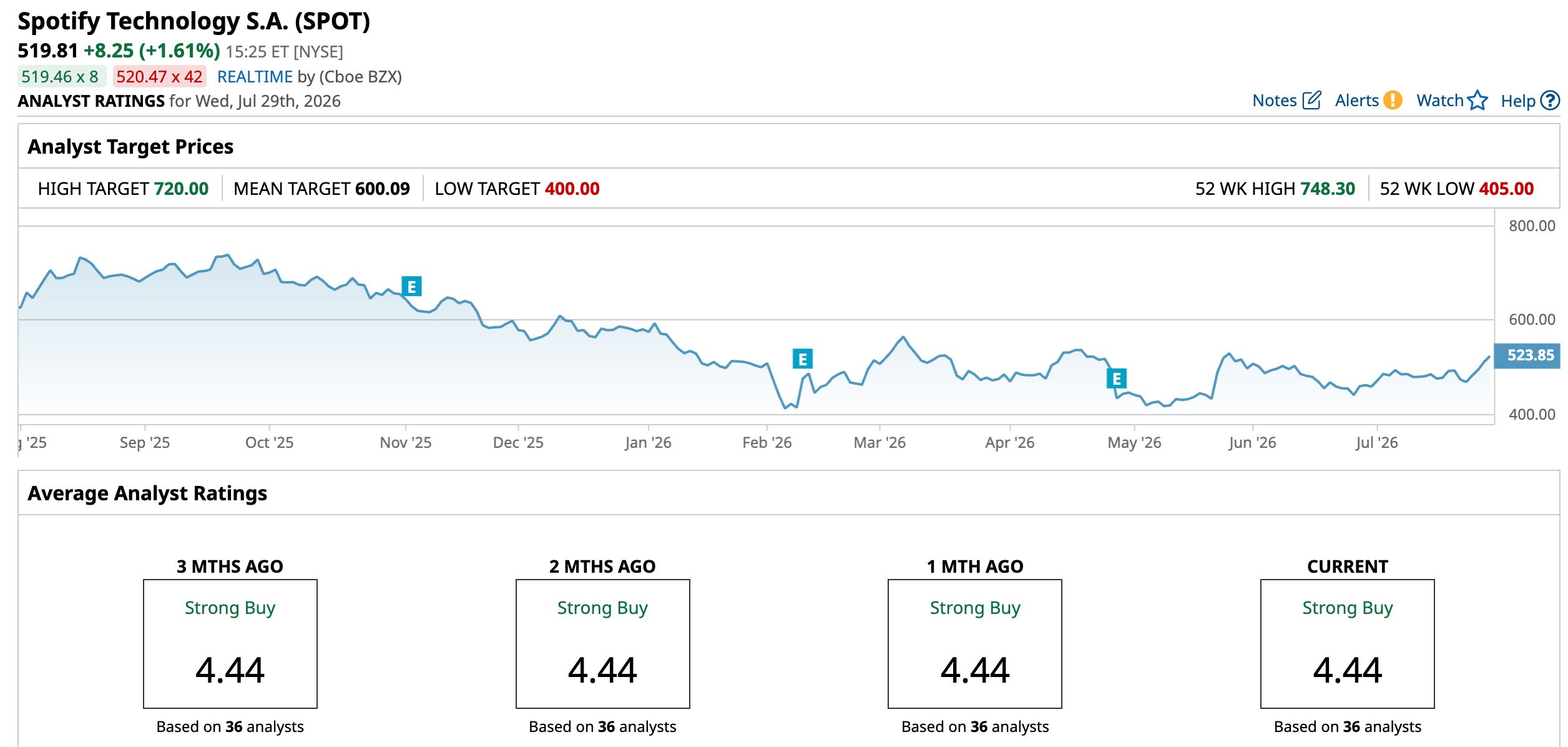
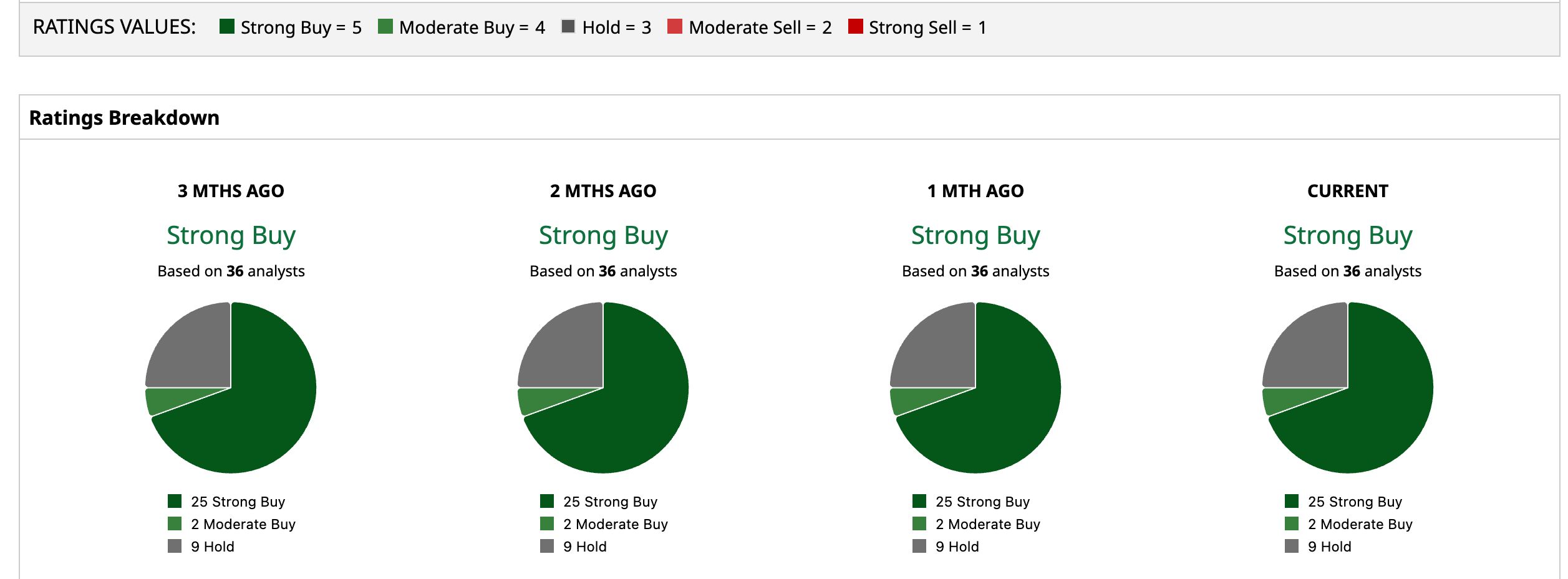
Despite investors' muted reaction to Spotify's first-quarter earnings report, Wall Street's confidence in the stock remains largely intact ahead of its next results. The streaming giant continues to enjoy strong support from analysts, with the stock carrying a consensus "Strong Buy" rating. Among the 36 analysts covering Spotify, 25 recommend a "Strong Buy," two rate it a "Moderate Buy," while nine remain on the sidelines with a "Hold."
The average price target of $600.09 suggests the stock could climb 15.4% over the next 12 months, while the Street-high target of $720 points to a potential upside of as much as 38.5% from current levels.
 www.barchart.com
  www.barchart.com
 On the date of publication, Anushka Mukherji did not have (either directly or indirectly) positions in any of the securities mentioned in this article. All information and data in this article is solely for informational purposes. For more information please view the Barchart Disclosure Policy here.
More news from Barchart
Vertiv (VRT) Stock Sinks Despite Earnings Beat. What to Know. Agentic AI Is Coming to Chip Design. Here Is Why Synopsys Stock Could Be the Biggest Beneficiary. Why Amazon’s Solid Q2 Won’t Be Enough to Lift AMZN Stock Dear Spotify Stock Fans, Mark Your Calendars for August 4