


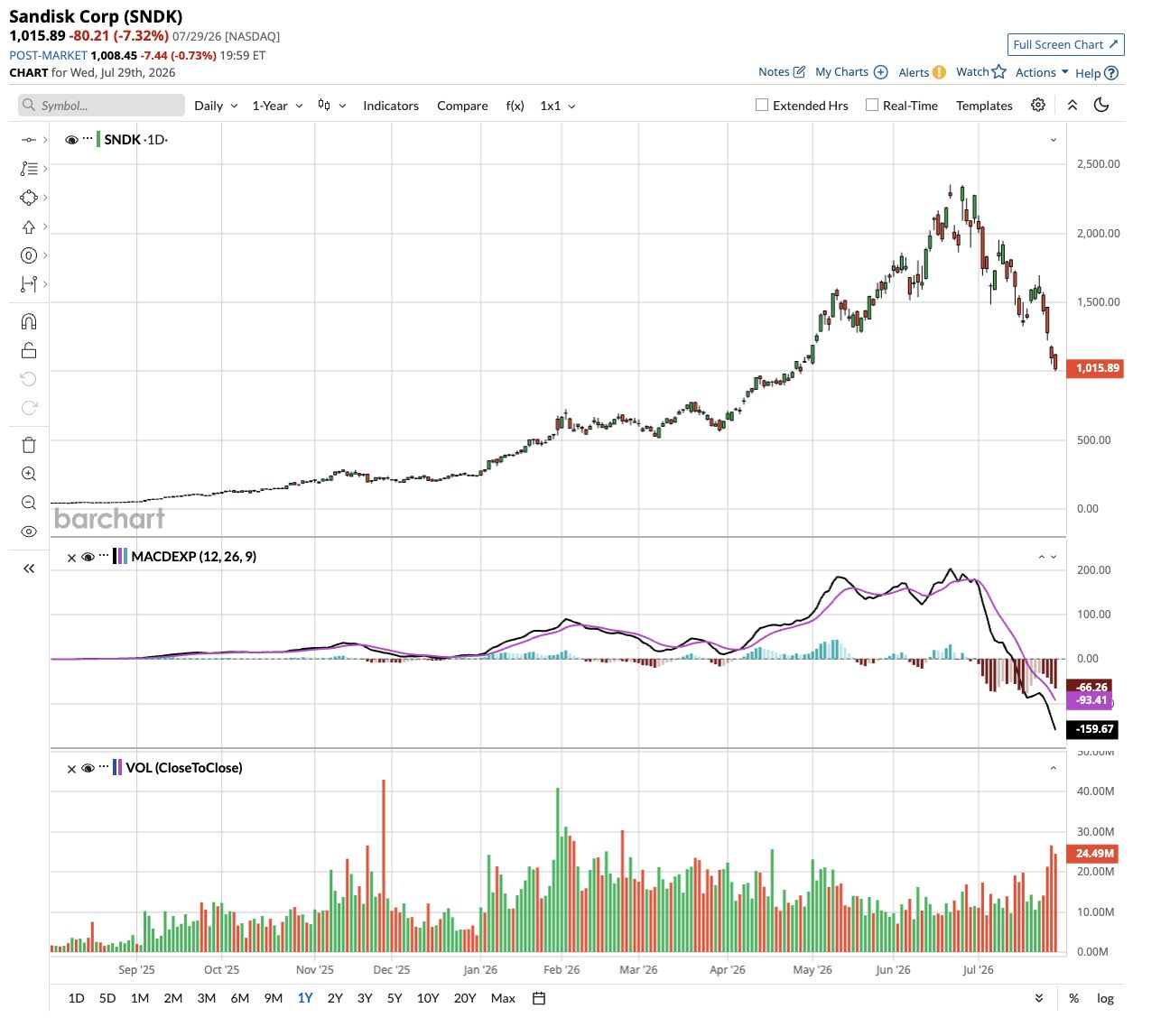
Sandisk (SNDK) has been among the most volatile stocks on Wall Street in the past year. Valued at a market capitalization of $189.5 billion, the tech stock has returned more than 2,800% over the last 12 months. Despite these market-thumping returns, SNDK stock is down more than 45% from its all-time highs.
Sandisk is down sharply from its peak, even though the company just posted one of the best quarters in its history. Let's take a closer look.
More Top Stocks Daily: Go behind Wall Street’s hottest headlines with Barchart’s Active Investor newsletter.
 www.barchart.com
 Sandisk Is Part of the AI Segment
Sandisk makes NAND flash memory, the chips that store data in everything from laptops to massive data-center servers. For years, this was a boring, cyclical business where prices rose and fell with supply and demand.
On the company's fiscal third-quarter earnings call, CEO David Goeckeler said that Sandisk signed five multiyear supply partnerships with customers that the company calls new business models (NBMs). These deals lock in demand for Sandisk and supply for its customers, backed by financial guarantees exceeding $11 billion. CFO Luis Visoso told analysts on the call that the three contracts signed in Q3 carry a minimum contractual revenue of about $42 billion, a figure the company now tracks as remaining performance obligations (RPO).
AI remains the key driver behind Sandisk’s explosive growth. Data-center revenue jumped 233% sequentially to $1.47 billion in Q3, fueled by demand for memory that supports AI inference, reasoning tasks, and agentic systems.
Goeckeler explained that AI workloads increasingly rely on techniques like KV cache, which require large amounts of fast flash storage well beyond what is needed to hold the AI model itself. Total revenue reached $5.95 billion in Q3, up 251% year-over-year (YOY), while non-GAAP gross margin expanded to 78.4%, up from 51.1% in Q2.
The Q3 report also showed that the board authorized a $6 billion share buyback program with no expiration date. That is a sign of confidence after Sandisk paid off its remaining term loan balance and built a net cash position of $3.74 billion.
Why Is SNDK Stock Falling?
In the last five trading days, SNDK stock has lost 13% as investors have worried about an AI bubble.
Wall Street opinion is reportedly split on Sandisk. Some analysts argue that NAND pricing still has room to run and point to the $42 billion contracted revenue figure as proof the market underestimates the company's shift away from a boom-and-bust chip cycle. Others counter that the rally has simply run too far, too fast, and that AI inference may ultimately need less NAND per parameter than bulls are betting on.
One firm flagged concentrated exposure to a small number of hyperscaler customers as a key risk, while another questioned whether Sandisk's valuation premium over rival Micron (MU) is justified.
Susquehanna recently trimmed its price target on SNDK stock to $3,050 from $3,250 while keeping a positive rating, citing unresolved questions about how memory gets divided between DRAM and SSDs in AI inference setups ahead of Sandisk's Q4 results.
What Investors Should Watch Next
For now, Sandisk's own guidance points to more growth ahead. The company forecast Q4 revenue between $7.75 billion and $8.25 billion, with gross margin expected between 79% and 81%. The gap between those numbers and the stock's recent downward spiral shows how quickly sentiment can shift once investors have already priced in years of good news.
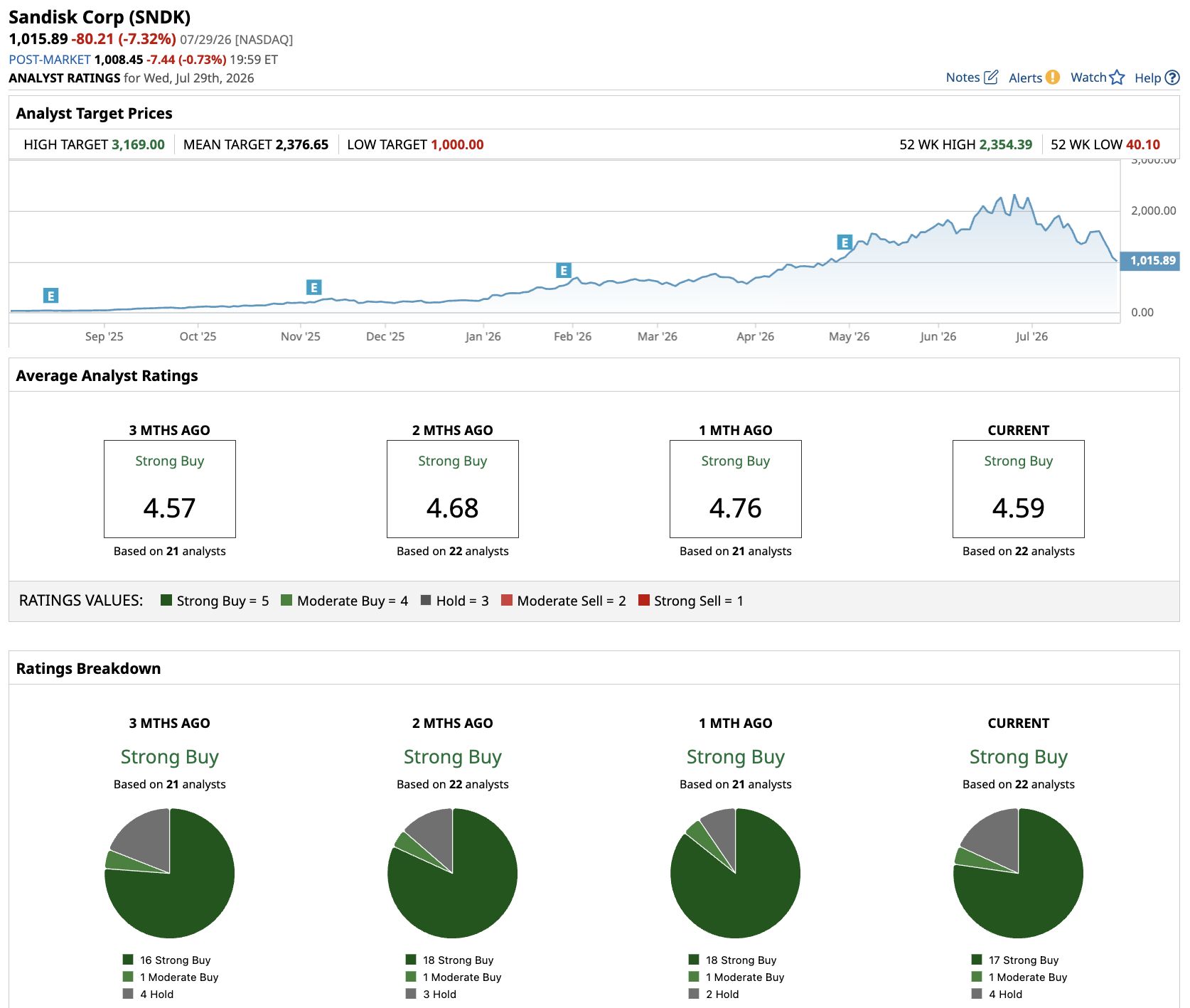
Out of the 22 analysts covering SNDK stock, 17 recommend a “Strong Buy,” one recommends a “Moderate Buy,” and four recommend a “Hold” rating. The average price target of $2,376.65 represents potential upside of 92% from current levels.
All told, whether Sandisk's new contract-based business model proves durable, or whether the AI memory trade has simply gotten ahead of itself, may not become fully clear until the company reports Q4 results.
 www.barchart.com
 On the date of publication, Aditya Raghunath did not have (either directly or indirectly) positions in any of the securities mentioned in this article. All information and data in this article is solely for informational purposes. For more information please view the Barchart Disclosure Policy here.
More news from Barchart
Midterm-Year Volatility Is Coming. Prepare to Buy the Dislocation. RIVN Stock Pops as Rivian Raises Delivery Guidance for 2026 NVO Stock Plummets as Novo Nordisk Heart Drug Fails Late-Stage Trial JMKE Stock Scores 'Buy' Rating Following the Jersey Mike's IPO