

Wall Street has spent the past two years obsessing over the hundreds of billions of dollars Big Tech is pouring into artificial intelligence. But an even bigger story may be unfolding off the balance sheet.
A recent Nikkei investigation found that the four largest hyperscale cloud providers have quietly accumulated roughly $1.65 trillion in off-balance-sheet obligations tied largely to data centers, power infrastructure, and long-term lease commitments. These aren't traditional loans investors see on a balance sheet. Instead, they're contractual guarantees and lease obligations designed to accelerate AI expansion while keeping reported debt lower than it otherwise would be.
More Top Stocks Daily: Go behind Wall Street’s hottest headlines with Barchart’s Active Investor newsletter.
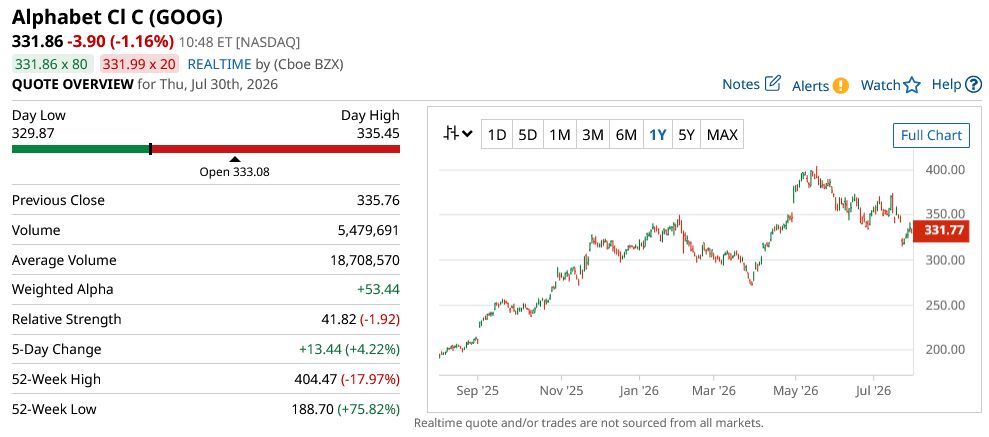
Alphabet's (GOOG) (GOOGL) Google is now providing one of the clearest examples of how this financing model works. Alphabet is rapidly expanding its use of financial guarantees to help build AI infrastructure, effectively putting its balance sheet behind billions of dollars of data center debt to accelerate adoption of its Tensor Processing Units (TPUs) in the race against Nvidia (NVDA).
 www.barchart.com
 The $44 Billion Number Hidden in the Footnotes
According to The Information, Alphabet has agreed to guarantee as much as $43.8 billion in data center lease payments if tenants default. Just nine months earlier, that figure stood at only $6.5 billion. In less than a year, Google's maximum exposure has increased nearly sevenfold.
The structure is relatively straightforward. AI cloud provider Fluidstack leases and develops data centers filled with Google's TPUs before renting that computing capacity to Anthropic. Google guarantees the leases, allowing lenders to provide financing at lower rates because Alphabet ultimately stands behind the obligation if something goes wrong.
The arrangement gives Google an important competitive advantage. Rather than simply selling chips, it's helping finance the infrastructure needed to deploy them, making TPUs more attractive as Nvidia continues to dominate the AI accelerator market.
From an accounting standpoint, however, the numbers look very different. Despite the $43.8 billion maximum exposure, Alphabet recorded only an $815 million liability on its balance sheet, representing management's estimate of probable losses under the guarantees. That's standard accounting treatment—but it also means investors need to pay close attention if those assumptions ever begin to deteriorate.
The Commitments Keep Growing
The guarantees are only one piece of Google's expanding AI infrastructure commitments.
Alphabet's total debt climbed to $98 billion as of June 30, up from $23.6 billion a year earlier. The company also issued debt for the first time in more than two decades while posting negative free cash flow during the second quarter, an unusual milestone for one of the market's most consistent cash-generating businesses.
To be clear, Alphabet isn't facing a liquidity problem. The company generated roughly $185 billion in operating cash flow over the past 12 months, comfortably exceeding even its largest guarantee commitments. That's why many investors view the strategy as entirely manageable.
Still, the pipeline continues expanding. Beyond the existing $43.8 billion in guarantees, Google has committed to another $24.1 billion in future guarantees awaiting final terms. It also has $85.2 billion in signed data center leases that haven't yet commenced, plus another $7.6 billion in power-related guarantees.
Taken together, Alphabet's off-balance-sheet commitments tied to its AI infrastructure buildout now exceed $150 billion (Nikkei puts the figure closer to $250 billion).
Google Isn't Taking All the Risk for Free
These guarantees aren't acts of corporate generosity. In several transactions, Google received equity warrants that allow it to participate in the upside if the data center developers prosper. Alphabet's filings indicate those warrants could ultimately represent roughly 14% of TeraWulf (WULF) and 5.4% of Cipher Digital (CIFR), giving Alphabet another way to benefit from the AI infrastructure boom beyond simply selling TPUs.
Not every transaction follows that model. Hut 8's (HUT) roughly $7 billion lease arrangement, along with another $2 billion in related commitments, reportedly came without equity warrants. According to one source familiar with Alphabet's strategy, however, similar structures are unlikely to become the norm.
Key Takeaway
Google's growing guarantee business isn't necessarily a red flag. With roughly $185 billion in annual operating cash flow, Alphabet has the financial strength to support these commitments, and the guarantees help accelerate TPU adoption in an increasingly competitive AI market.
But investors shouldn't ignore how quickly these obligations are accumulating. Google's maximum guarantee exposure has jumped from $6.5 billion to $43.8 billion in just three quarters, while its broader AI-related off-balance-sheet commitments have climbed beyond $150 billion. Combined with the Nikkei estimate that the four largest hyperscalers now carry roughly $1.65 trillion in similar obligations, it's clear that much of the AI buildout is being financed outside the traditional debt markets investors typically watch.
Rather than focusing solely on the headline guarantee amounts, investors should keep an eye on the fair-value liability Alphabet records each quarter. If that figure begins rising materially faster than management expects, it could provide one of the earliest indications that this increasingly popular financing strategy is becoming riskier than the market currently believes.
On the date of publication, Rich Duprey did not have (either directly or indirectly) positions in any of the securities mentioned in this article. All information and data in this article is solely for informational purposes. For more information please view the Barchart Disclosure Policy here.
More news from Barchart
Visa Stock Looks Attractive After Layoffs, Strong Earnings Google Piles On Off-Balance-Sheet Risk to Fuel Its AI Chip Push Hoping for Lower Prices at the Gas Pump? After Exxon Doubles Profits, CEO Darren Woods Says ‘I Wouldn’t Hold My Breath.’ Why Investors Shouldn’t Sweat the Dip in Qualcomm’s Handset Revenue, According to Experts