


This stock market is shaky at best. Some might even say you need “nerves of steel” to navigate through it successfully.
As it turns out, the continued geopolitical turmoil has kept prices high for many commodities. And that has put a bid under commodity stocks, including, ironically, steel stocks. That makes the VanEck Steel ETF (SLX) a consideration for AI-weary investors.
More Yield, Less Trap: Sign up free to get Barchart’s daily Dividend Investor newsletter straight to your inbox.
 www.barchart.com
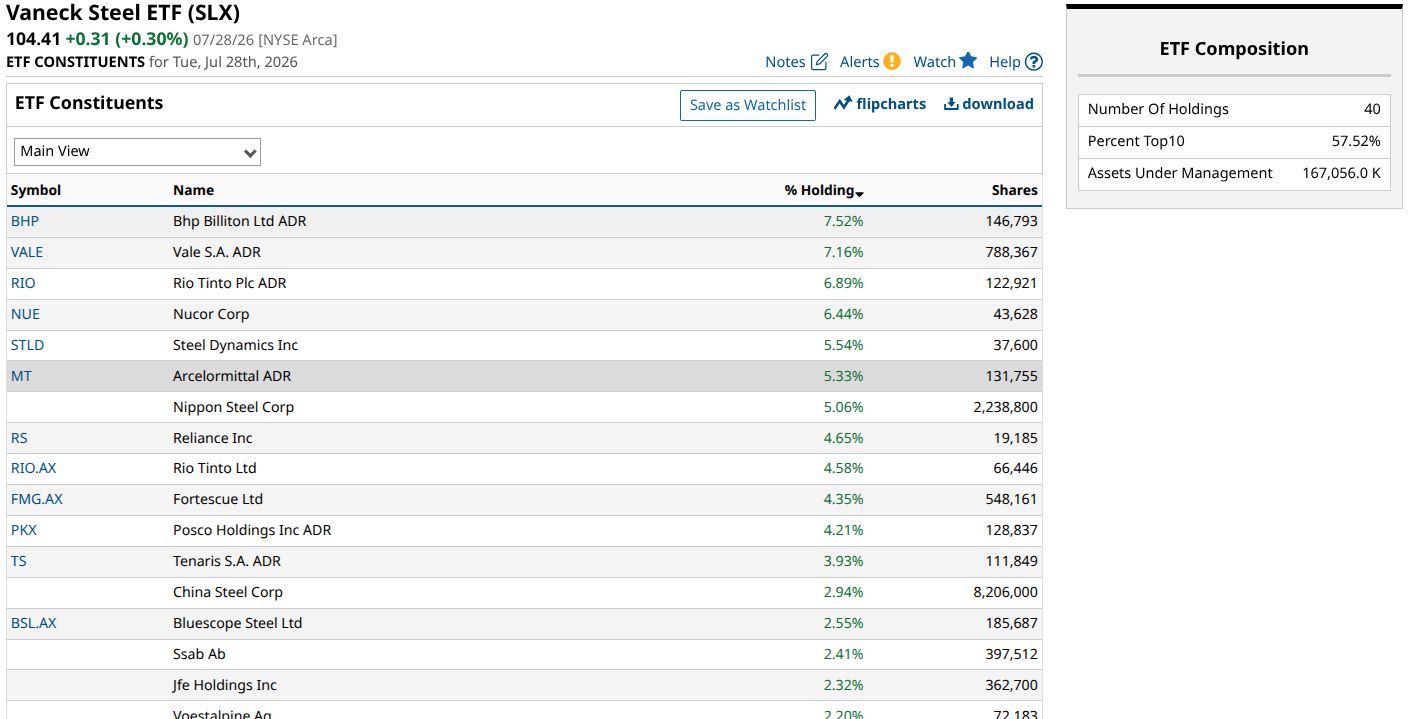
 SLX is a 40-stock ETF, although 10 stocks account for 57% of the fund’s assets. That includes U.S. firms involved with the commodity, as well as those in Latin America and Asia. As steel (HVQ26) is a bit of a market niche, with far less glamour than gold, silver, or even copper, its $167 million asset base, 20 years since it debuted, is not surprising.
 www.barchart.com
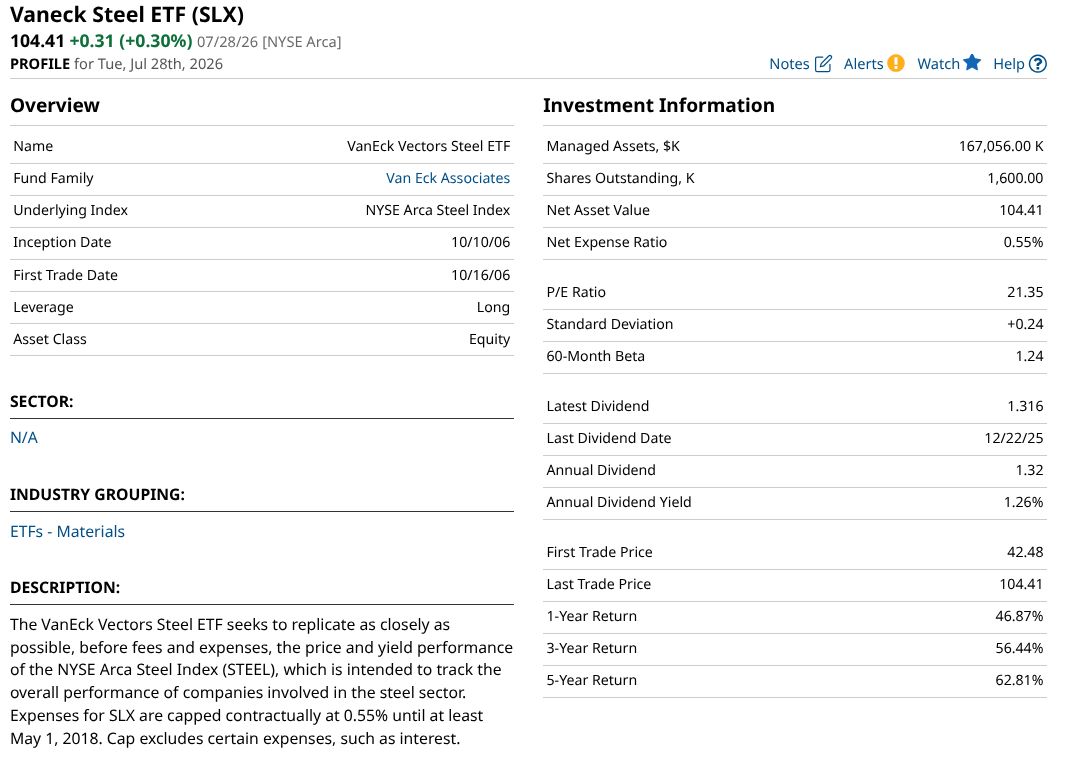
 When we examine SLX’s past performance (above), its 1-year return simply made up for lost time. If we interpolate between that and the 5-year return, we realize that most of the past five years has resulted in lagging performance for SLX versus the S&P 500 Index ($SPX).
It also speaks to the highly volatile nature of investing in steel stocks. Indeed, the ETF’s beta over that time period indicates that it was 24% more volatile than the S&P 500. And at 21x trailing earnings, this basket is not particularly cheap. Still, that might not matter to the market when commodity prices are rising more than stock prices are.
When global trade friction or broad economic weakness threatens corporate earnings, domestic steelmakers benefit from trade protectionism. High tariffs on foreign steel (such as Section 232 measures and tariff hikes up to 50%) effectively block cheap imports from flooding the domestic market.
This gives domestic U.S. producers strong pricing power and guaranteed market share, creating an insulated revenue moat (sustainable competitive advantage) even if overall global demand softens.
And, while consumer spending and tech earnings contract during dangerous market environments, public sector infrastructure spending operates on multi-year, locked-in budgets. Highway, bridge, rail, and port upgrades funded through government infrastructure initiatives provide guaranteed, non-discretionary steel demand. Furthermore, global geopolitical friction and domestic grid modernization mandate steady consumption of plate steel and specialized electrical steel, regardless of stock market sentiment.
Lest we think steel is a no-show in the AI trade, note that it is actually at the foundation of the physical infrastructure required for next-generation tech. Expanding AI data centers requires massive structural steel frameworks, backup power containment, and heavy electrical equipment. And, the push to build semiconductor fabs, battery facilities, and domestic supply chains requires heavy upfront steel before factory floors ever become operational.
In a volatile market where high-duration growth stocks face severe valuation contraction, capital rotates toward real assets with low relative earnings multiples. Modern steel producers generate substantial free cash flow, allowing them to fund dividends and share repurchases. Also, hard assets and industrial materials historically serve as an equity hedge during periods of persistent commodity inflation or currency weakness.
 www.barchart.com
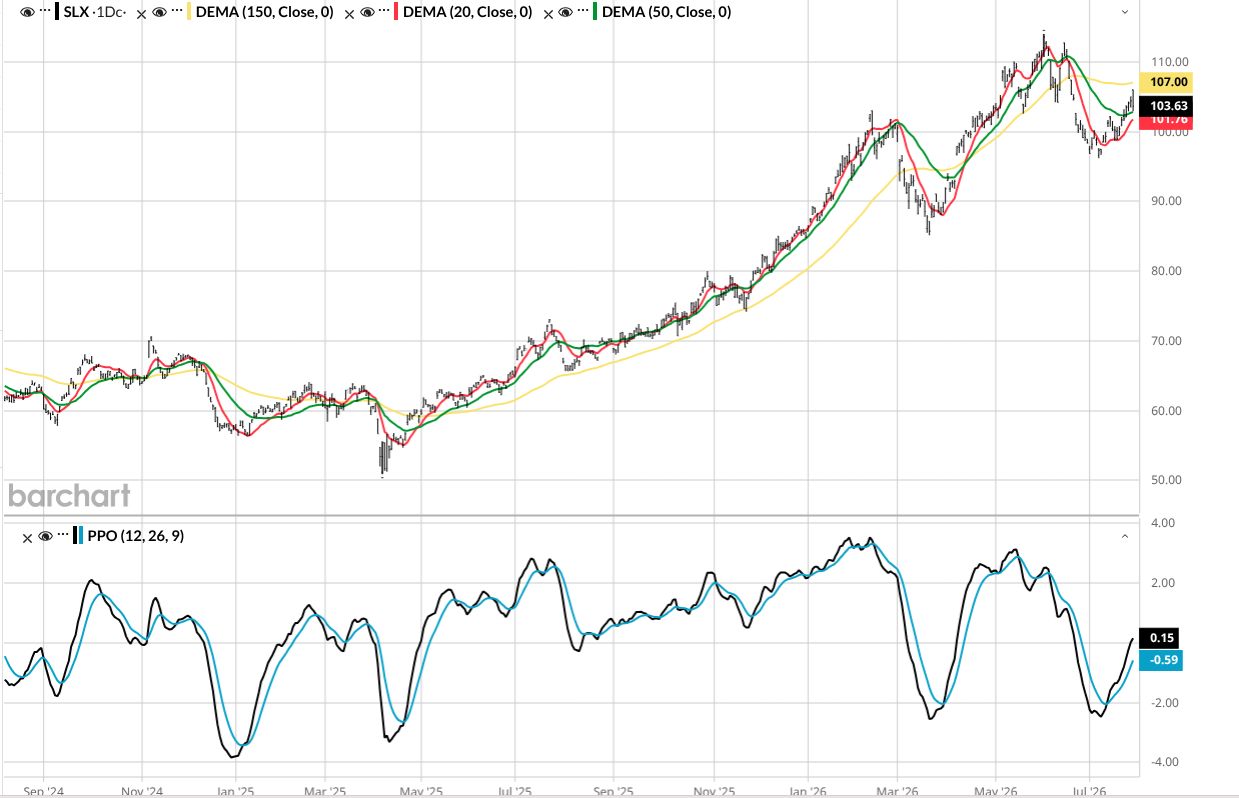
 To me, it always comes down to the chart. The daily view above is bullish, at least compared to most ETF market segments I track.
That said, this market is not to be trusted. Everything is a trade, not a long-term investment, until proven otherwise. I like SLX on a relative basis. But this market can turn on a dime. Or maybe a steel penny, like the U.S. produced in 1943, just for a year, to help save copper supply used to fight World War II.
The current market might be entering a financial war to go along with the one in the Middle East. That makes commodity stocks something to follow closely.
Rob Isbitts is a semi-retired CIO, former fiduciary investment advisor, and Barchart columnist. Check out his other work at ETFYourself.com (featuring the Fresh Charts weekly trading post), and ROAR.PiTrade.com, helping investors to better-manage their own portfolios.
On the date of publication, Rob Isbitts did not have (either directly or indirectly) positions in any of the securities mentioned in this article. All information and data in this article is solely for informational purposes. For more information please view the Barchart Disclosure Policy here.
More news from Barchart
Why Steel Stocks Are the Perfect Blend Between a Hot AI Trade and a Crash-Proof Portfolio Why This High-Yield Stock Fund Should Replace Covered Call ETFs… At Least for a While These Floating-Rate ETFs Could Keep Your Portfolio Afloat Amid Rising Rates Clean Energy Stocks Have Plunged Into the Red. Even Bottom-Fishers Should Stay Away.