

Half a trillion dollars in a single trading session. That is the scale of value Microsoft Corporation (MSFT) created on July 30, when its shares rocketed 15.51% higher, its strongest one-day performance in nearly two decades.
The move added roughly $450 billion to Microsoft’s market capitalization, the largest one-day gain ever recorded by a United States company. Now, this has lifted the software giant’s valuation to approximately $3.45 trillion.
More Top Stocks Daily: Go behind Wall Street’s hottest headlines with Barchart’s Active Investor newsletter.
The rally came after a strong fiscal fourth quarter report that showed accelerating Azure growth of 30%, and clear evidence that its massive AI infrastructure investments are beginning to translate into higher profits.
Heading into the print, Microsoft had lagged many of its Magnificent 7 peers, such as Alphabet (GOOG) (GOOGL), as investors fretted that capital spending was outrunning returns. The earnings results changed that view quickly and forced investors to rethink its growth outlook.
However, can a one-day record of this magnitude mark the start of sustained outperformance, or will the momentum fade once the initial relief settles?
Microsoft’s Record Numbers
Microsoft develops software, cloud services, and AI tools from its base in Redmond, Washington, and it sits among the world’s most valuable companies. It also runs Azure, the third-largest cloud platform, while selling productivity, gaming, security, and enterprise products.
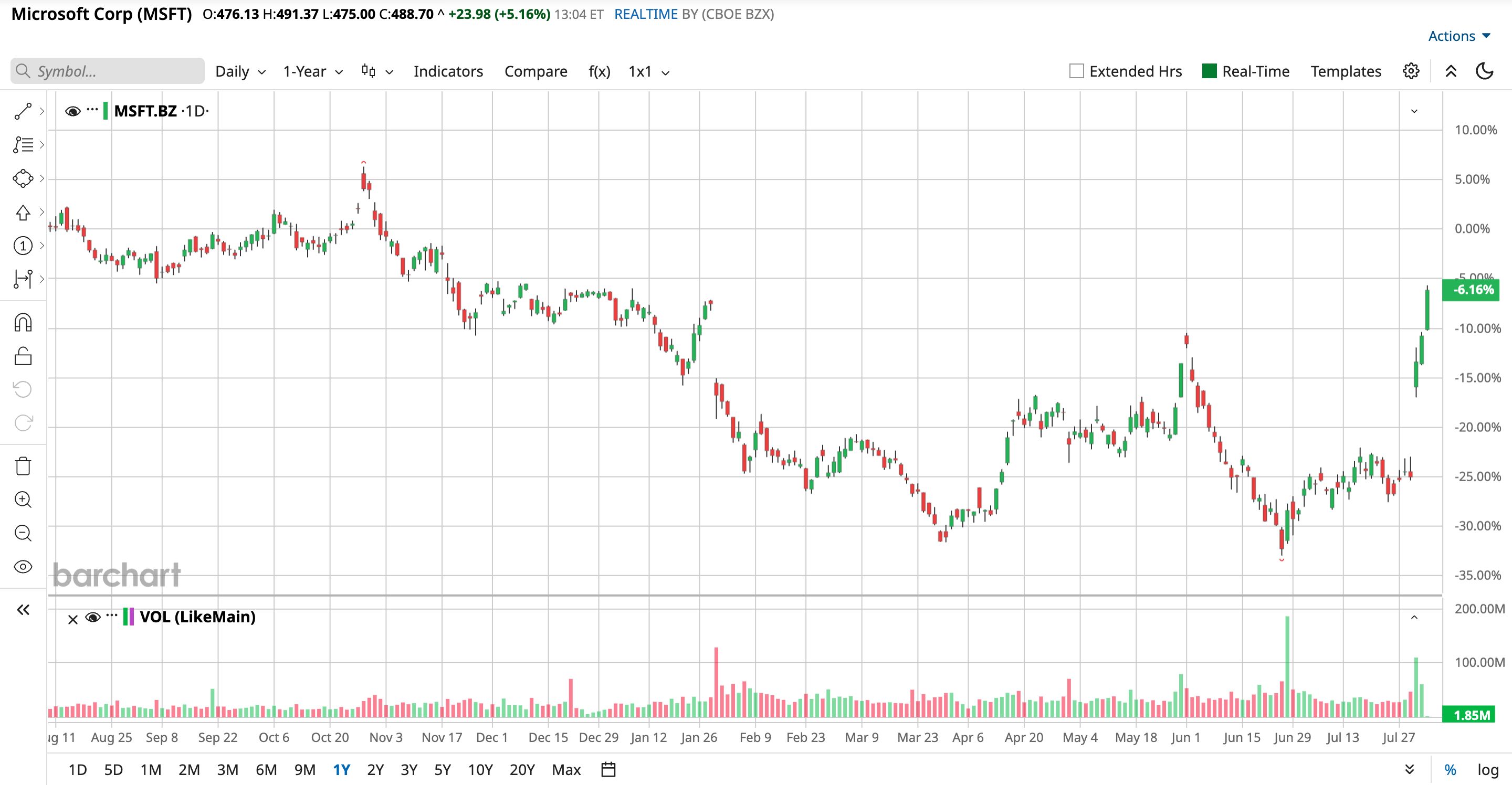
MSFT is up marginally 0.81% year-to-date (YTD) but down 6.98% over the past 52 weeks, though the stock is still up 25% since its earnings release.
 www.barchart.com
 The company has a premium valuation at 26.89 times trailing price-to-earnings, slightly above the sector median of 25.15 times, while its trailing price-to-sales ratio stands at 10.40 times versus the sector median of 3.57 times. MSFT also pays an annual dividend of $3.64, with a forward yield of 0.81%.
Their earnings history has been strong, as Microsoft reported Q2 CY2026 revenue of $90.01 billion, topping the $87.71 billion estimate by 2.6%. That’s a 17.7% increase year-over-year (YOY).
Also, this marked a clean beat on earnings, with GAAP EPS of $4.81 versus a $4.22 estimate, or a 14.1% surprise. Its gross margin came in at 67.2%, down from 68.6% a year earlier, while operating margin held steady at 45.1%.
This free cash flow margin slipped to 21.8% from 33.4% a year ago, which reflects the cost of scaling AI infrastructure and data centers. Microsoft’s Intelligent Cloud (Azure & Cloud Computing) segment made up 41.5% of total sales and grew at a 31.6% rate in the quarter. That growth rate topped AWS’s 28.4% increase, though it trailed Google Cloud’s 81.8% rise.
The segment’s five-year growth rate of 17.9% still ran faster than companywide revenue growth.
Microsoft’s Expanding Partnership Pipeline
Microsoft’s recent deals show it is building a wider business around cloud, infrastructure, and enterprise demand.
Microsoft’s deal with French AI start-up Mistral stood out because it expands AI capacity in Europe and gives businesses and regulated industries more control over use of advanced AI. The company will use Mistral’s Europe-based GPU capacity to support its cloud and AI work, while Mistral models are being added to Microsoft Foundry, Copilot Studio, and Azure.
Further, Microsoft's 3M (MMM) partnership points in the same direction. The deal focuses on AI data center infrastructure and enterprise change, with Azure Cloud and AI Infrastructure becoming the first announced hyperscale cloud provider to deploy 3M’s Expanded Beam Optical technology.
Finally, the Databricks deal adds another layer. Microsoft and Databricks extended their partnership into the 2030s, with Databricks deepening its use of Azure Databricks and Azure Cobalt to improve speed and efficiency. Microsoft, in turn, will keep weaving Databricks’ data and AI platform into customer workflows.
Together, these moves show Microsoft is building more than a one-quarter story.
Analysts Still See More Room
Microsoft’s next earnings date will be November 4, and analysts think the September quarter will still show solid growth. The current estimate is $4.67 a share, up from $4.13 a year ago, which points to 13.08% YOY growth.
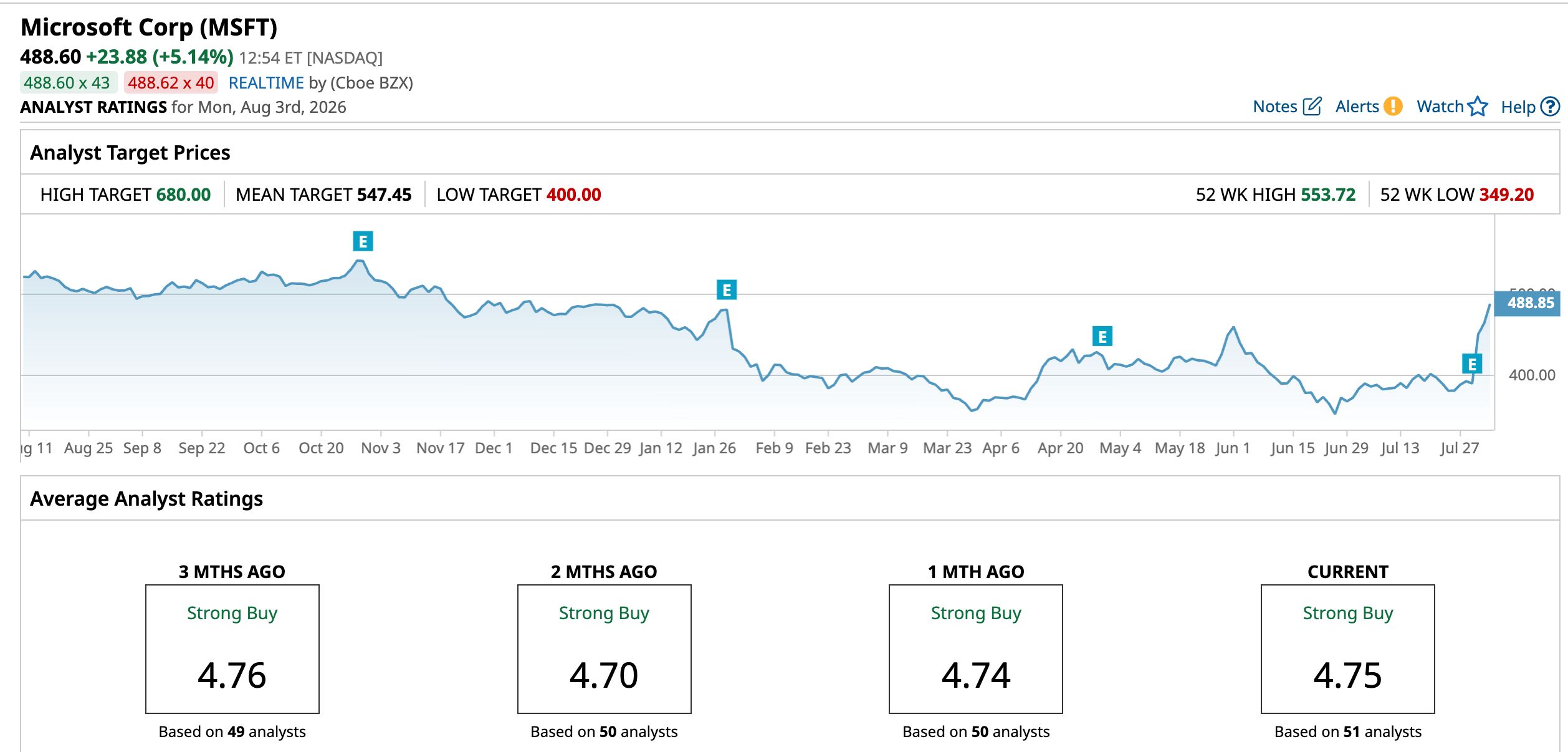
Even after the big rally, the Street has not turned cautious. Guggenheim’s John Difucci and his team kept their “Buy” rating on July 27 and left its $586 price target in place. That target still points to a 19.6% upside.
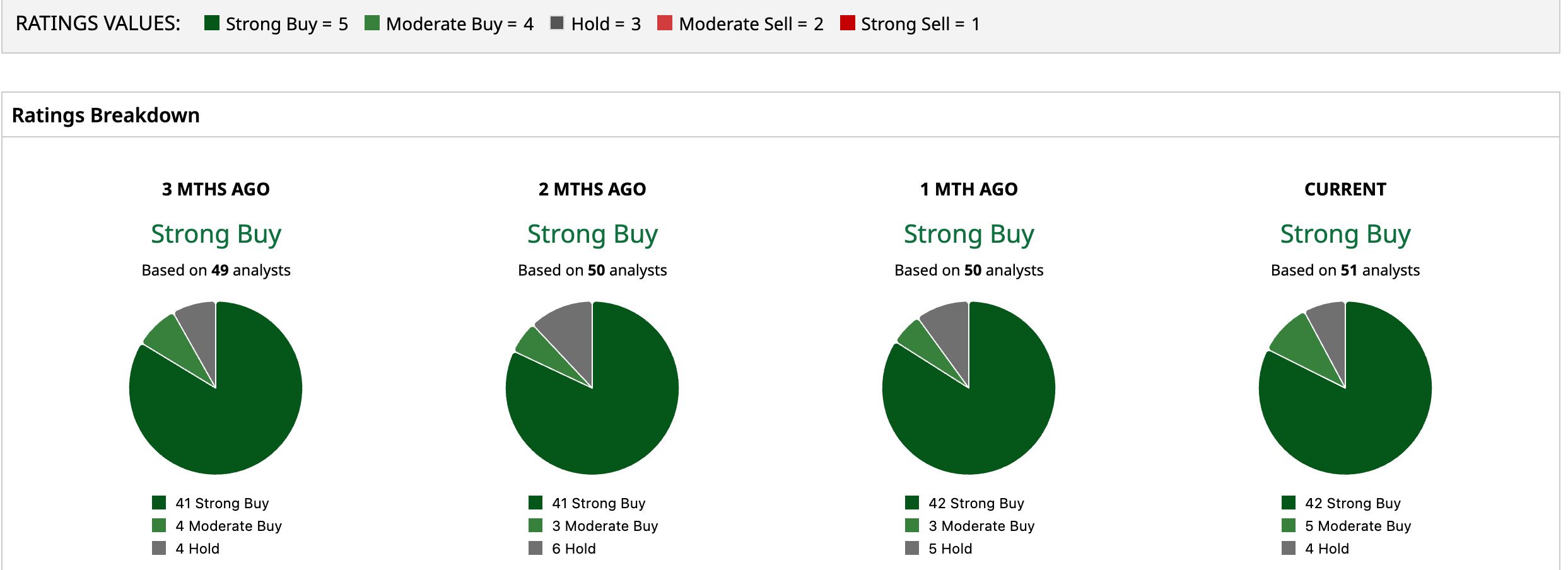
This optimism lines up with the broader Street view. Among 51 analysts surveyed, Microsoft carries a consensus “Strong Buy” rating. The average price target sits at $547.45, which implies a 12% upside from the stock's current price.
 www.barchart.com
  www.barchart.com
 Conclusion
Microsoft’s big jump looks fair for now because the numbers, cloud growth, and new deals all point the same way. Though, the real question is whether the stock can keep climbing after such a huge move. Most likely, its shares can still move higher, but not as fast as before. If Azure stays strong and the AI spending keeps paying off, the stock looks more likely to rise than to give back all the gains.
On the date of publication, Ebube Jones did not have (either directly or indirectly) positions in any of the securities mentioned in this article. All information and data in this article is solely for informational purposes. For more information please view the Barchart Disclosure Policy here.
More news from Barchart
Analysts Have Discovered Lost Love for Ford, But Don’t Rush to Buy F Stock for 2027 Investors Pile Into Long-Dated Microsoft Call Options in Unusual Volume - Bullish on MSFT Stock Microsoft Just Posted the Largest One-Day Market Cap Gain in U.S. History. More Gains Are Likely Still Ahead. Microsoft’s Data Center Leases Crossed $100 Billion In Q4. What This Means for MSFT Stock Here.