

Microsoft's (MSFT) latest quarterly results were highly anticipated by the Street. They were primarily positive and provided a much-needed fillip to the AI trade, which was under pressure due to capex-related and ROI concerns. However, apart from the usual aspects, market participants are also poring over some of the key details emanating from the company's Q4 2026 print that have not grabbed as much attention.
One of the notable ones among them was when Microsoft revealed in its Annual Report that the company has parted with about $130 billion to secure data center leases. Overall, the company's non-commenced leases for the quarter ended June 30, 2026, ballooned to $329.1 billion (vs. $196.6 billion in the prior year).
More Top Stocks Daily: Go behind Wall Street’s hottest headlines with Barchart’s Active Investor newsletter.
 www.barchart.com
 Microsoft's Lease List
Microsoft did not give a breakdown of the $130 billion data center leases for Q4 2026. The tech giant says only that the leases are "primarily for datacenters," that some remain "subject to certain contractual conditions being met," and that they begin between fiscal 2027 and fiscal 2033 with terms running from one to 20 years.
However, a calculated guess from public records can give a clearer picture.
For instance, Nscale committed €695 million on May 5, 2026, splitting €230 million into shared infrastructure and €465 million into a second 200-megawatt building at Start Campus in Sines, Portugal, dedicated to Microsoft and filled with more than 66,000 Nvidia (NVDA) Vera Rubin NVL72 class GPUs from late 2027. That sits on top of the 12,600 Blackwell Ultra GPUs already running there, on a campus permitted for 1.2 gigawatts.
Then there was Crusoe's new 900 megawatt Abilene campus, two buildings at 336 megawatts of critical IT load apiece plus an onsite power plant, which was announced for Microsoft in late March and takes that site toward 2.1 gigawatts.
However, these lease agreements notwithstanding, it must be noted that the substantial rise in non-commenced leases highlighted earlier was accompanied by an increase in useful life for long-lived assets like data centers and buildings from 15 years to 25 years in the last quarter as well. This comes across as a nifty accounting move by Microsoft to tackle the burgeoning depreciation costs that could have come with such large build-outs. Yet, this can turn out to be a double-edged sword, as reduced depreciation costs will also lead to reduced additions to net income to get free cash flows, a metric that is increasingly gaining importance for hyperscalers like Microsoft.
A Q4 to Remember
Having said that, there is little room for dispute when it comes to Microsoft's Q4 numbers.
Microsoft delivered solid financial results with revenue climbing 18% year-over-year (YoY) to $90 billion, exceeding forecasts by $2.4 billion. The Intelligent Cloud segment, which encompasses Azure, expanded 31.5% YoY to $39.31 billion. Although operating margins for the segment held roughly steady from the prior year, absolute operating income advanced 31.4% to $15.96 billion. Azure itself grew 43% YoY, surpassing expectations that had been set in the 39% to 40% range. For the full year, Azure revenue crossed a $100 billion run rate for the first time. Commercial backlog nearly doubled YoY to $684 billion, with approximately 30% of that amount expected to be recognized over the next twelve months, underscoring robust demand for the company’s cloud offerings.
Earnings per share rose 23% to $4.74, comfortably beating the consensus estimate of $4.24 and marking the ninth consecutive quarter of outperforming profit forecasts. It is worth noting that this figure includes a $3.2 billion gain related to the company’s investment in Anthropic, the developer of Claude.
Cash generation remained strong, with net cash from operations reaching $55.44 billion, a 30% increase from the year-earlier period. Microsoft closed the quarter with $76.8 billion in cash, well above its short term debt balance of $9.23 billion.
On the valuation front, MSFT appears reasonably positioned. The forward P/E ratio of 23.71 times is almost identical to the sector median of 23.23, while the P/CF multiple of 15.31 times is below the sector median of 19.06 times. The forward P/S multiple of 8.83 times exceeds the sector median of 3.26 times but remains below the stock’s own five-year average of 10.86 times.
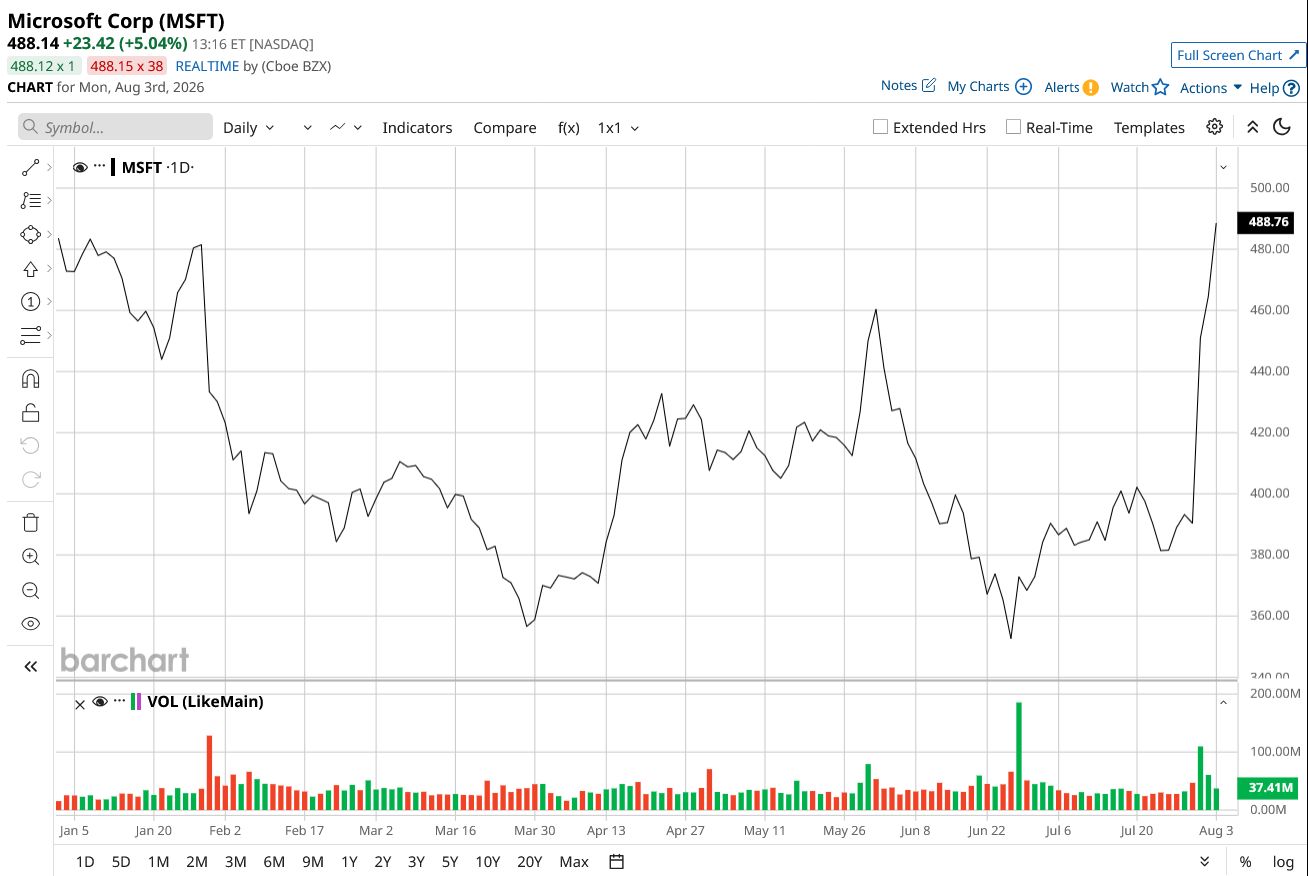
Currently valued at a market cap of $3.45 trillion, Microsoft is the fourth-largest company in the world, and its stock is essentially flat on a year-to-date (YTD) basis.
Analyst Opinion of MSFT Stock
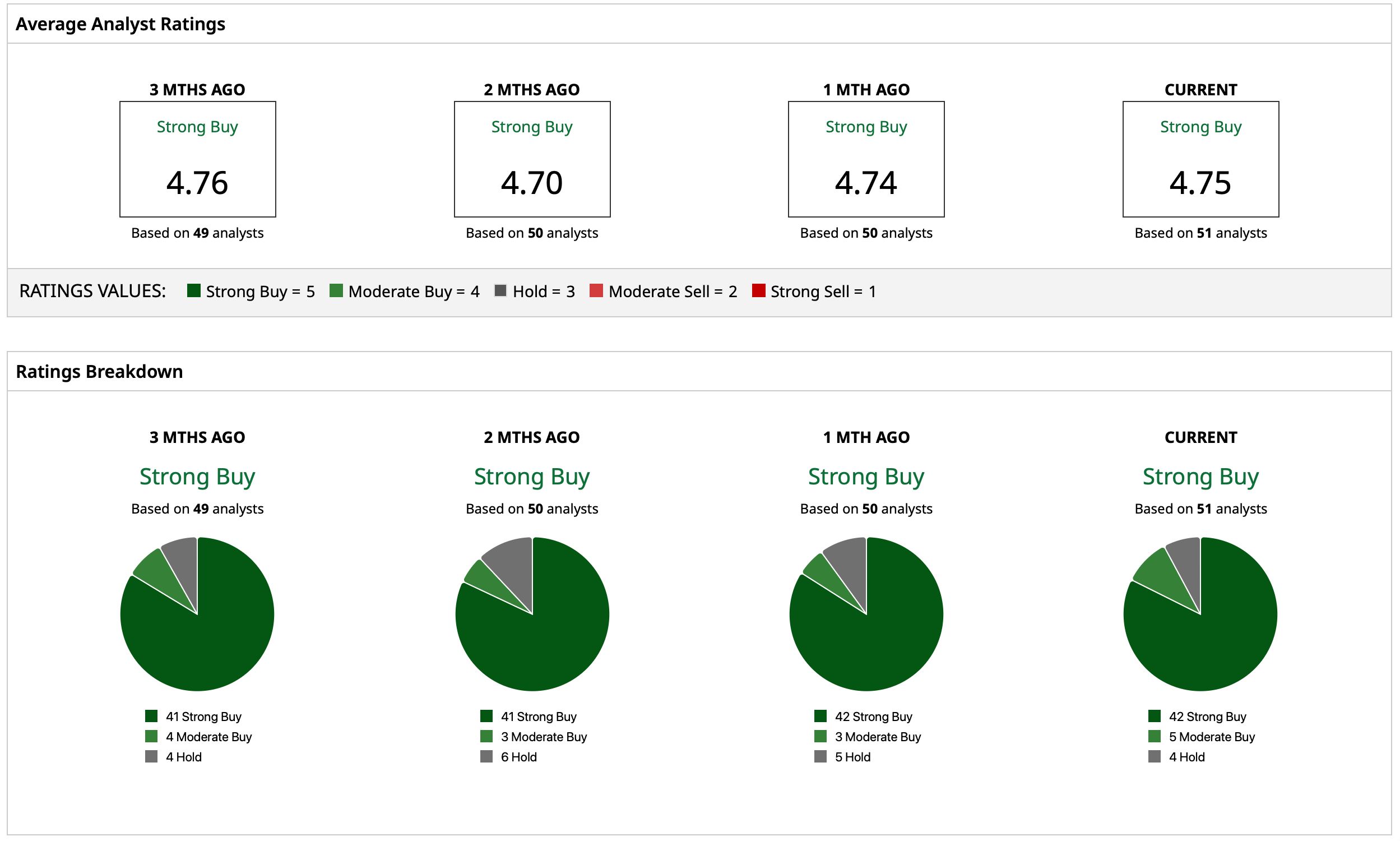
Thus, analysts have assigned MSFT stock a consensus “Strong Buy” with a mean target price of $547.45. This indicates a potential upside of about 12% from current levels. Out of the 51 analysts covering the stock, 42 have a “Strong Buy” rating, five have a “Moderate Buy” rating, and four have a “Hold” rating.
 www.barchart.com
 On the date of publication, Pathikrit Bose did not have (either directly or indirectly) positions in any of the securities mentioned in this article. All information and data in this article is solely for informational purposes. For more information please view the Barchart Disclosure Policy here.
More news from Barchart
Analysts Have Discovered Lost Love for Ford, But Don’t Rush to Buy F Stock for 2027 Investors Pile Into Long-Dated Microsoft Call Options in Unusual Volume - Bullish on MSFT Stock Microsoft Just Posted the Largest One-Day Market Cap Gain in U.S. History. More Gains Are Likely Still Ahead. Microsoft’s Data Center Leases Crossed $100 Billion In Q4. What This Means for MSFT Stock Here.