


It is not often that TSMC (TSM) takes cues from Intel (INTC), but that is undoubtedly what's happening. According to The Information, the world’s largest contract chipmaker is quietly building a new packaging technology modeled on Intel’s EMIB. TSMC’s own engineers are reportedly calling the project “EMIB-like” in-house. The company is developing it with a Taiwanese substrate maker, Kinsus Interconnect Technology. Following the report, TSMC’s U.S.-listed shares rose about 8%, while Intel climbed roughly 11% on July 30. For a company that usually defines the industry’s direction, TSMC borrowing ideas from Intel is worth a closer look.
The fight is all about how chips get packaged. TSMC’s main method, CoWoS, uses a large and expensive silicon layer to link chips together. Intel’s EMIB takes a leaner route, embedding tiny silicon bridges only where the chips actually connect. That makes it cheaper and potentially better suited to the increasingly large AI chip designs. The timing makes this sting more for the Taiwanese company. TSMC’s CoWoS is sold out into 2027, with some customers waiting well over a year. That backlog is pushing buyers to look for alternate suppliers, and Intel is ready. Its newest version, EMIB-T, recently hit a 98% yield rate, matching CoWoS in that metric, and has already drawn interest from Google (GOOG) (GOOGL), Amazon (AMZN), and Nvidia (NVDA). Every customer who leaves over the wait chips away at TSMC’s lead.
More Top Stocks Daily: Go behind Wall Street’s hottest headlines with Barchart’s Active Investor newsletter.
For Intel, this is a rare moment of strength. Its foundry turnaround has been slow, and outside customers still bring in very little. Intel’s foundry earned just $293 million from external clients last quarter, a sliver of the $5.8 billion the unit made overall, with the rest coming from Intel itself. But packaging gives Intel a genuine opening. If big customers come for EMIB, they may stay for Intel’s chipmaking too, which is where the real money is. TSMC clearly sees that risk, and its Kinsus project is the answer. It is worth noting that TSMC already uses silicon-bridge technology in one version of CoWoS, so the Kinsus effort may be as much about adding cheaper capacity as copying a rival. Either way, the message is the same. Packaging has become the next big battleground in the AI chip race. TSMC still holds a commanding lead across the board. But for once, Intel is the one setting the pace in a corner of the market that suddenly matters a great deal.
Two Expensive Stocks, Very Different Risks
Both stocks look expensive right now, but for very different reasons. TSMC trades at a forward price-to-earnings (P/E) of 23.95x, a modest 8% above its 5-year average. Its forward price-to-sales (P/S) ratio of 11.62x is much steeper, sitting roughly 46% above its historical average. That premium is defensible, though, with the EPS outlook and the company’s balance sheet. Analysts expect a growth of 58% in 2026 and then slowing down but remaining at a healthy 28-30% growth through 2028. The balance sheet shows the company holding around $80 billion in net cash. Investors are paying up for a business that clearly earns it.
Intel is the harder one to judge. Its forward P/E is not meaningful, since the company is barely profitable right now. That leaves the P/S ratio of 7.22x, which sits a striking 145% above its 5-year average. The EPS growth looks enormous on paper, starting with 261% in 2026, though that partly reflects how low Intel’s current earnings are. Like TSMC, Intel is expected to slow from there while still posting strong growth. The company’s EPS growth is expected to improve each year from 2027 to 2029, going from 34% in 2027 to 44% in 2028 to 66% in 2029. In contrast to TSMC’s strong cash pile, Intel carries roughly $21 billion in net debt. In terms of market cap, TSMC is over 4 times larger than Intel.
Overall, TSMC is the safer, sturdier pick, with a premium backed by profits, growth, and a strong balance sheet. Intel offers more upside if its foundry and packaging push pays off, but the stock already assumes plenty of that success. One is priced for proven dominance, the other for a comeback still in progress.
Packaging Technology Stock #1: Taiwan Semiconductor Manufacturing Company (TSM)
Taiwan Semiconductor Manufacturing Company is the world’s largest contract chip manufacturer. It manufactures advanced semiconductors for technology companies around the world. The company’s chips are used in smartphones, high-performance computing, AI, IoT devices, automotive systems, and consumer electronics. Taiwan Semiconductor also offers mask manufacturing, engineering support, and invests in emerging technologies.
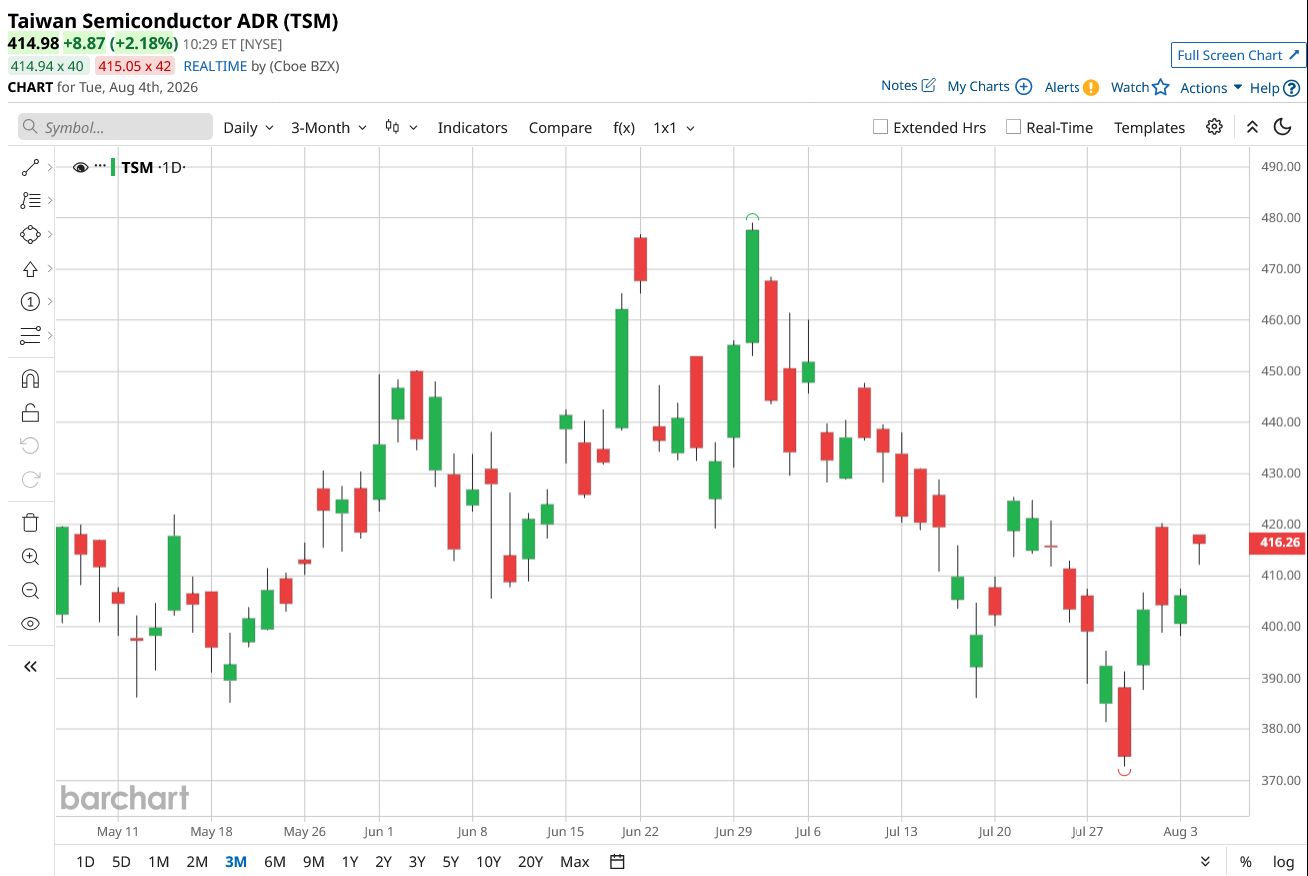
Taiwan Semiconductor significantly underperformed the broader semiconductor sector over the past year. The stock delivered returns of around 73%, compared to the iShares Semiconductor ETF’s (SOXX) gain of about 121% during the same time period. The stock underperformed mainly due to the company-specific concerns, including customers such as Apple (AAPL) diversifying suppliers and worries that heavy U.S. investment could pressure profit margins despite record earnings.
 www.barchart.com
 The company posted its second-quarter fiscal 2026 results on July 16, beating both revenue and earnings estimates. Revenue for the quarter came in at $40.2 billion, exceeding market expectations by $900 million. This marks a 33.7% increase from the same period last year. It reported GAAP earnings per ADR of $4.31, exceeding market expectations by $0.37. Gross margin reached 67.7% while operating margin and net margin came in at 60.3% and 55.6%, respectively.
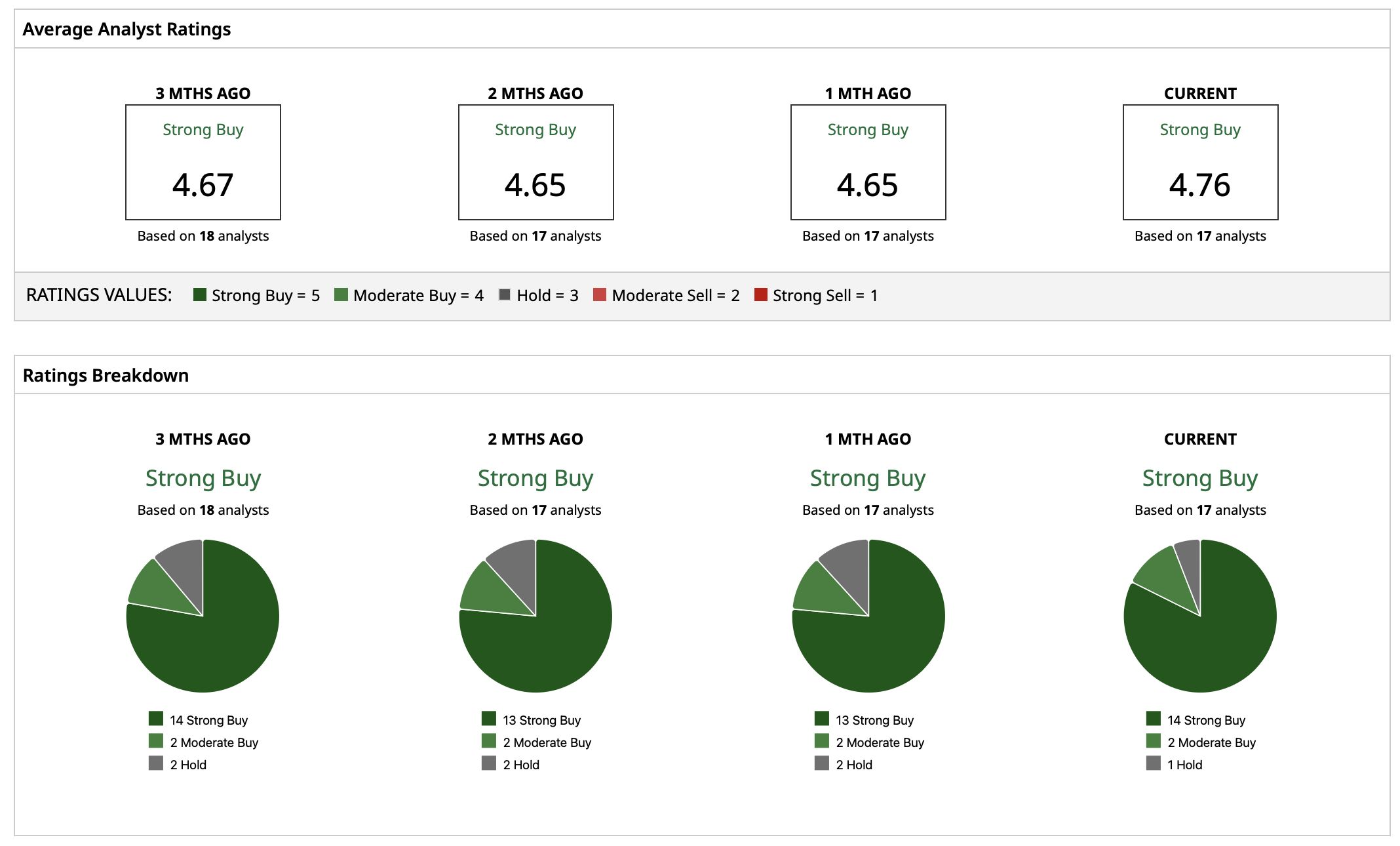
Needham analyst Charles Shi raised the firm’s price target on the stock from $480 to $530 while assigning a “Buy” rating on July 27. A few days earlier, D.A. Davidson also maintained its “Buy” rating with a $500 price target. TSMC enjoys a consensus “Strong Buy” rating from 17 Wall Street analysts. According to their estimates, the stock has a median price target of $503.15, implying a further 21% upside from the current share price. In addition, the highest price target of $650 offers 57% upside from here.
 www.barchart.com
 Packaging Technology Stock #2: Intel Corporation (INTC)
Intel Corporation is a Santa Clara, California-based semiconductor company that manufactures, designs, and sells computing chips and related technologies. The company’s three main operating segments are DCAI, CCG, and Foundry. Its offerings include networking products, processors, AI solutions, graphics chips, and semiconductor manufacturing services.
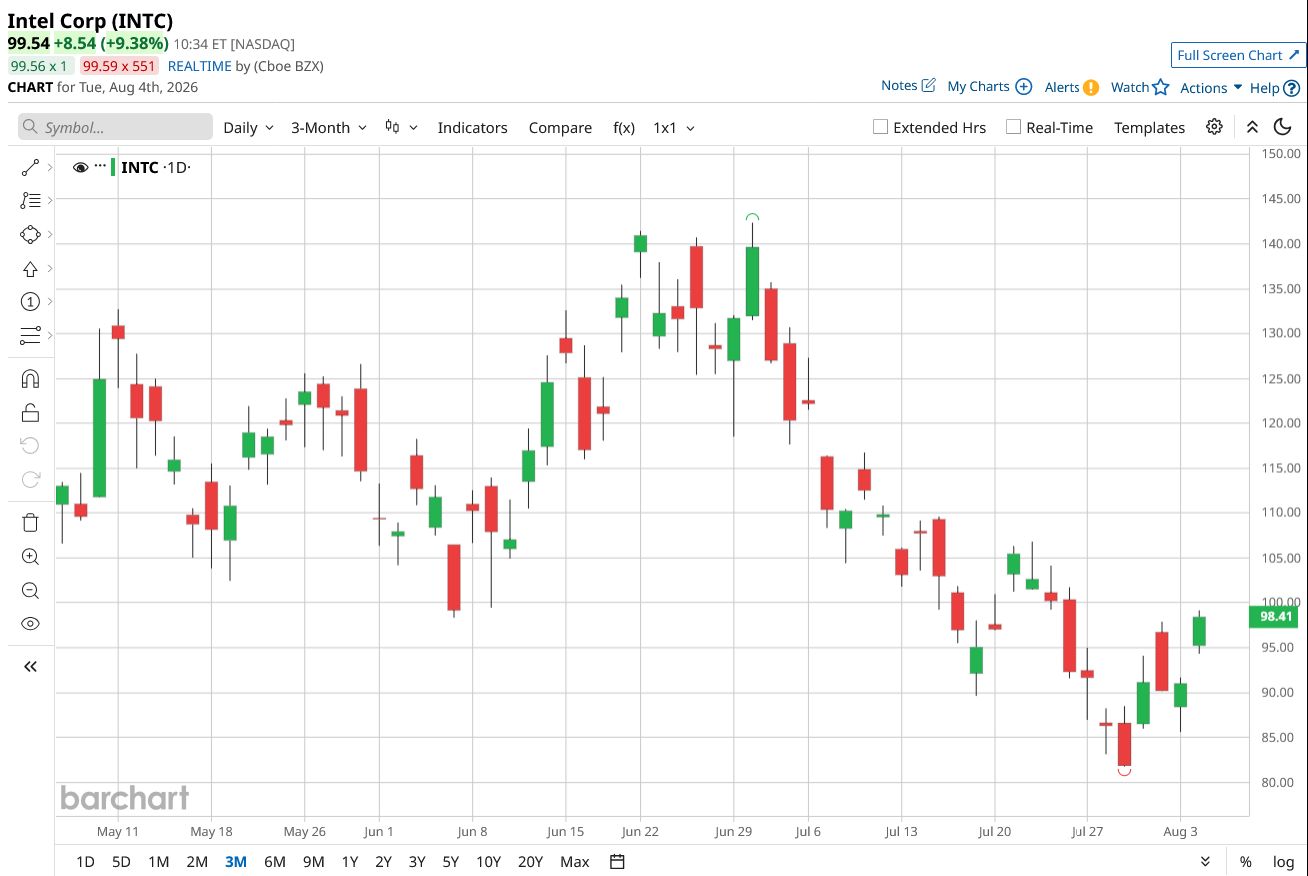
Over the past year, the stock has delivered an exceptional performance, rising about 400% and significantly outperforming the broader semiconductor sector. As stated earlier, the iShares Semiconductor ETF surged about 121% during the same period. This means Intel generated more than three times the return of the sector benchmark. It highlights growing investor confidence in the shares. That surge, though, comes off a deeply depressed base. Intel’s stock had been battered for years, so much of the climb is recovery rather than proof of strength.
 www.barchart.com
 The company reported its second-quarter fiscal 2026 earnings on July 23, generating $16.1 billion in revenue. Segment revenue included $8.9 billion from CCG, $6.3 billion from DCAI, and $5.8 billion from Foundry. It reported a non-GAAP gross margin of 41.8% and non-GAAP earnings of $0.42 per share. Revenue for the third quarter is expected in the range from $15.8 billion to $16.8 billion. The company also forecasts non-GAAP earnings of $0.38 per share and a non-GAAP gross margin of 42%. For the full year, it plans to keep operating expenses at around $16.5 billion.
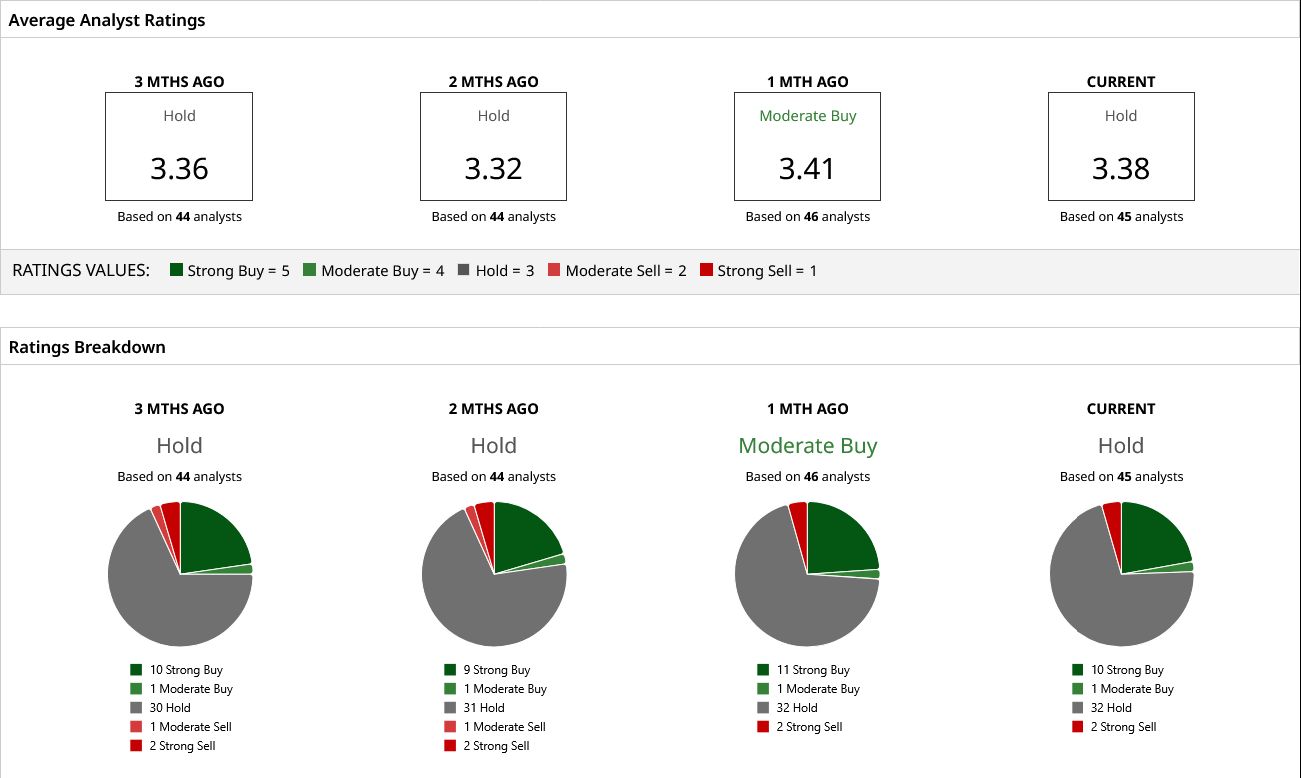
Recent analyst ratings show that Wall Street remains divided on Intel’s outlook. On July 28, Bank of America Securities analyst Vivek Arya reaffirmed a “Buy” rating on the shares with a $160 price target. In contrast, Stifel maintained its “Hold” rating with a price target of $110. Overall analyst sentiment remains cautious but still generally positive. Intel is currently covered by 45 Wall Street analysts and holds a consensus “Hold” rating. Based on their estimates, the average price target of $114.50 reflects a further 15% upside from current levels. In addition, the highest price target of $200 implies an impressive 100% upside from here.
 www..barchart.com
 On the date of publication, Jabran Kundi did not have (either directly or indirectly) positions in any of the securities mentioned in this article. All information and data in this article is solely for informational purposes. For more information please view the Barchart Disclosure Policy here.
More news from Barchart
AAPL Stock Alert: What to Know as Apple Acquires PlasmaSolve Meta Platforms Stock Could Be Signaling a Quick Pop Above $600 Why Wall Street Is Panicking About Apple’s Services Business Reddit's Tumble Has Been Overdone After It Produced Strong FCF - RDDT Could be 40% Too Cheap