


Quantum computing is a market where the biggest opportunity may sit years ahead. That makes choosing the best quantum computing stock now more difficult, as investors are betting on which technology can scale, which company can turn research into commercially useful systems, and which balance sheet can survive long enough to reach that point.
Quantum computing firms IonQ (IONQ) and Rigetti (RGTI) are taking very different routes. But only one stock could be the better pick for long-term investors. Let's take a closer look.
More Top Stocks Daily: Go behind Wall Street’s hottest headlines with Barchart’s Active Investor newsletter.
The Case for Rigetti: A More Focused Bet on Superconducting Quantum Computing
Valued at $5.9 billion by market capitalization, Rigetti Computing is a quantum computing company that builds superconducting quantum computers designed to solve complex problems beyond the capabilities of traditional computers. The company uses a technology called chiplet architecture, which connects smaller quantum chips together rather than attempting to build one massive quantum chip.
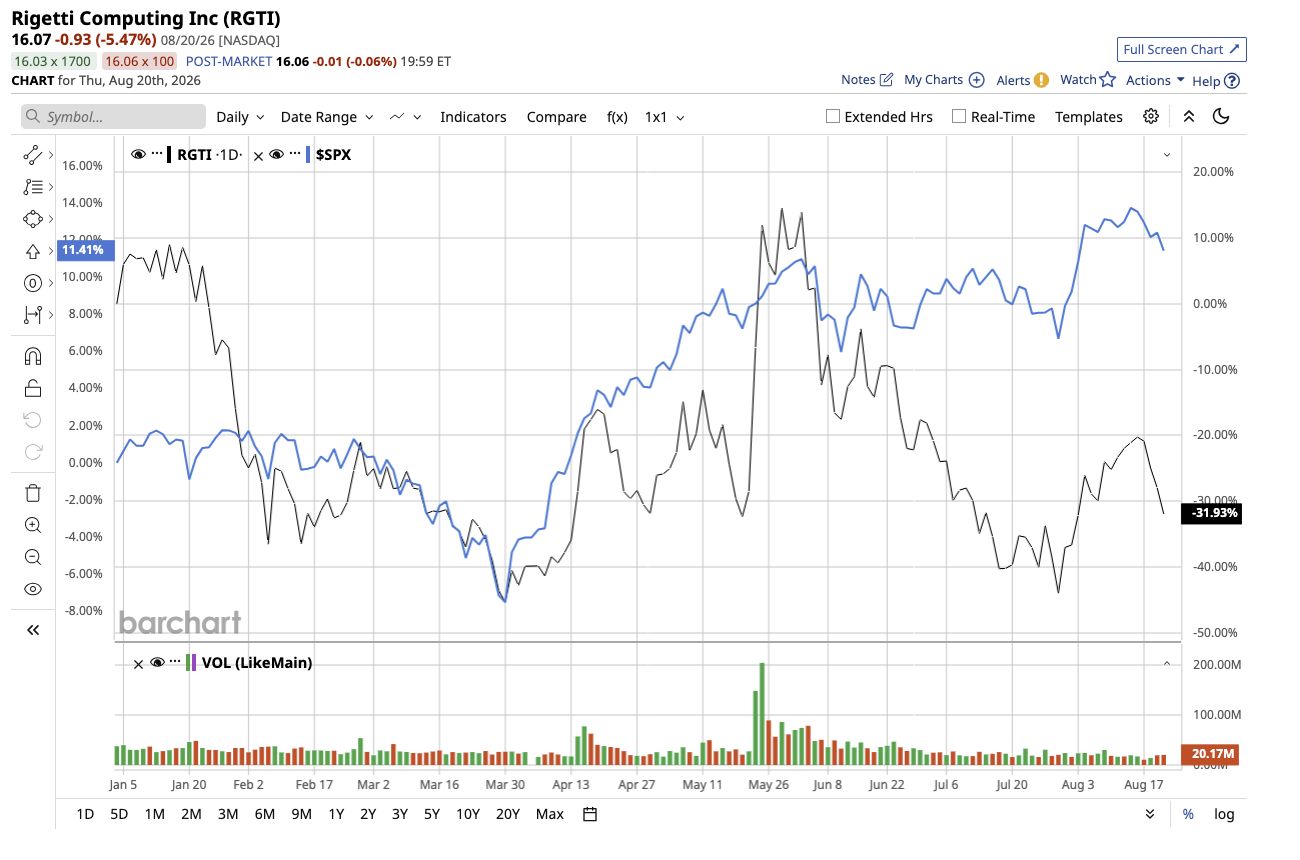
Over the last two years, RGTI stock has climbed more than 1,800%, owing mostly to predictions that quantum computing could be the next big thing after artificial intelligence (AI). However, some of that enthusiasm has cooled, with the stock down 19% year-to-date (YTD).
 www.barchart.com
 Currently, the company’s flagship product is the Cepheus-1-108Q, a 108-qubit system made up of 12 interconnected 9-qubit chiplets. Rigetti claims to be one of only a few companies to have created gate-based systems with more than 100 qubits. In the second quarter, revenue increased 183% year-over-year (YOY) to $5.1 million. Gross margin improved to approximately 43%, but the company reported an adjusted net loss of $16 million.
Management is certain that the company’s architecture offers a combination of scalability and speed that is difficult to replicate, paving the way for a more practical path toward 1,000 qubits and beyond in roughly three years. However, to get there, the firm has to continue investing in dilution refrigeration, Fab-1 manufacturing infrastructure, and partnerships.
For now, the balance sheet gives Rigetti room to keep pushing. The company ended Q2 with around $541.3 million in cash, cash equivalents, and available-for-sale investments, with no debt. Management believes this provides sufficient runway for its technology and deployment milestones. However, 2026 capital expenditures are expected to increase because of investments in Fab-1 and dilution refrigeration. Additionally, Rigetti has signed a letter of intent (LOI) with the U.S. Department of Commerce that could provide up to $100 million in funding over three years, although investors should be aware that the LOI is not yet a binding deal.
Moreover, even if the company eventually reaches 1,000 qubits, that doesn't necessarily mean the technology will suddenly become commercially useful. In fact, to create a potentially useful quantum computer, the company has to also focus on improving accuracy and faster operations. Reaching that will take huge investments and flawless execution. If Rigetti actually achieves this goal, the company could move from primarily selling quantum systems for research and experimentation to selling machines capable of solving commercially meaningful problems. That could make the potential market for Rigetti's technology dramatically larger.
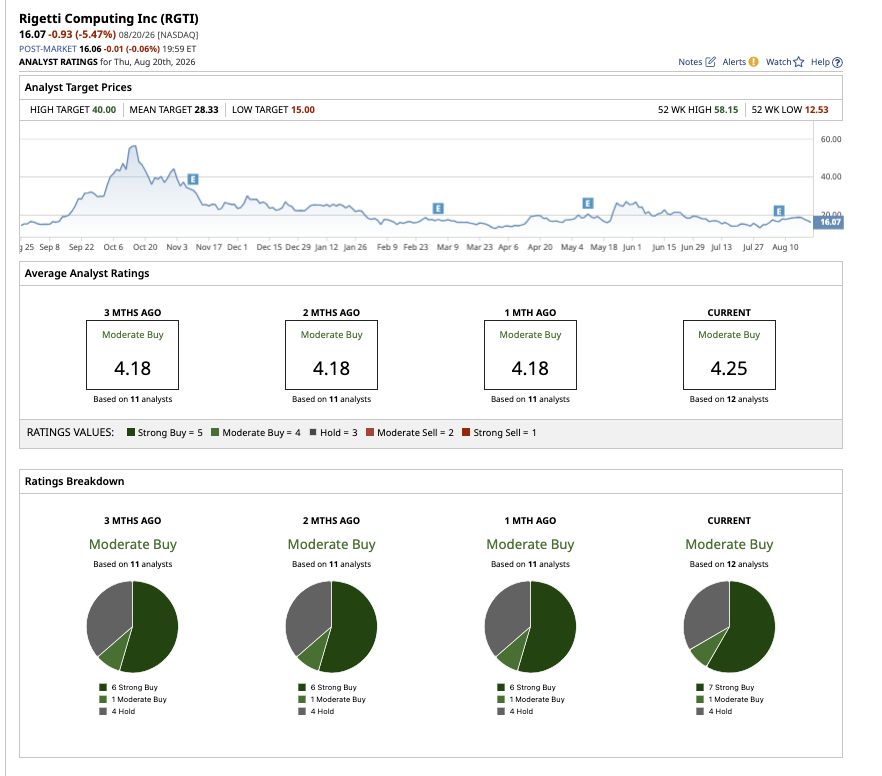
Overall, RGTI stock has a consensus “Moderate Buy” rating on Wall Street. Among the 12 analysts covering the stock, seven have a “Strong Buy” rating, one has a “Moderate Buy” rating, three have a “Hold,” and one analyst has a “Strong Sell" rating. While the stock is down 19% YTD, the average price target of $28.33 suggests potential upside of 58% from current levels. Plus, the highest estimate of $40 implies potential upside of 123% over the next 12 months.
 www.barchart.com
 The Case for IonQ: From Quantum Computer Maker to Full-Stack Platform
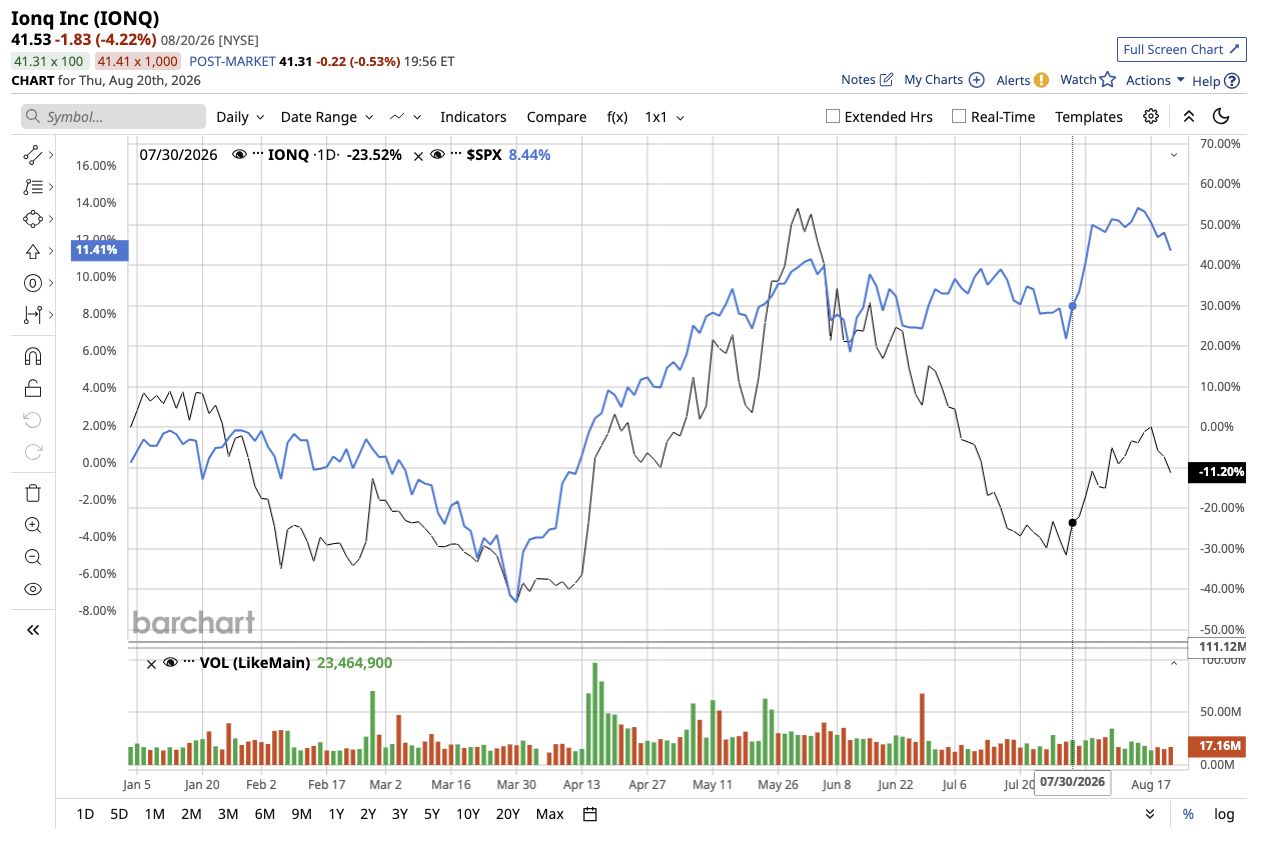
Valued at $17 billion by market cap, IonQ is another quantum computing company that builds quantum computers and related technologies to help solve complex problems. Over the last two years, IONQ stock has climbed 477%, while the stock is down less than 1% YTD.
 www.barchart.com
 In the most recent second quarter, IonQ reported an extraordinary 287% YOY increase in revenue to $80.1 million. Management called it the strongest quarter in the company's history, and it also marked the fifth consecutive quarter of strong revenue growth. IonQ also grew organic revenue 132% YOY, driven by global quantum computer deployments.
IonQ has now progressed from just showing that its technology works to actually deploying systems. Around 60% of Q2 revenue came from commercial customers rather than the U.S. government. In fact, 50% of revenue mostly came from international customers, with the technology being used in over 50 nations. This demand shows that quantum computing is no longer just government-funded; there is already a large commercial customer base forming around the technology.
Importantly, IonQ is building around trapped-ion technology while aggressively moving toward semiconductor-based electronic qubit control. Not only that, the company is trying to build something broader than just a quantum computer. Notably, semiconductor manufacturing, networking, sensing, and quantum security all are becoming part of the platform. This was more evident in Q2 as multi-product sales increased 40% YOY and represented about 25% of total revenue.
Recently, IonQ closed the $1.8 billion acquisition of SkyWater, creating a vertically integrated quantum platform spanning design, fabrication, packaging, and deployment in U.S. facilities. Management believes that if quantum computing eventually scales through semiconductor manufacturing, controlling more of that manufacturing chain could become a competitive advantage.
The company is spending aggressively, which is why it is still not profitable. Nonetheless, its financial visibility is improving, too. IonQ ended Q2 with $485 million of remaining performance obligations (RPO). IonQ also raised its 2026 revenue guidance to a range of $280 million to $290 million and continues to expect approximately 100% growth in its organic business.
Which Is the Better Buy Now?
For long-term investors who can wait a decade for the quantum computing industry to show its potential, IonQ may be the better choice. It currently combines faster revenue growth, rising commercial adoption, stronger forward revenue visibility, and a much wider quantum platform, making it the stronger buy now.
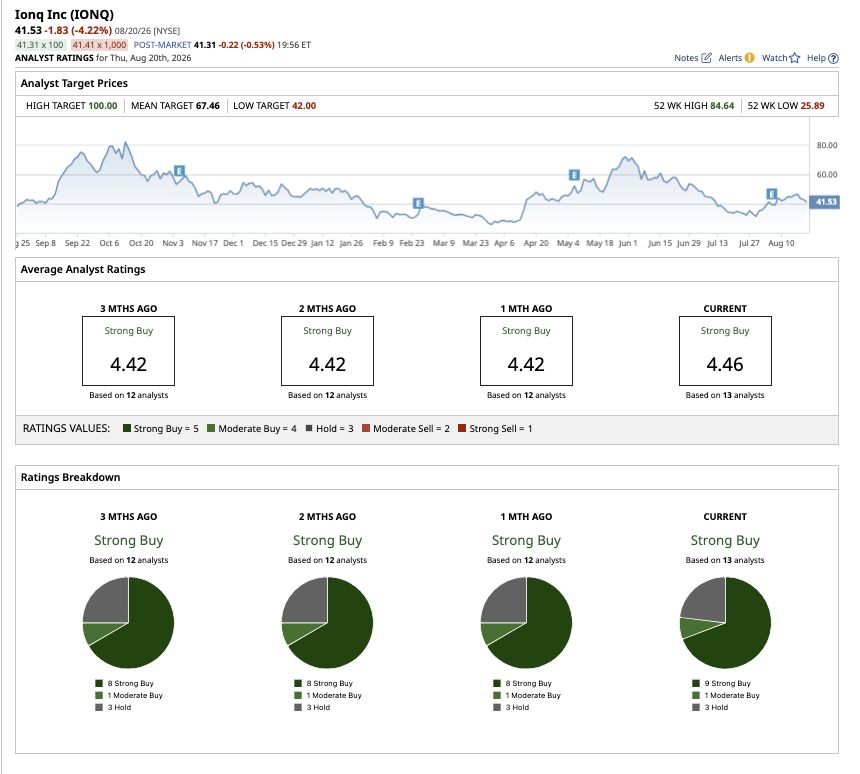
Overall, even analysts seem to agree, giving IonQ a consensus “Strong Buy" rating. Among the 13 analysts covering IONQ stock, nine have a “Strong Buy" rating, one has a “Moderate Buy,” and three suggest a “Hold" rating. The average price target of $67.46 suggests that the stock could rally as much as 50% from current levels, while the high price estimate of $100 implies potential upside of 123% over the next 12 months.
 www.barchart.com
 On the date of publication, Sushree Mohanty did not have (either directly or indirectly) positions in any of the securities mentioned in this article. All information and data in this article is solely for informational purposes. For more information please view the Barchart Disclosure Policy here.
More news from Barchart
IonQ vs. Rigetti: The Better Quantum Computing Stock for Long-Term Investors Option Volatility and Earnings Report For Aug 24-28 Stocks Set to Open Lower as Chipmakers Get Hit, Nvidia Earnings and Warsh’s Jackson Hole Speech Awaited Duos Technologies’ AI Transformation Has Wall Street’s Attention. Here’s How Big This $300 Million Market Cap Company Could Get.